
Korean team sets efficiency record for perovskite/CIGS tandem
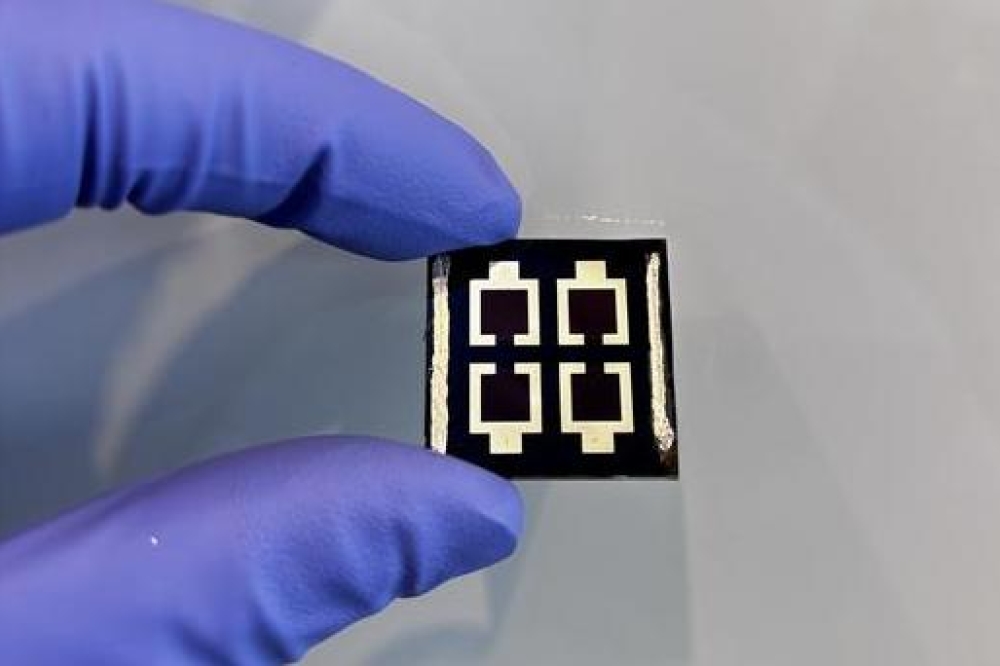
The Korea Institute of Energy Research (KIER) has achieved a world-record efficiency of 26.7 percent for perovskite/CIGS tandem solar cells, certified by the Fraunhofer Institute for Solar Energy Systems (ISE) in Germany and listed in the Best Research-Cell Efficiencies Chart published by the US National Laboratory of the Rockies (NLR, formerly NREL).
The previous world-record efficiency of 26.3 percent was set a year earlier by a joint research team from Seoul National University and the Korea Institute of Science and Technology (KIST).
The perovskite/CIGS tandem solar cells developed by the KIER research team have a perovskite cell at the top and a CIGS cell at the bottom. This unique configuration enables the two cells to absorb different wavelengths of sunlight simultaneously. Since both perovskite and CIGS are well suited for thin-film processing, the technology combines high efficiency, light weight, and flexibility.
Assembling the two cells may, however, degrade the perovskite light-absorbing layer. In addition, some cell layers may absorb unwanted light, reducing the overall efficiency.
To address these challenges, the KIER research team conducted a comprehensive analysis of the root causes of such efficiency losses. As a result, they developed an advanced interfacial layer material and processing technology to mitigate potential damage to the perovskite layer. The team also successfully minimised undesired light absorption and potential photocurrent loss by optimising the structure of the top transparent electrode and charge transport layer.
This approach resulted in a laboratory-measured efficiency of 27 percent and a Fraunhofer ISE-certified efficiency of 26.7 percent.
The developed technology is expected to increase electricity generation per unit area and thereby expand the potential applications of photovoltaic power generation. Furthermore, owing to their lightweight and flexible thin-film design, they are promising not only for buildings and automobiles but also as power sources for small satellites and space-based data centers for future space applications, where weight and space constraints are critical.
Inyoung Jeong, a senior researcher at KIER who led the research, said, "This achievement is significant in that both cell efficiency and stability can be enhanced by minimising potential interfacial and optical losses during the integration of perovskite and CIGS. The resulting efficiency was also officially certified by a world-renowned institute and recognised as a world-record performance, underscoring Korea's technological competitiveness."
The research team says it will next focus on ensuring that large-area modules achieve the same efficiency as the small-area devices developed in this study. They will collaborate with industry partners interested in mass production and commercialisation and pursue technology transfer. In the long term, they plan to expand the technology to next-generation space solar cells capable of reliable operation in space due to their light weight and high efficiency.