
GaN: No knockouts in the patents war
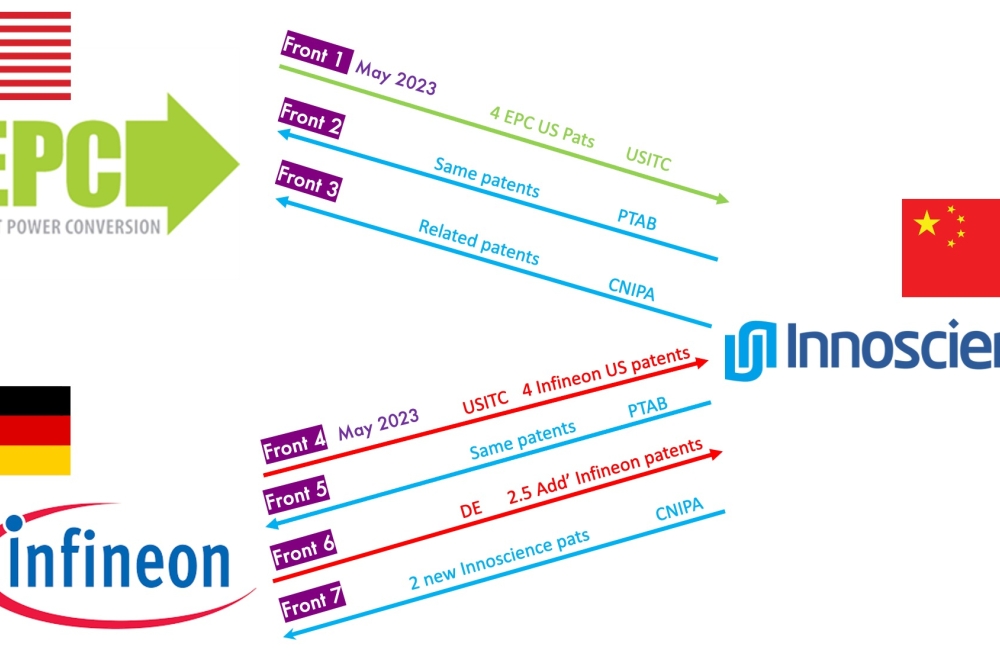
While four years of fighting over intellectual property has driven changes in device design, it’s failed to force any settlements or cross-licensing agreement’.
BY RICHARD STEVENSON, EDITOR, CS MAGAZINE
For most of us, when we read a company’s press release related to a ruling of a patent dispute, we’ll concluded that this firm emerged largely victorious. But if we had instead read the release of their adversary, we’d think that the outcome had ruled in their favour.
While both conclusions can’t be right, it’s incredibly difficult to uncover the truth. What’s needed is the view of an unbiased expert in patent law with expertise in the critical technologies.
Offering this in the ongoing GaN IP war is David Radulescu, head of the patent litigation boutique firm Radulescu LLP. He discussed details of patents wars between EPC, Innoscience and Infineon in a July 29 webinar. Alongside his commentary, industry expert Ralf Higgelke provided yet more welcome insight, discussing the implications of various rulings on purchasers of GaN power electronics.
One key point made by Radulescu is that after just over four years of fighting, there’s still no licensing. “It does tell you that the asserted patents and the cases that have been filed have not created enough pressure.”
While no side has had a breakthrough, there have been skirmishes on many fronts (see Figure for an overview). They include cases filed in the US International Trade Commission (ITC) for import bans, costing around
$8-12 million per side, with an outcome taking typically 16 months or so. Invalidity petitions have also been filed in the US Patent and Trademark Appeal Board, an action costing less than $1 million per patent, and involving an 18-month validity review. Infineon has also used German courts, where it’s possible to obtain a preliminary injunction within a few days. “You can get a full sales injunction in 9 to 12 months, and you’re also paying a bond to cover if you’re wrong,” explains Radulescu. In addition, there are courts in China that may rule in favour of a nationwide injunction for 12 months, as well providing fast-track patents.
To fight an effective war, companies must carefully optimise all these options.
ITC rulings
The GaN patents war began in summer 2023, when EPC announced it had taken legal action against Innoscience for infringing four of its patents; and in March 2024, Infineon joined in, also taking to court claims of infringement of four patents.
“Within months, half the patents were dropped,” said Radulescu. “It’s probably because the claims of infringement were just too weak.”
The two remaining EPC’s patents were: the ’508 patent, which describes a multi-step process that uses three different photoresist patterns to produce a self-aligned gate; and the ’294 patent, entitled ‘Compensated Gate MISFET’.
For Infineon, it’s remaining duo were: the ’481 patent, involving a Kelvin source, added so that parasitic elements associated with the packaging and connections have a reduced impact on overall system performance; and the ’755 patent, detailing a non-coplanar drain finger.
The ITC determined infringement on two of these four: EPC’s ’294 patent and Infineon’s ’481 patent.
Differing views
Although the ITC found violation on two claims concerning the ´294 patent, Innoscience convinced the US Patent Office that the relevant claims are invalid.
In patent cases, either filed in district court, the Patent Office, or the ITC, parties appeal to the US Court of Appeals for the Federal Circuit, a specialised appeals court. When the Patent Office is involved, the appeals court tends to side with them quite often, according to Radulescu. The appeals argument will be heard in October 2026 at the earliest, and a decision typically issues several months later, depending on the issues presented.
However, to cater for an unfavourable outcome from its perspective, Innoscience has launched new families of products that distance themselves from the technology described in the ’294 patent. Now, after epitaxy, there’s an anneal to drive out hydrogen and ensure conductivity just comes from the magnesium dopant. The latest approach, which is widely employed for manufacturing LEDs, is reflected in new model numbers, featuring an added suffix AD.
According to Higgelke, the introduction of this new process will have required a lot of investment. As well as optimising material properties and manufacturing processes, Innoscience will have had to generate reliability data from scratch.
Another downside, argues Radulescu, is the additional time for the epiwafers in the MOCVD chamber. “It’s requiring Innoscience to add 15 minutes to its epitaxy process, to theoretically out the hydrogen, which I believe was driven out elsewhere, and probably not a lot to start with.”
The third leg
When ruling on the Infineon’s ’481 patent, related to the Kelvin source, the administrative law judge concluded that just two claims were infringed and not invalid. One, claim 4, describes planar contact surfaces and leads exposed on the bottom; and the other, claim 17, details a voltage of at least 400 V, and a frequency of at least 100 kHz.
Due to this ruling, Innoscience was hit by a cease-and-desist order, and had to pay 100 percent bond for importation.
Innoscience responded to Infineon’s action by redesigning its packages. “If you remove that pin, you’re out from under the ´481 patent,” said Radulescu.
However, the redesign degrades performance, according to Higgelke, who explained that the Kelvin source pin is a performance feature. Without it, the device suffers from slower switching, additional losses and instability. In short, the advantages of using GaN are negated.
So, the pin is an important technology that will apply pressure to Innoscience, and may lead to a settlement or cross-licence.
A counter-attack
Innoscience has pushed back against its adversaries, partly by taking action in its own backyard, where it has won injunctions against Infineon from the Chinese courts.
“The counterattack in China is faster than what happens in the US,” remarked Radulescu. “It flips the table, because of the tremendous pressure that you can get with these injunctions. The goal, from a patent litigation perspective, is leverage. You want to force a return to the negotiating table.”
The Chinese chipmaker filed two patents with the Chinese patent office. One concerns the passivation layer on the gate, and is directed at the ratio of sidewall thickness to the thickness in the drift region; and the other concerns a field plate with rounded corners.
Actions in Germany
To strengthen Infineon’s IP, it has a counterpart of the ’481 patent filed in Germany – the ’947 patent, which is related to a Kelvin-source sense lead.
There are also three related patents: ‘691, involving a third lead that provides source sense functionality; the ’465, covering interleaved elongated source-drain pad metallisation over the non-active regions of a lateral GaN transistor; and the ’054, concerning a GaN die with a deliberate vertical leakage structure.
“They had 4 first-instance wins in Munich Regional Court,” remarked Radulescu, who added that Innoscience is saying all these ruling only apply to discontinued legacy packaged parts.
State of play?
Based on the various actions of EPC, Infineon and Innoscience, are there any winners?
According to Radulescu, little pressure has been created during the EPC-Innoscience battle. “It looks like the appeals are just going to run their course, and I assume the campaign’s just going to fizzle out.”
That’s unlikely to happen in the battle between Infineon and Innoscience, which Radulescu views as currently a draw. “Innoscience and Infineon are in a position with a balanced pressure, to possibly enter into some type of cross-license.”
As this may take some time, don’t be surprised to first see more propaganda-ridden press releases, claiming final victories for the companies involved.