
xEV power chip market to hit $14.5b by 2031
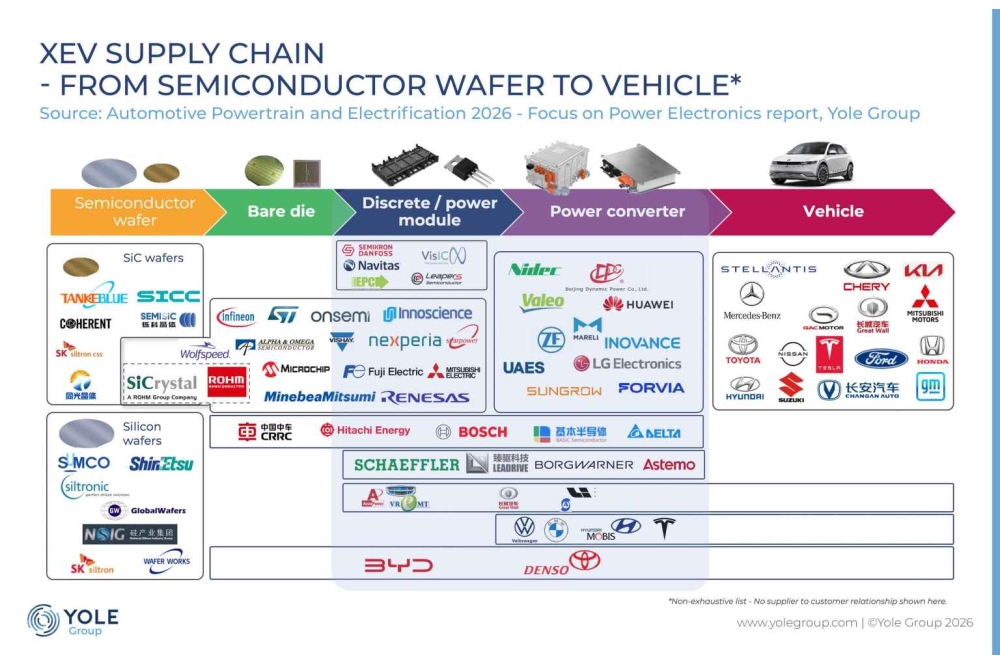
Yole Group's latest report, 'Automotive Powertrain and Electrification 2026 – Focus on Power Electronic's, shows that the xEV power-chip market will more than double to $14.5b by 2031, making up around 70 percent of light-vehicle production by 2031, with China leading adoption. Battery-electric vehicles alone will account for 33 million units.
The other big trend, says Yole, is how SiC is displacing silicon as batteries move from 400V to 800/1,000V.
Milan Rosina, principal technology and market analyst, Power Electronics & Battery, at Yole Group said: "China is building a power-electronics supply chain that answers to no one – strong in finished systems, device packaging, and semiconductor wafers and closing the gap on front-end chip manufacturing faster than most expected."
The report provides particular insight into the technical shift now underway inside the traction inverter, which accounts for the large majority of xEV power-device revenue through 2031. Power modules are expected to grow at about a 14 percent CAGR25-31. Silicon IGBT modules will remain dominant, reaching almost $7b. SiC MOSFETs are rapidly gaining share, growing at a 21.5 percent CAGR25-31, driven largely by China’s BEV fleet.
And GaN HEMT is the fastest-growing technology of all, at almost a 90 percent CAGR25-31, though it will remain a tiny market in 2031 compared with silicon and SiC devices.
Underpinning this shift is the industry’s move from 400V to 800/1,000V architectures, concentrating rising semiconductor value into higher-voltage devices – segments rated 1.2kV and above are growing at a 27.4 percent CAGR25-31.
Furthermore, one of the main messages delivered by Yole Group’s analysts is the accelerating consolidation and regionalisation of the xEV supply chain.
OEMs, particularly in China, are increasingly bringing traction inverter and e-axle production in-house, while Tier-1 suppliers continue consolidating through M&As.
At the same time, Bosch, Renesas, and Rohm are all reassessing their SiC manufacturing footprint amid overcapacity, and licensing and partnership deals continue multiplying as the industry shifts from technical validation to securing capacity and executing at scale.