
Eggtronic unveils GaN microinverter platform
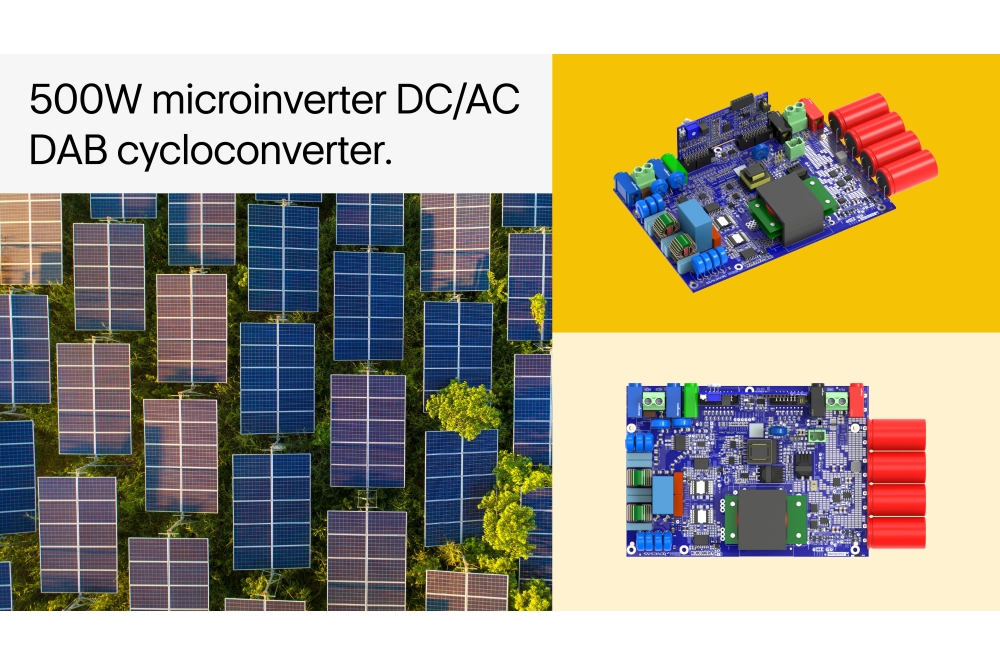
Eggtronic and Renesas have unveiled a jointly developed 500W
solar microinverter reference platform that combines advanced mixed-signal
control and bidirectional GaN technology to deliver over 96% efficiency,
offering OEMs a cost-optimised pathway to next-generation high-power
photovoltaic systems.
Eggtronic, a semiconductor company in
high-performance IC controllers for power electronics, has announced the
release of a jointly developed 500W solar microinverter reference platform with
Renesas Electronics Corporation.
The design combines Eggtronic’s EPIC mixed-signal
controller technology with Renesas’ bidirectional Gallium Nitride (GaN) switch
to demonstrate a high-efficiency architecture to support microinverter OEMs and
system manufacturers in developing next-generation solar microinverters and
power conversion applications.
The reference platform achieves 96.1% average efficiency
under CEC standards and 95.9% under EU standards, validating the performance
potential of a single-stage DC-to-AC topology enabled by advanced digital
control and wide-bandgap semiconductors.
As photovoltaic (PV) module output continues to increase
beyond 400W, microinverter manufacturers must continuously optimize efficiency,
thermal performance, component integration, and overall system cost. Many
established architectures — whether based on interleaving, multi-stage
topologies, or advanced GaN implementations — involve design trade-offs between
complexity, power density, and cost that require careful engineering balance.
The jointly developed reference design demonstrates how
semiconductor-level innovation — combining intelligent mixed signal control and
high-performance bidirectional GaN switching devices — can enable OEMs to
explore alternative architectures that optimize efficiency and power density
while maintaining system reliability.
At the core of the platform is Eggtronic’s proprietary EPIC mixed-signal controller EPIC2ACO01. The controller executes patented Variable
Frequency Modulation (VFM) and current-mode strategies designed to maintain
Zero-Voltage Switching (ZVS) across the full load range. This single stage
approach minimizes BOM cost, switching losses, reduces reactive power
circulation, and maintains low Total Harmonic Distortion (THD), while enabling
operation at switching frequencies up to 1 MHz — significantly reducing the
size of magnetic components.
The platform leverages Renesas’ TP65B110HRU bidirectional
GaN switch, integrated in a common-drain configuration suitable for
cycloconverter-based AC switching. The device’s low on-resistance and fast
switching characteristics enable
high-frequency operation and reduced conduction losses,
supporting compact and thermally optimized designs.
“This reference platform highlights how advanced digital
control combined with high-performance GaN devices can support OEM partners in
developing efficient and compact microinverter solutions,” said Igor Spinella,
CEO of Eggtronic. “Our objective is to provide enabling semiconductor
technologies that help established and emerging manufacturers accelerate
innovation while optimizing overall system performance.”
“We are pleased to collaborate with Eggtronic on this
high-efficiency reference design,” said Pietro Scalia, Sr. Director, Power
System Marketing and Architecture at Renesas. “Our bidirectional GaN technology
combined with advanced control solutions serves as a strong foundation for
next-generation microinverter systems developed by our customers.”
Key Features of the 500W Reference Platform
● High Efficiency Demonstration: 96.1% average efficiency
(CEC) and 95.9% average efficiency (EU), with a flat efficiency curve across
operating conditions
● 500W Continuous Output Power: Designed to support modern
high-power PV modules
● High-Frequency Operation: Switching frequencies up to 1
MHz to reduce magnetics size
● Low THD Performance: <3%, compliant with IEEE 1547
standards
● Single-Stage Cost Optimize Architecture: Designed to help
OEMs reduce component count and optimize cost