
Pushing the boundaries of organic solar cells
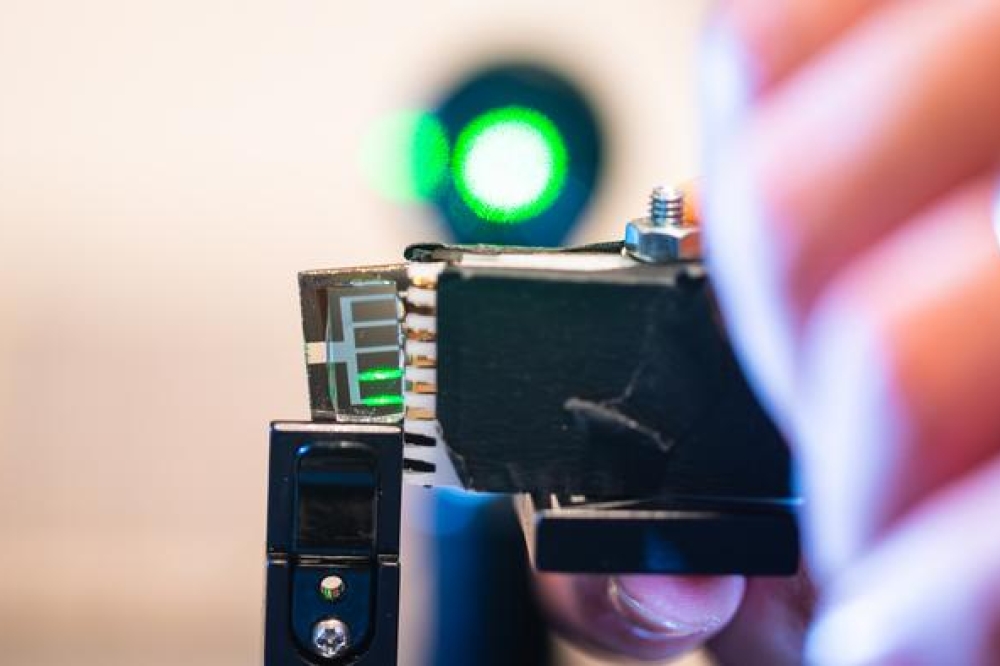
Researchers at Linköping University, Sweden, have now demonstrated how solar cells based on organic semiconductors can become more efficient than previously thought possible.
The key is to extend the time that electrons in the material remain excited, which leads to improved performance. The findings 'Overcoming the fill-factor limit of organic solar cells' are published in the journal Nature Photonics.
Organic solar cells have many desirable characteristics such as low manufacturing cost, light weight and high flexibility. In addition, they can be semi-transparent and produced on a large scale.
The proportion of the sun’s rays converted into energy using such devices has increased from around 10 percent to over 20 percent in ten years. But researchers have assumed that the limit for improvement had been reached. Until now.
“What we demonstrate in this study takes efficiency to the next level. With our new understanding, the research community may be able to improve efficiency closer to its practical limit,” says Feng Gao, professor of optoelectronics at Linköping University.
To increase the efficiency of organic solar cells, the researchers investigated the so-called fill factor of solar cells, which has been a limiting factor. It is one of three parameters that describe how efficiently the solar cell converts light into electricity in operation and is one of the most important contributors to high efficiency.
“It’s a complex parameter that hasn’t been very well studied in organic solar cells,” says Feng Gao.
Organic solar cells consist of two materials, known as a donor and an acceptor, placed close together. When sunlight is absorbed, it gives energy to electrons, putting them into an excited state. For the solar cell to work efficiently, these excited electrons must move to the acceptor while the corresponding positive charges remain in the donor. The charges can then travel through the device to generate electricity.
Huotian Zhang, a postdoctoral researcher in Feng Gao’s research group, is first author of the study in Nature Photonics. He has investigated more than 100 different material combinations to understand how the fill factor affects efficiency and how it can be improved. His conclusion is that the key to a more efficient solar cell is to extend the time that the electron remains excited.
“By combining fundamental physics with new materials technology, we showed that efficiency is influenced by the interplay between the electric field and the photoexcitation. By extending the excited-state lifetime, more of the absorbed light can be converted into useful current, improving device performance,” says Zhang.
He continues: “The results show that organic semiconductors can perform as well as inorganic semiconductors in photovoltaic applications. The findings are also relevant for other semiconductor applications. The next step is to add machine learning to accelerate material discovery and optimisation of the solar cell.”
The study is funded mainly by the Swedish Research Council, the Göran Gustafsson Prize, and through the Swedish government’s strategic research programme in advanced functional materials (AFM) at Linköping University.