
UC Berkeley team finds new way to power nanophotonic lasers
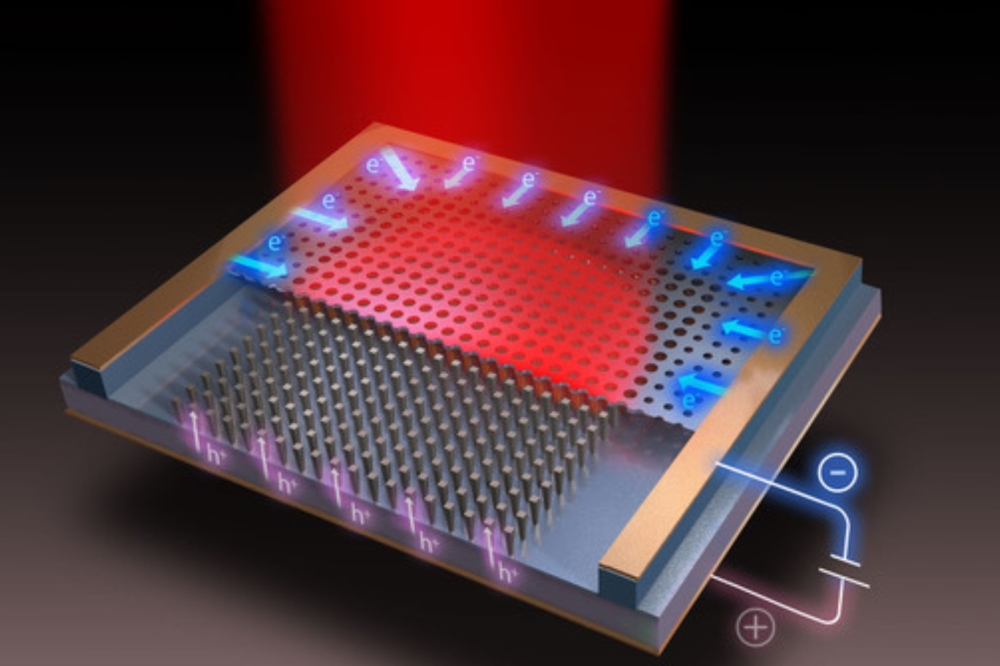
A team of researchers from UC Berkeley and Lawrence Berkeley National Laboratory (Berkeley Lab) in the US has unlocked a new way to power nanoscale light-generating devices with electricity while preserving the delicate optical properties needed for efficient operation.
In addition, they developed a monolithic fabrication process capable of producing hundreds of nano-post electrical contacts with the uniformity required for laser operation.
This work overcomes a longstanding challenge in nanophotonics in which the electrical connections needed to operate a device often disrupt the very light-confining nanostructures that make the device useful.
As reported in Nature Nanotechnology, engineers solved this problem by introducing an architecture that decouples electrical injection from optical confinement. This allows electricity to be delivered where it is needed while leaving the light-guiding structure largely undisturbed.
“This breakthrough could help enable a new generation of compact and energy-efficient photonic technologies,” said principal investigator Boubacar Kanté, a professor of electrical engineering and computer sciences at UC Berkeley and a faculty scientist at Berkeley Lab. “More broadly, our approach, which I call orthogonal optoelectronics, enables engineering electrical pathways and optical modes independently, so that each can be optimised without compromising the other.”
Through this study, researchers set out to find a better way to electrically power extended modes of nanophotonic lasers. These devices use structures smaller than the wavelength of light to control how light is generated, trapped and emitted. They are key to enabling compact, efficient and highly controllable light sources that could ultimately impact many applications.
The best nanophotonic devices, however, often require strong index contrast, an ongoing challenge according to Emma Martin (PhD ’25 EECS), co-lead author and formerly a graduate student researcher in the Kanté Lab. She explained that this contrast is what allows the device to tightly confine and control light. But to electrically power such a device typically requires the addition of conductive materials or electrical pathways. This can create a problem, since the added materials can disturb the optical design, reduce the refractive-index contrast and degrade the device performance.
“In simple terms, we were trying to solve the conflict between ‘good optics’ and ‘good electrical injection.’ We wanted to create a structure that could be electrically powered without disturbing the optical cavity that makes the device work,” said Martin. “Our goal was to demonstrate an electrically pumped nanophotonic laser where current can be delivered across an extended optical mode while still preserving the optical advantages of a suspended, high-contrast photonic crystal structure.”
To achieve the best of both worlds — good optics and good electrical injection — the researchers developed a new device design that allows them to inject electricity into a light-trapping structure without disturbing the light.
According to Md Ishfak Tahmid, co-lead author and a PhD student in the Department of Electrical Engineering and Computer Sciences, the “trick” is to support the device on an array of nano-posts, which are placed exactly at the spots where the light’s electromagnetic field naturally goes to zero. The nano-posts can then conduct electricity while remaining invisible to the light.
“Using this design, we achieved electrically powered lasing at room temperature at the wavelengths used in fibre-optic communications,” said Tahmid. “It’s the first time current has been delivered uniformly across hundreds of these tiny cells while preserving the optical properties of the underlying photonic structure.”
According to Tahmid, the nano-posts or other electrical pathways also can be selectively positioned to excite specific optical modes. “This could lead to highly controlled electrically driven lasers, integrated photonic circuits and devices for quantum photonics,” he said.
While demonstrating that they can electrically inject current into an extended nanophotonic laser mode while preserving its optical properties, the researchers made an unexpected discovery: Their main limitation was not the optical design, but rather the uniformity of electrical pathways.
They observed that the optical mode was quite robust even when there were some variations in the nano-post sizes. However, small variations in the nano-posts could strongly affect how uniformly current was injected across the device.
“This showed us that when electrical injection is distributed over many nanoscale contact points, fabrication uniformity becomes extremely critical,” said Kanté. “This was an important finding because it identifies a new design regime for electrically injected nanophotonic devices. And it means future devices will require close co-design of optics, electronics, heat flow and nanofabrication.”
Looking ahead, this work could be useful for many technologies that require compact and controllable light sources, including optical communication, data centres for AI, sensing, imaging, LiDAR, on-chip photonic systems and quantum technologies.
“Our work provides a way to electrically control nanoscale optical states without strongly disturbing them, which is a key requirement for many advanced photonic technologies,” said Kanté.
This research was supported by the Office of Naval Research, with partial support by the NSF Quantum Leap Challenge Institutes (QLCI) program, the Bakar Prize and the Berkeley Emerging Technology Research (BETR) Center at UC Berkeley.