
Vapour-deposited perovskite LEDs reach 21.9% efficiency
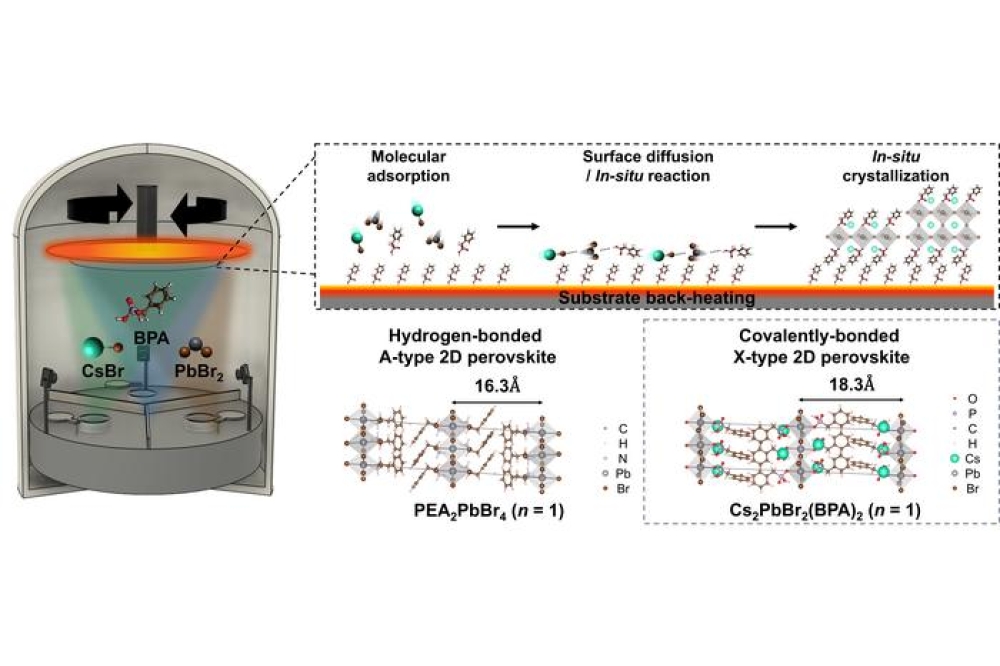
A joint research team led by Tae-Woo Lee of the Department of Materials Science and Engineering at Seoul National University (SNU) and Samuel D. Stranks of the University of Cambridge has developed a vapour-deposited perovskite LED (PeLED) with world-leading efficiency of 21.9 percent.
The team achieved this by discovering a new X-type perovskite emitter capable of thermodynamically stabilising a luminescence-favourable phase during the vacuum deposition process. Their findings were published on July 1 in Nature Nanotechnology.
Perovskites have attracted significant attention as next-generation display materials due to their high efficiency, vivid colour emission, and compatibility with existing OLED fabrication processes. However, in conventional vacuum deposition processes, crystallisation is not thermodynamically controlled, leading to rapid and non-uniform crystal growth.
To address this issue, the research team introduced X-type spacer organic molecules to design a new X-type quasi-2D perovskite emitter, enabling thermodynamically controlled crystal growth on the substrate and the formation of a uniform emissive phase favourable for high-efficiency light emission.
In addition, the team developed a hetero-scaffold that promotes selective crystal phase growth, providing a strategy for precise crystallisation control in vacuum deposition. As a result, they successfully realised PeLEDs with both high emission efficiency and high colour purity
Currently, vacuum deposition is widely used in OLED production. If perovskites can be fabricated using this method, compatibility with existing infrastructure would significantly enhance commercialisation potential.
However, perovskite vacuum deposition involves complex simultaneous reactions of multiple precursors on the substrate to form crystals. When this process becomes too rapid and complicated, multiple crystal phases can form, resulting in non-uniform films with reduced emission efficiency and colour purity.
Thus, beyond simple process optimisation, a new material design strategy capable of controlling the formation pathway of perovskite crystals is essential for commercialisation.
Through this approach, the team achieved perovskite thin films with a photoluminescence quantum yield (PLQY) exceeding 85 percent. The resulting PeLEDs exhibited an external quantum efficiency (EQE) of 21.9 percent and a narrow emission linewidth of 16.8 nm, demonstrating both high efficiency and excellent colour purity—representing world-leading performance among vapour-deposited PeLEDs.
The team also confirmed that these PeLEDs can be fabricated on large-area substrates, flexible platforms, and patterned structures, highlighting their applicability to real-world display manufacturing.
Tae-Woo Lee stated, ““This study is significant because it provides a fundamental understanding of how perovskite precursors react and crystallise on a substrate during vacuum deposition and, based on this understanding, establishes a new X-type quasi-2D perovskite emitter design.
"By realising perovskite LEDs with world-leading efficiency and colour purity through a vacuum-deposition process compatible with existing OLED manufacturing infrastructure, this work is expected to provide a key technological foundation for accelerating the practical implementation of ultra-high-resolution displays and AR/VR microdisplays.”
Pictured above: Principle of vapour-deposited perovskite and structure of the newly developed X-type quasi-2D emitter