
Photon Design adds multi-junction VCSEL simulation
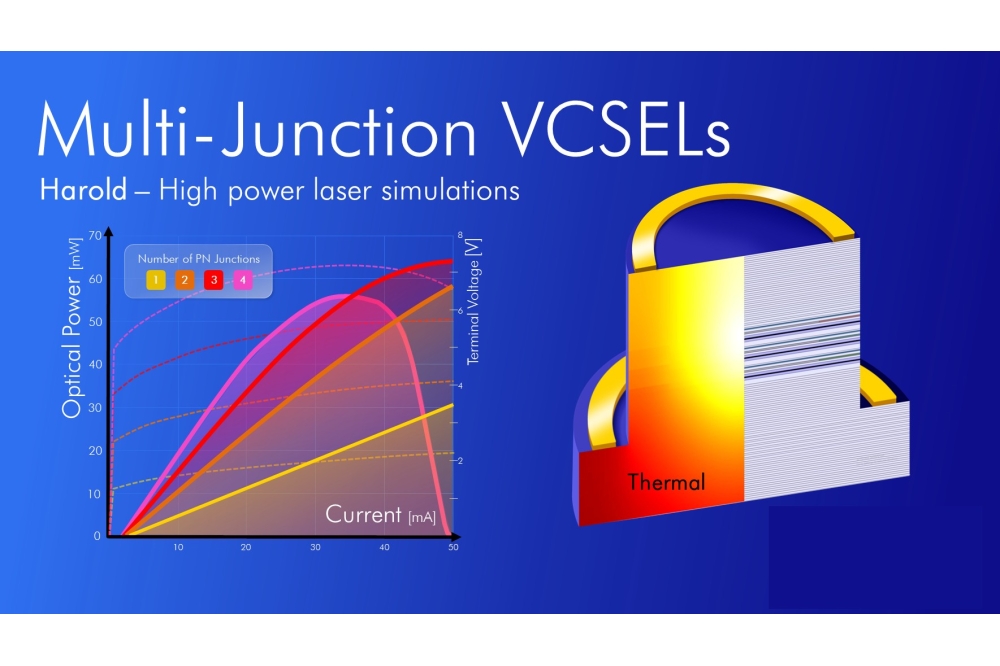
Photonics simulation firm Photon Design is now offering pioneering simulation of multi-junction VCSELs within its HAROLD simulation tool.
Multi-junction VCSELs deliver higher optical power than traditional VCSELs, while retaining their compact, efficient, manufacturable and reliable design. Instead of one gain junction, a multi-junction VCSEL has several junctions stacked vertically within its epitaxy. Efficiency comes from using the same current across the multiple gain junctions.
This enables either a higher optical power for the same current, or a longer lifetime and reliability from delivering single-junction power levels with less current and therefore generating less heat. The high power and efficiency of multi-junction VCSELs is contributing to their rapid uptake in many markets, including high-speed datacoms, machine vision, longer-range automotive LiDAR and consumer 3D sensing applications such as facial recognition.
Dominic Gallagher, CEO of Photon Design, said: “Photon Design’s HAROLD simulation tool supports the demanding design requirements of multi-junction VCSELs, providing 3D optical, electrical and thermal simulations.
"HAROLD shows engineers how additional junctions can raise output power, before efficiency then declines as a result of losses in what is now a larger epitaxy structure. HAROLD provides designers with band diagrams using 3D drift-diffusion modelling of the energy-band structure; thermal analysis of current-induced temperature gradients and their effect on gain; and rigorous output-power predictions from combining the 3D optical profile of the DBR gratings with simulated gain spectra.”