
Semiconductors: 'The oil of our generation'
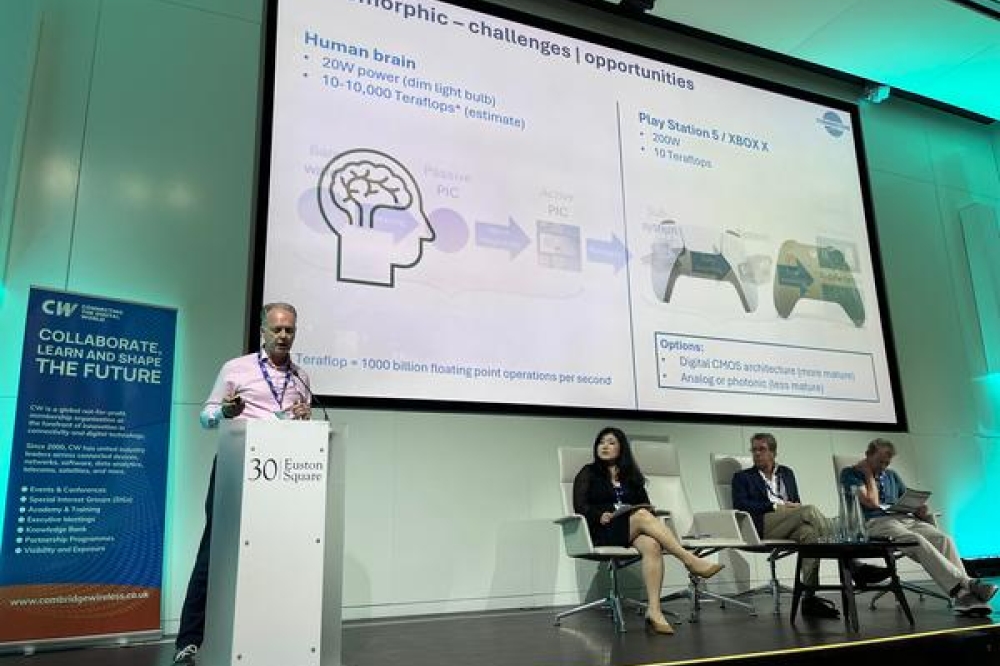
Earlier this month, Cambridge Wireless hosted its annual CW Technology & Engineering Conference with a clear focus: moving beyond AI hype to assess the future of semiconductor and photonic technologies.
AI is an industry in which computing requirements are doubling every 2.5 months. The technology is constrained by speed, complex GPUs waiting for data, and energy consumption.
Rodney Peizel, CTO and COO of the compound semiconductor materials firm IQE plc, made the case that compound semiconductors can address these points directly from the edge to the chip: “The entire end-to-end chain has compound semiconductors in every single step and that’s why we’re migrating to new materials, because compound semiconductors do what silicon begins to fail to do.”
He spoke about GaN as one particular example that can facilitate huge power reduction, enabling up to 5 percent more compute capacity with the same power budget.
And he made the wider point that semiconductors are the "the oil of our generation". Geopolitics is rewriting the rules of the game as we encounter warfare, trade barriers and races for critical materials.
Jon Hefferman, director, National Epitaxy Facility, University of Sheffield, spoke at the conference about the need for new materials to meet specific requirements from advanced applications like AI, but also neuromorphic, quantum, space compatible electronics and more. Moreover, that AI is not only driving this need but can also play a significant role in finding new solutions.
Hefferman argued that the semiconductor sector should be taking its lead from the pharmaceutical industry where AI has been used successfully for drug discovery and notably reducing time to develop. When it historically takes 20-30 years for a material to transition from lab to global industrial scale (commercialised to a $1bn market), any time saved could have a significant impact.
He noted that Google and Microsoft are already conducting AI-assisted inorganic materials discovery which has been very successful for batteries and opens up opportunities for semiconductors. “AI is currently our telescope, scanning the known space” he said. “But the revolution will be AI shifting paradigms of functional design.”
The conference also heard from UK materials innovators including Paragraf, which has created the world’s first 2D material foundry; and Finchetto which has been working with TFLN (Thin Film Lithium Niobate) as a solution that offers a combination of materials that is extremely difficult to match for photonics. On the computing side were speakers from Quantum Dice, Lumai, and Neuroware (the UK Innovation and Knowledge Centre in Neuromorphic Computing Hardware).
A repeated message was the significant opportunity for the UK; an opportunity that nevertheless required choosing directions carefully. Gary Graham, professor in Operations Management, Liverpool John Moores University, introduced the concept of strategic bottlenecks in the semiconductor industry.
Chokepoints or bottlenecks can be seen as dynamic sites of leverage that can be created, mitigated or dissolved through policy, ownership or regulation. And in a world where the UK needs to pick its battles and work out where it can take a leadership position, consideration should be given not just to what we’re good at but the power we hold and the role of strategic understanding and negotiation.
“If you own part of the supply chain”, said Pelzel, “you have leverage to negotiate access to other parts”. This was echoed by Janet Collyer, MBE, portfolio non-executive director, and part of the UK Government’s Semiconductor Advisory Panel. She argued that it’s possible to be strategically significant without being the biggest player.
Andy Sellars, director of strategy, Cornerstone, the UK's leading silicon photonics hub hosted by the University of Southampton, commented; “There’s no point going head to head with something already in existence,” he said. “Playing catch up is time consuming and expensive”. He went on to observe that there are no dominant players in the edge AI market for instance, the photonics quantum platform is built on mature tech and is therefore scalable, and neuromorphic offers considerable potential.
One other opportunity - which would offer practical as well as strategic value - is the creation of a pilot line to support these developing technologies. Offering modest volumes and consistent processes, this would feed into the larger ecosystem enabling system integration companies to scale up. Sellars believes this pilot line would be the first in the world giving the UK a significant first mover advantage.