
Scientists develop first semiconductor maser
Lasers are indispensable in everyday life and research. Masers (microwave amplification by stimulated emission of radiation) actually came first but have so far mostly depended on technically demanding operating conditions, such as very low temperatures.
Now a research team led by Vladimir Dyakonov and Andreas Sperlich from Julius-Maximilians-Universität Würzburg (JMU) in Germany has made a significant breakthrough towards practical maser systems. As the scientists report in the journal Nature Communications, they have developed a SiC-based maser that operates continuously – even above room temperature.
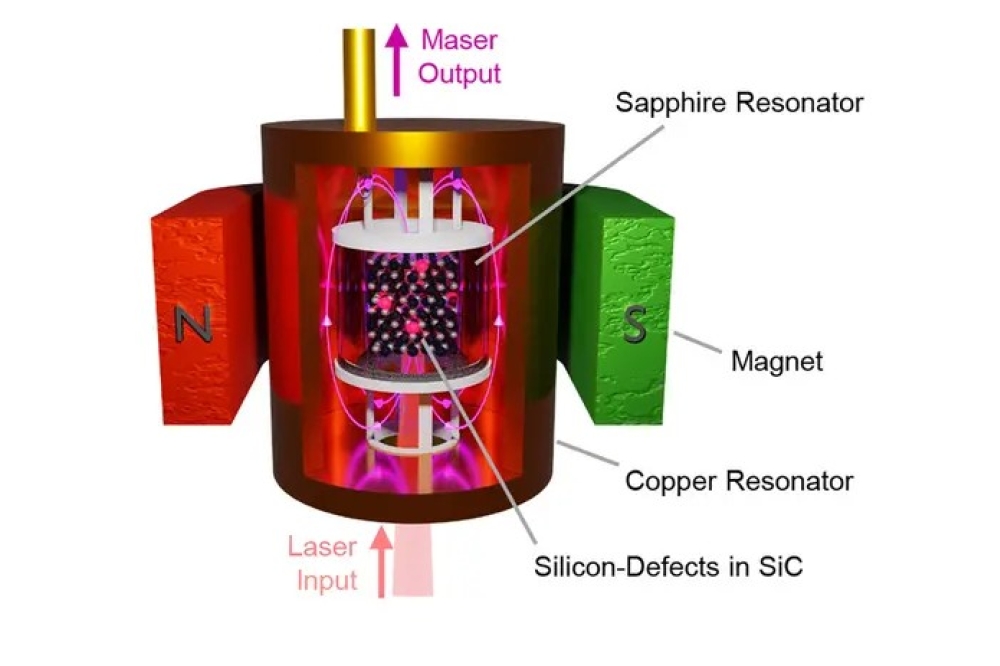
Within the SiC semiconductor's crystal lattice, the researchers deliberately created atomic defects by removing individual silicon atoms. These defects possess well-defined quantum spin states that can be selectively excited using light.
“By leveraging these spins, we turn SIC into a material that actively interacts with microwaves,” explains Andreas Gottscholl, first author of the study. “Using light, we can bring the spins into an excited state in which they emit coherent microwave radiation or even amplify it.”
For the effect to become sufficiently strong, the maser – just like a laser – requires a resonator. It works in a similar way to a swing: only microwave oscillations at the right frequency build up and are amplified further and further. Through careful engineering, the Würzburg team increased the resonator’s quality factor to the point where continuous maser operation is now possible at room temperature.
The new SiC maser can serve not only as a microwave source: in initial experiments and simulations, the team also demonstrated its potential as a low-noise amplifier. “Such amplifiers are essential, for example, for weak signals in communications and measurement technology,” explains Sperlich, senior author of the study. “Smartphones, mobile-phone base stations, computers and satellites all employ several microwave signal amplifiers, which so far have had to operate without maser technology.”
The maser also opens up new possibilities for highly precise magnetic field measurements. Its exceptionally high frequency stability makes it possible to detect even the smallest changes in a magnetic field with great sensitivity. In this context, the maser functions like a ticking clock – an oscillator – whose frequency depends strongly on the surrounding magnetic field. The stronger the field, the faster the clock “ticks.”
The researchers estimate a magnetic field sensitivity of around 20 picotesla at room temperature – about one million times weaker than Earth’s magnetic field. This level of precision could be relevant for future metrology applications and even for GPS-independent navigation.
In the long term, the researchers envision electrically driven maser diodes integrated on a chip. This is supported by the fact that the spin states in SiC can, in principle, be excited not only optically but also electrically.
The work was carried out at the Chair of Experimental Physics 6 at the University of Würzburg and within the Würzburg-Dresden Cluster of Excellence ctd.qmat. The project received funding from the European Research Council (ERC) and the German Research Foundation (DFG), among others.