
£8m project aims to take ultra-stable lasers beyond the lab
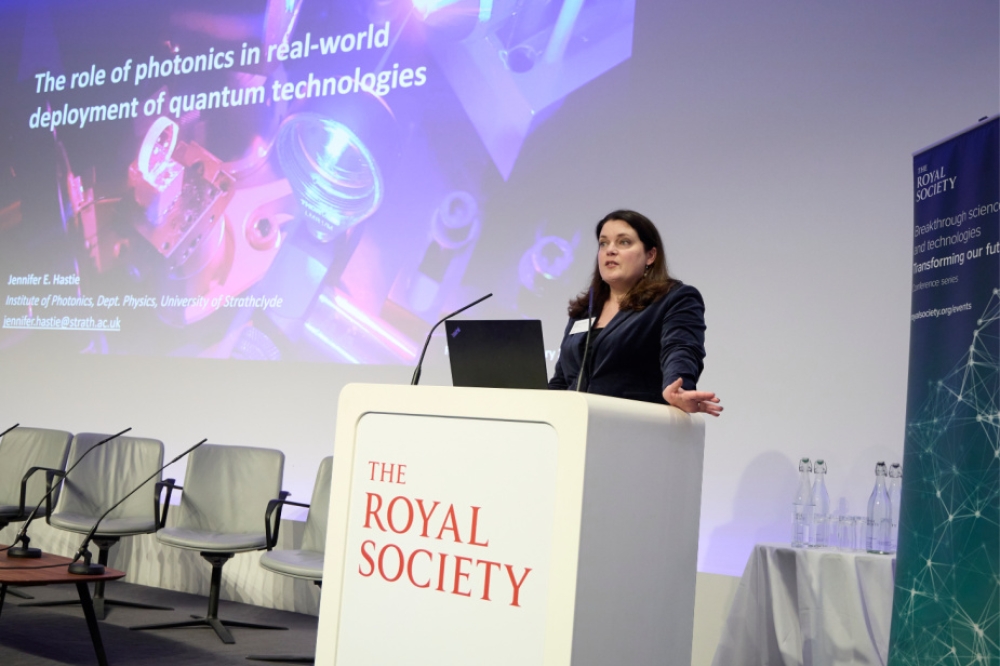
Jennifer Hastie, from Strathclyde's Institute of Photonics, and Deputy Principal Investigator of the UK Hub for Quantum Enabled Position, Navigation & Timing, has been awarded an £8 million Royal Society Faraday Discovery Fellowship to lead a 10-year research programme.
The PORTAL (Portable Ultra Coherence) project will focus on creating compact, highly stable lasers that could help enable future advances in areas including quantum-enabled navigation, sensing, communications and precision timing.
Hastie leads a research team with a main interest in optically-pumped semiconductor and solid-state lasers for high spatial and spectral brightness and broad tuneability at novel wavelengths.
The fellowship will support the expansion of Hastie's research team and collaboration with researchers from the UK Hub for Quantum Enabled Position, Navigation and Timing, the National Physical Laboratory, the Fraunhofer Centre for Applied Photonics, Imperial College London and the University of Waterloo in Canada.
Many of today's most advanced quantum technologies rely on exceptionally stable laser light to operate, but the systems capable of producing that level of performance are often large, complex and confined to specialist laboratories.
Researchers aim to develop lasers capable of delivering similar performance in smaller, more practical systems suitable for use outside specialist laboratories. One potential application area is quantum-enabled positioning, navigation and timing (PNT) technologies, including future alternatives to GPS that are more resilient to interference, spoofing and jamming.
Hastie, said: "The most demanding quantum technologies require laser light that remains extraordinarily pure and stable over enormous distances. Although the wavelength of light is measured in nanometres, some applications require coherence lengths extending tens of thousands of kilometres.
"Achieving that degree of coherence from a practical laser source is extremely challenging. Many of the systems capable of delivering it today remain confined to laboratories because they depend on large and complex stabilisation equipment.
"If successful, these lasers could underpin future quantum sensors, clocks and positioning, navigation, and timing systems that are deployable in real-world environments."