
Bosch boosts SiC capacity
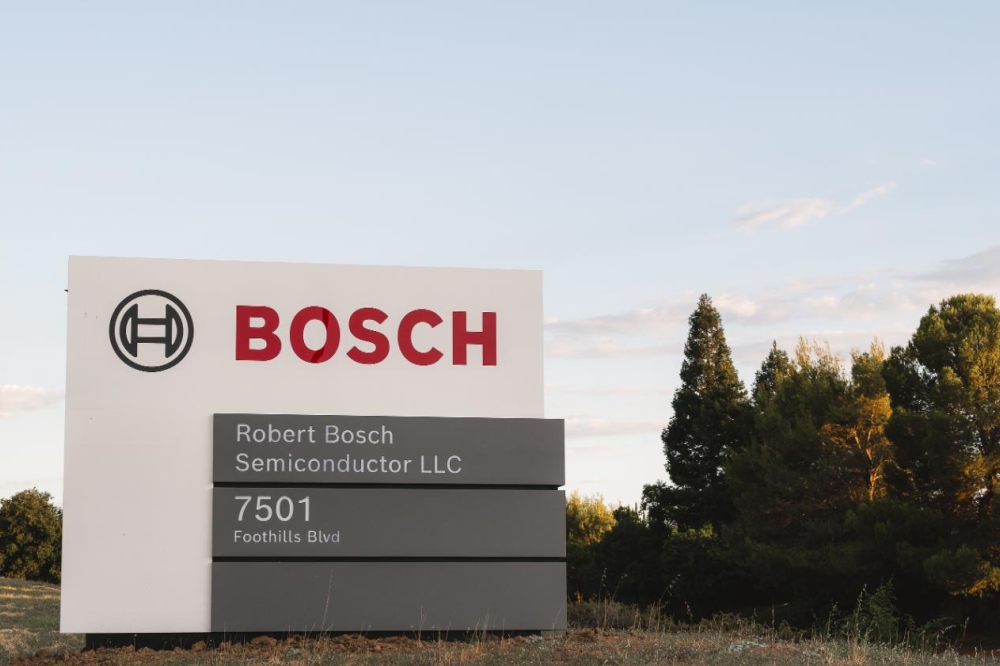
Supported by up to $225 million from the US CHIPS Act, Bosch is expanding the production capacity of its SiC trench MOSFETs, with devices from its second site in Roseville now out for sampling.
BY RICHARD STEVENSON, EDITOR, CS MAGAZINE
When chipmakers want to increase their capacity, they have a number of options at their disposal. They can invest in tools with higher throughput, possibly in conjunction with expanding the footprint of a fab. Or they can build a new fab, or even buy an existing facility.
Going with the latter is power electronics manufacturer Bosch. This European chipmaker recently bought silicon fab in Roseville, CA, and is now investing $2 billion in this facility, where it will ramp production of its SiC trench MOSFETs. These devices, with a smaller footprint than their planar cousins, are produced using the Bosch process, which involves a high-aspect-ratio etch. To accelerate the production ramp of these devices, engineers at the site are drawing on processes already employed for SiC MOSFET production at Bosch’s established fab for SiC chip production in Reutlinger, Germany.
The Roseville facility has a rich history in semiconductor chip production. Built by NEC in 1984, ownership initially transferred to Renesas, before Telefunken bought the facility in 2011. The latter used the fab for chip production on a 200 mm line that primarily manufactured high-voltage and low-voltage devices based on silicon-on-insulator structures. In addition, the fab produced silicon IGBTs and MOSFETs, and SiGe-based devices, all typically at the 0.25 µm node.
Acquiring this site to expand Bosch’s production of SiC trench MOSFETs has merit on a number of fronts, according to seasoned engineer Dan Marrujo, who has intimate knowledge of this facility, recently held the role of chief strategist at Sacramento’s Defense Microelectronics Activity, and had been working with investors to ensure that the Roseville facility can be accredited under the US Department of War’s Trust Accreditation Programme.
Marrujo points out that as well as increasing capacity for chip production, having a second site for making SiC trench MOSFETs reduces the risk associated with catastrophic unknown events. For example, if a delay hampered the installation of a new tool in Reutlinger, devices could be produced in Roseville.
Another advantage of acquiring the Roseville site is that it gives Bosch an existing engineering ecosystem. “It’s not a greenfield facility, where people are having to learn how things are or are not going to work.”
Having the facility already equipped with 200 mm tools is a huge benefit in the current climate, according to Marrujo, given the long lead times associated with tool purchases, which are impacted by high demand and tariffs.
While it’s not possible to replicate Reutlinger’s line exactly, the team at Roseville can ‘copy smart’, using existing and established recipes, fine-tuning them for their set of tools.
As well as production tools, the Roseville facility is equipped with what Marrujo describes as a world-class set of testing capabilities. “They have everything from wafer-level testing to select package-level testing.”
Thanks to this capability, which allows engineers to assess environmental and thermal stresses on components, the fab can quickly ramp to full-rate production.
According to Marrujo, yet another advantage of Roseville acquisition is that it comes with ‘once-in-a-generation’ timing.
“You have a heavily invested site from the Japanese, prior to the ownership of Telefunken TSI, and the CHIPS Initiative working with the Department of Commerce to ensure that there were grants to help with the cost of that facility.”
Marrujo understands that support from the Department of Commerce, worth up to $225 million, is more competitive than any bank can provide. Thanks to funding on very attractive terms, Bosch has a wonderful opportunity to expand its customer base and develop new products.
Further support for Bosch’s Roseville acquisition has come from the Greater Sacramento Economic Council (GSEC).
“GSEC made this a priority within the region. It has allowed Bosch to not only hit the ground running, but see the opportunity space grow, as they want to grow the site,” says Marrujo.
Bosch will initially invest up to $2 billion at the Roseville site, and is already sampling SiC MOSFETs produced at this facility.
Marrujo expects that as this chipmaker progresses from ‘short-loops’ to full-rate production, it will draw on baseline data from the German fab, and allow customers to evaluate SiC devices with a range of fidelities.
Final capacity at Roseville is unclear. Bosch’s investment of up to $2 billion could be the first of many, with customer demand ultimately determining this facility’s final footprint.
“There’s so much land that’s available there,” says Marrujo, who adds that the expansion could be aided by a central utility plant that’s oversized.

The Roseville site is Bosch’s second fab for the production of SiC trench MOSFETs.
Prime
location
For any chipmaker, high-quality
device production is not just dependent on great tools and processes – skilled
and dedicated staff are needed to run them.
Fortunately, Sacramento is home to many manufacturers of memory chips, including Micron, Samsung, Western Digital and Solidigm – in fact, it has more fabs than Silicon Valley. The addition of Bosch to this list will help to strengthen the local semiconductor ecosystem, and allow engineers and technicians to advance their careers without having to leave California.
In this regard, success breeds success, encouraging other companies operating in the semiconductor supply chain to set up satellite offices in Sacramento, and even headquarters. The result is an ever-expanding semiconductor cluster.
The chipmakers in and around Roseville are already working together, supported by the regional government.
Helping such efforts are local academic institutions, responding to the launch of Bosch’s second site for SiC trench MOSFETs. This includes: Sierra College, which is adding mechatronics courses to support students who wish to develop skills that are needed at the Roseville site; and Sacramento State, which is considering overhauling its electrical engineering department, with an increased focus on ruggedized technologies through a programme called WARPTEN. Further afield, but still within a 100-mile radius of Roseville, is Berkley University – Bosch is drawing on its expertise.

The Roseville site that Bosch has acquired is equipped with a central utility plant that is oversized in many aspects.
Local
beneficiaries
As production of SiC
MOSFETs ramps at the Roseville fab, this facility will take on more staff,
providing employment for hundreds of local people.
While it is not possible to know where every chip will go, it’s likely that a significant proportion will be deployed domestically, within the US electric vehicle sector. And that’s surely good news for those overseeing the implementation of the CHIPS Act, as it strengthens native production of an increasingly important device, the SiC MOSFET.