
Semiconducting polymers with a twist
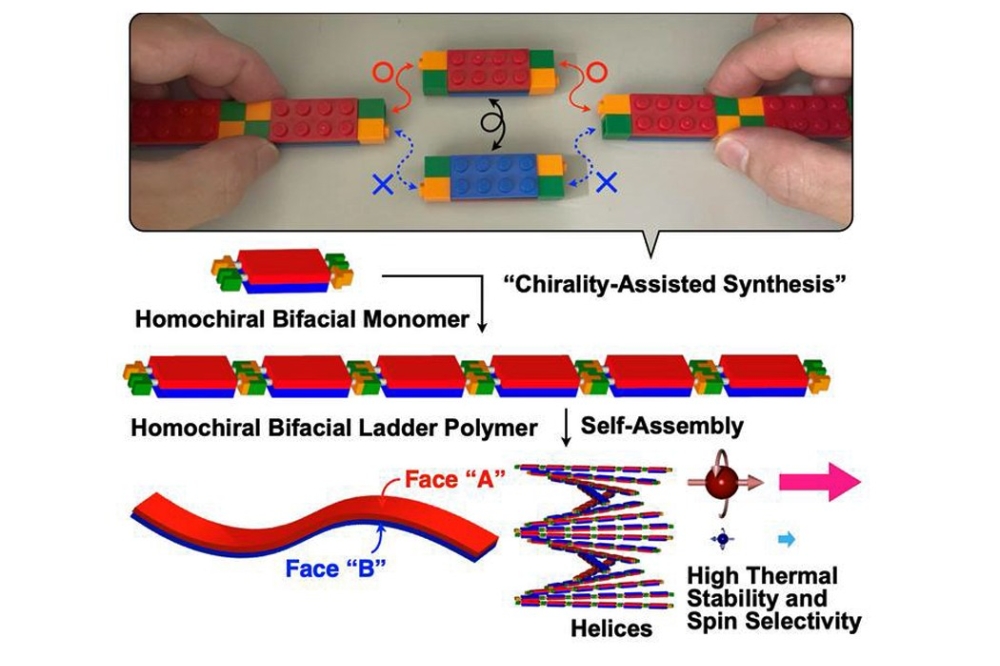
From corkscrewed vines to seashells, forms with distinct left- and right-handed spirals (chiralilty) are one of nature's oldest design principles. Now, scientists are harnessing chirality at the molecular scale in the lab to create materials that control the movement of electrons.
In an article 'Bifacial ladder polymers enabled by chirality-assisted synthesis that exhibit self-assembly and chirality-induced spin selectivity' recently published in Nature Communications, a team from the University of Osaka announced the creation of a new family of chiral semiconducting polymers whose molecular structures twist like left- or right-handed spirals.
As electrons move through materials, they can generate highly spin-polarised electric currents. Conventional electronics rely only on this flow of electrical charge, but researchers have also been interested in ‘spintronic’ devices that harness electron spin as well. As spin can carry information while using less energy, controlling it could lead to greener and more efficient technologies.
“Our approach is to use molecular structure to control electron spin,” says lead author Fumitaka Ishiwari. “Rather than using bulky magnetic materials, we take advantage of the enormous flexibility of organic materials.”
The team designed polymers featuring a rigid bifacial ladder molecular framework. This unique architecture promotes the formation of highly ordered helical structures, enhancing the material’s ability to selectively transmit electrons with a particular spin orientation. When incorporated into electronic devices, the currents produced had spin polarisation values of 70 percent and higher.
“The degree of spin polarisation achieved with these polymers ranks among the highest reported values for organic materials,” explains senior author Akinori Saeki. “This finding demonstrates that molecular design can be a powerful strategy for controlling electron spin.”
Unlike many existing spin-selective materials that depend on rare or magnetic components, the developed polymers are lightweight, carbon-based semiconductors that can be fabricated into thin films using established processing techniques. Their compatibility with the manufacturing process of organic electronics makes them promising candidates for future applications.
“The ability to efficiently generate spin-polarised currents could have broad implications for emerging energy technologies,” remarks Ishiwari. “Such currents may improve the efficiency of solar energy conversion and other energy-harvesting processes.”
Pictured above: Chirality-assisted synthesis of a bifacial ladder polymer with high thermal stability and spin selectivity.