
Photonics at the speed of AI
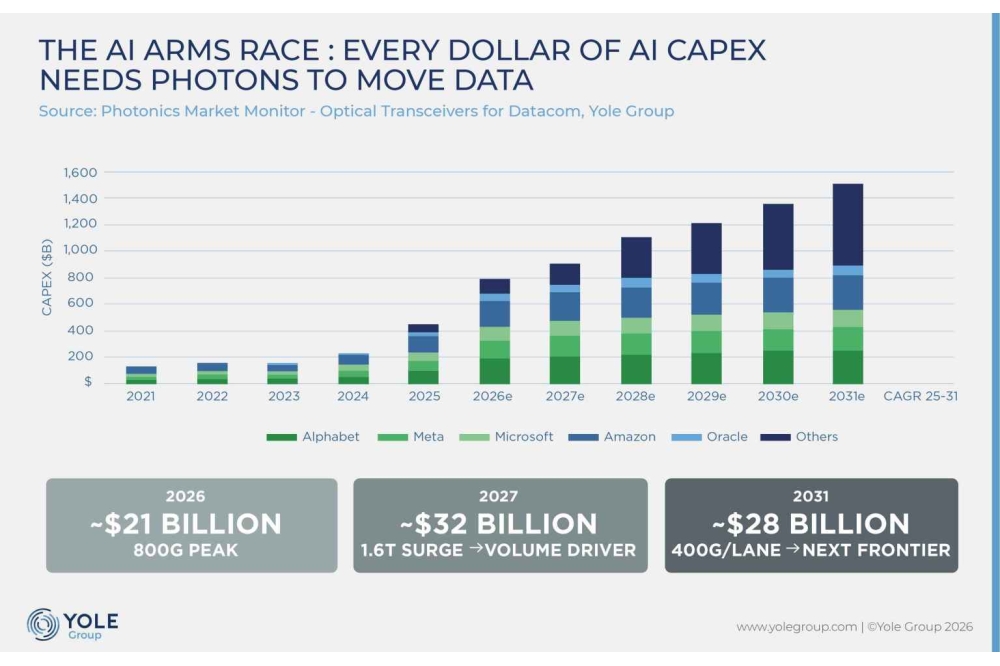
In 'Photonics at the Speed of AI', part of the company's AI white papers collection, Yole argues that optical transceivers, once a supporting piece of data centre infrastructure, have become a system-level requirement for scaling artificial intelligence.
The picture, it says, is neither a simple “copper is dying” nor a “CPO will solve everything” story: copper is being extended deliberately through megawatt-class rack engineering, while co-packaged optics (CPO) is entering commercial deployment narrowly, in proprietary switching platforms, for the handful of players vertically integrated enough to absorb its manufacturing risk.
For most of the past decade, optical transceivers were just infrastructure. Yole says that era is over. When a cluster of tens of thousands of GPUs is built to train a single model, compute is only as useful as the communication fabric that holds it together: latency stalls synchronisation, bandwidth throttles utilisation, and interconnect power competes directly with compute power. The bottleneck has migrated to the wire, the fibre, and the components that convert between them.
"AI makes photonics a system requirement, not an optional enhancement. The bottleneck is shifting from compute to communication," commented Martin Vallo senior technology and market analyst, photonics at Yole Group.
To make sense of that shift, Yole Group’s White Paper introduces a four-domain framework, Scale-In, Scale-Up, Scale-Out, Scale-Across, reflecting how interconnect engineers think about the problem today. Each layer has a different technology entry point, a different incumbent technology to displace, and a different commercialisation timeline.
The scaling math is stark. AI models grow roughly 100x every two years while compute improves only about 3.3x, pushing the industry to deploy approximately 70x more interconnects every two years – a rate the optics module industry is not currently equipped to sustain. That pressure flows directly into the transceiver market: from roughly $10b in 2021 to a forecast $112b in 2031 (~35 percent CAGR), fueled by hyperscaler capex projected to reach $670b in 2026 alone, and a combined $5.3 trillion between 2026 and 2031.
The White Paper also maps where pluggable optics are headed next, evolving through LPO, XPO, and the Open CPX ecosystem toward optical conversion progressively closer to the GPU and CPU package. Yole recent report, 'Co-Packaged Optics for Data centres 2026', quantifies that shift with CPO optical-engine revenue forecast to grow from $0.6b (2026) to $112.1b (2031), with scale-up applications alone expected to capture approximately 94 percent of that market.
Jean-Christophe Eloy, founder and president, Yole Group commented: "As AI infrastructure scales globally, the industry’s primary constraint is shifting. The question is no longer simply which accelerators can be deployed, but whether the networking and photonic technologies required to connect them will be available at the right scale, at the right time, and at the right cost."