
Atomic tweaks could make smarter wireless devices
Queen Mary University of London researchers have discovered a new way to make wireless communication devices more adaptable. Published in Science Advances, their work 'Emergent polar order from interlayer microstrain in layered perovskites' could help create a new generation of devices that change frequency on demand.
Hangfeng Zhang, lead author of the study, said: "Wireless technologies are becoming increasingly sophisticated, and that creates a need for materials that can adapt quickly and efficiently. Our research shows that small changes at the atomic level can have a surprisingly large effect on performance. We hope this approach will help support the development of smarter antennas, tuneable communication devices and other technologies that need to respond to changing demands in real time."
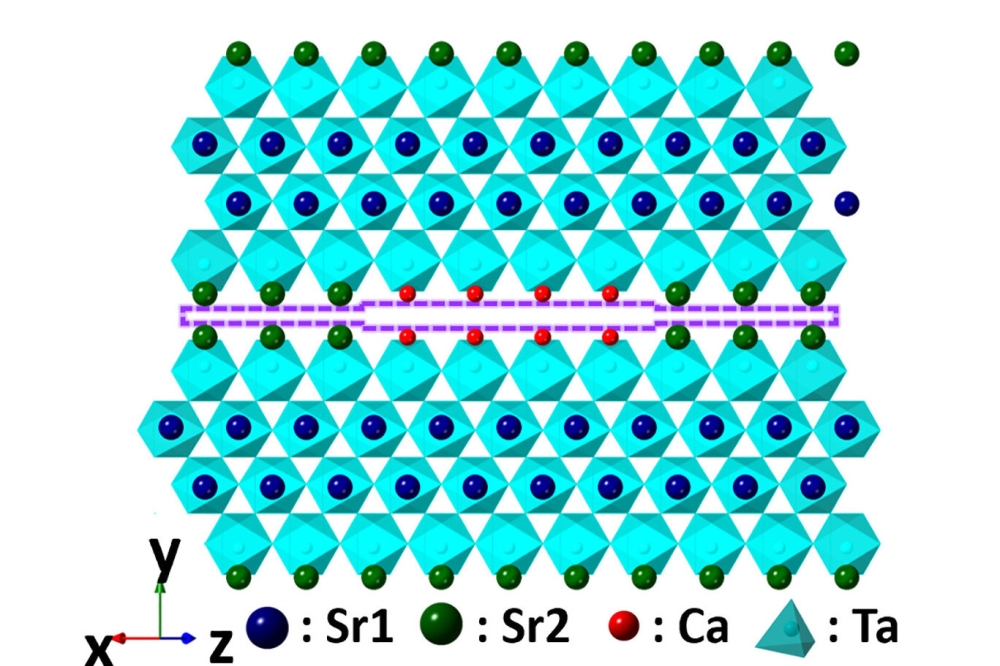
The team focused on the wide bandgap ceramic semiconductor strontium tantalate (SrTiO₃). By replacing a small number of atoms with slightly smaller calcium atoms, they created tiny distortions in the material's structure. Although these changes occur at the atomic scale, they have a major effect on how the material behaves.
The researchers found that these atomic-scale distortions create small regions of electrical activity, known as polar nanoclusters, inside a material that would normally be electrically inactive. These nanoclusters can quickly respond to electric fields, allowing the material's properties to be tuned when needed.
"This is a bit like finding a way to add dimmer switches to a system that previously only had an on and off setting," said Yang Hao, corresponding author and professor of Antennas and Electromagnetics at Queen Mary University of London. "Small structural changes give us a much greater level of control."
One of the most striking findings was how little calcium was needed to achieve the effect. The best-performing material contained just 8 percent calcium, yet it showed a rare combination of strong tuneability, low energy loss and stable performance across a wide range of frequencies.
The researchers also incorporated the material into prototype antennas and microwave devices and demonstrated that the operating frequency could be changed using electrical voltage or temperature.
They say the discovery could support the development of reconfigurable antennas, adaptive communication networks and advanced sensing systems. Because the material is lead-free, it could also contribute to more environmentally sustainable electronic technologies.
Yang Hao said: "Our work shows that very small changes at the atomic scale can have a remarkable impact on material performance. By engineering microscopic strain between the layers of a crystal, we were able to create dynamic polar regions that deliver strong tunability without the drawbacks usually associated with conventional ferroelectric materials. This opens an exciting pathway towards smarter, more adaptive communication technologies."
Pictured above: Atomic model of Perovskite layered structure (PLS) representing the expanded interlayer spacing by Ca substitution