
RF GaN IP competition intensifies
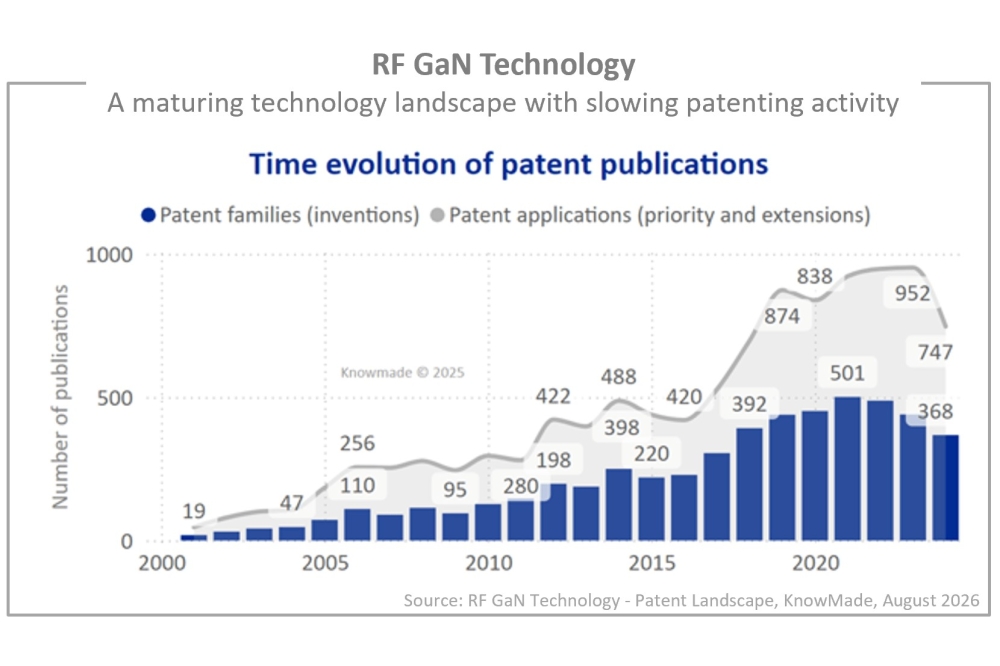
RF GaN technology is entering a new phase of growth and strategic competition, according to KnowMade in its latest report, 'RF GaN Technology Patent Landscape Analysis 2026', based on analysis of 5,300 patent families.
While telecommunications infrastructure remains an important market, demand is increasingly supported by defence, electronic warfare, counter-drone systems and satellite communications.
At the same time, the industrial landscape is being reshaped by consolidation, technology licensing, patent transfers, manufacturing-sovereignty initiatives and restrictions affecting access to critical materials and process know-how.
KnowMade’s analysis reveals a dual trend. Overall RF GaN patenting activity is slowing as the technology matures, yet competition is intensifying in selected technology segments and geographic regions. Portfolio breadth, international patent coverage and control of critical process technologies are becoming increasingly important dimensions of IP leadership.
GaN-on-SiC remains the reference platform for high-power telecommunications, radar and electronic-warfare applications. Its strong power density, thermal performance, reliability and qualification history continue to support its position. However, substrate availability, manufacturing know-how, long qualification cycles and the transition toward larger wafer diameters maintain high barriers to entry.
In parallel, GaN-on-Si is progressing from an emerging platform toward early industrialisation, supported by 8-inch manufacturing. Its development could create opportunities in lower-power radio architectures and, over the longer term, in FR3 and 6G applications above 10 GHz. Nevertheless, cost competitiveness, thermal management, reliability, process maturity and scalability remain important technical challenges.
Innovation is also extending toward longer-term platforms such as GaN-on-diamond and GaN-on-AlN, which aim to overcome current thermal and performance limitations. Although their industrial adoption remains constrained by cost, manufacturing complexity and qualification requirements, patent activity can help identify the organisations already building positions in these emerging fields.
Competitive IP positions remain concentrated around a limited number of established players, but the balance is shifting across the RF GaN ecosystem.
Japanese companies continue to hold strong patent positions in RF GaN wafers and epiwafers. Sumitomo Electric and NGK Insulators rank among the established leaders, while Shin-Etsu has emerged as a significant challenger. These portfolios reflect the strategic importance of substrates and epitaxy for device performance, manufacturing control and supply-chain security.
US players retain a particularly strong IP position in devices and downstream technologies. Following the transfer of Wolfspeed’s RF business and related patent assets, Macom stands out for the breadth of its IP position across RF GaN devices, packaging and circuits. Its patent portfolio gives the company one of the most comprehensive positions across the value chain and illustrates how acquisitions and patent transfers can rapidly reshape the competitive landscape.
China’s leading RF GaN patent positions remain largely driven by state-backed organisations and academic institutions. CETC and Xidian University are particularly prominent, with Xidian University emerging as the leading domestic patent applicant in RF GaN devices. At the same time, industrial companies including Huawei, Enkris and Hanhua Semiconductor are becoming more visible, indicating a gradual diversification of China’s innovation base beyond institutional applicants.
Patent protection strategies are also becoming more international. US companies are increasingly extending their filings into Europe and China, while Japanese players have expanded their patent protection in the United States and China since 2022. Europe is consequently gaining importance as a strategic patent jurisdiction, as companies seek to protect technologies in the regions where RF GaN supply chains, markets and industrial capabilities are developing.
Together, these trends point toward more direct competition across both technical segments and jurisdictions. They also underline the growing role of patents in securing access to critical technologies, protecting qualified manufacturing routes, preserving freedom to operate and strengthening negotiating positions in licensing, cross-licensing, partnerships and mergers and acquisitions.