
Branched nanowire LED could bring big efficiency gains
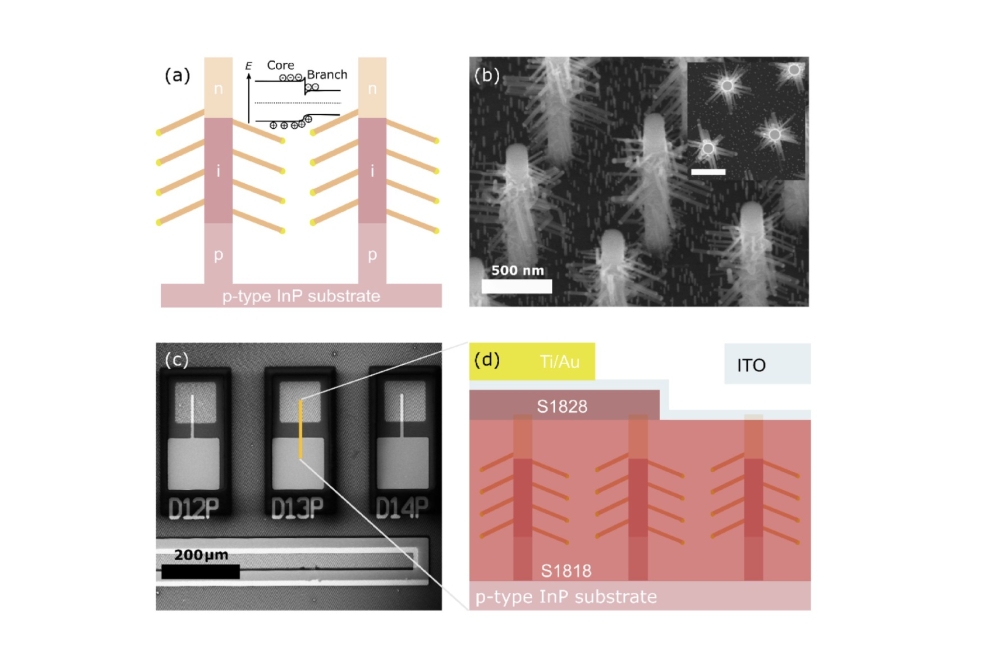
Researchers at Lund University in Sweden have developed a new type of LED based on thin branched GaInP nanowires.
Published in the journal Nano Research, the work 'Diffusion-driven light emission in branched GaInP nanowire LEDs enabled by indirect–direct bandgap engineering' reveals a new type of LED with higher efficiency and lower production costs than current technology.
By controlling where in the nanowire structure light is generated, the researchers have reduced the losses that would otherwise limit the amount of light that can be utilised.
In the LED bulbs found in most our houses, much of the light is trapped inside the material due to total internal reflection. The new design overcomes this problem because the light is emitted from very thin side branches that extend from a central nanowire.
“If the structures are made thin enough – thinner than the wavelength of light – the light cannot be trapped inside the material in the same way. Theoretically, this could enable a very high light output. In principle, it would be possible to release virtually all the light,” says Magnus Borgström, professor of solid-state physics at Lund University.
In the materials used for today’s LEDs, only around 4 percent of the light is emitted without additional surface treatment. To improve efficiency, various techniques and methods of processing the material are therefore used to increase light extraction. If the new technology proves successful, it would be possible to avoid these costly processes. Although LEDs are already inexpensive, any improvement in efficiency is important for industrial production.
In the nanowire approach, a central core is used to inject charge carriers, whilst the light emission takes place in thin side branches. By designing the core so that it does not emit light itself, the researchers have been able to show that the light is indeed generated in the branches – and not through the re-absorption of light from the core.
“This was an important question for us. Our results show that the light is generated precisely where we want it to be, which is crucial for the technology to work,” says Yue Zhao, a doctoral student in solid-state physics and co-author of the study.
Although the technology remains at the research stage and is still a long way from matching the efficiency of commercial LEDs, the researchers see great potential. One advantage is that the structures can be produced at the nanoscale, which means that less material can be used and that manufacturing costs may fall in the long term.
The research team is now continuing its work on improving efficiency. A key challenge is to reduce losses associated with surface defects in the nanostructures used.
“The fact that the technology works at all is an important first step. The focus now is on optimising the materials and structures to achieve greater efficiency,” says Magnus Borgström.
In the long term, the new technology could lead to more energy-efficient light sources and have implications for everything from public lighting to advanced optoelectronic applications.
Pictured above: Overview of branched nanowire LEDs (a) Schematic drawing; (b) SEM image of as-grown branched nanowires from a tilted view; (c) SEM image of three fully processed LED devices with an active area of 100 μm × 100 μm; (d) Schematic drawing of a fully processed device in cross-section.