
Besxar completes first Space flight
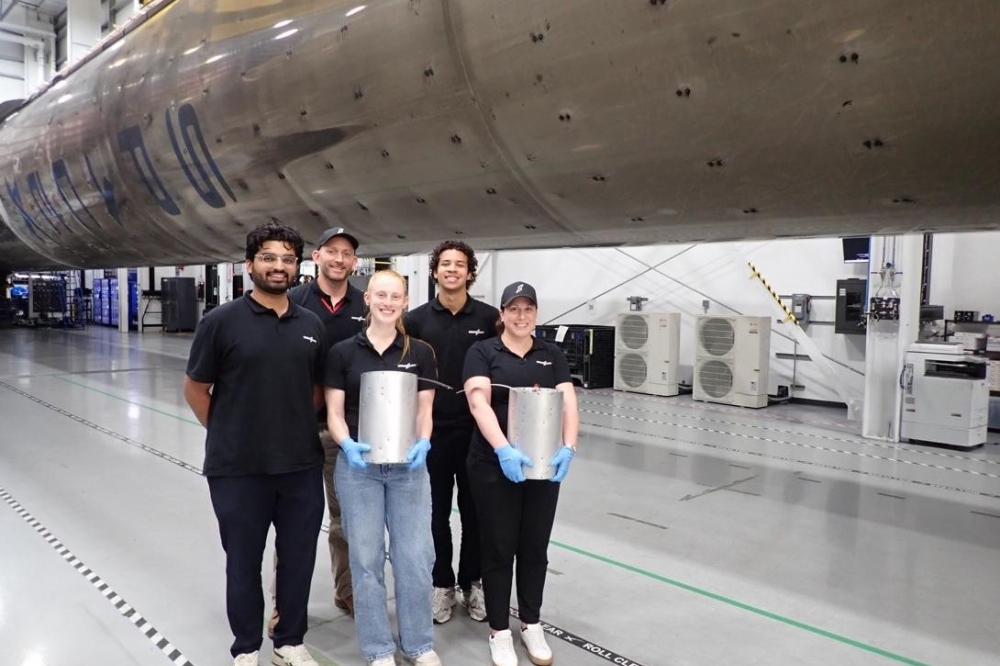
Besxar, a Washington DC-based start-up with aims to make semiconductor materials in Space, has reported the results of its inagural flight: Besxar Flight-1 'Mission Asimov.'
On July 5, 2026, two Besxar-built 'Clipper-class' canisters flew aboard a SpaceX Falcon 9 first stage booster and were recovered intact after the booster returned to land.
It was the first flight carrying custom wafer cartridges, power, avionics, and printed-circuit hardware that Besxar designed and built in-house, all of which qualified on the first attempt.
The mission carried GaN-on-sapphire, undoped silicon, and bare sapphire wafer samples from Besxar, in addition to GaAs, and AlInAsSb wafers from academic research partners at the University of Virginia (UVA) and the University of Texas at Austin (UT Austin).
Besxar's primary test objective for Flight-1 was the viability and performance of the canister design in admitting vacuum – in short, does it work as a cleanroom? The canister needed to (1) maintain structural integrity through all phases of flight, re-entry, and recovery, (2) allow vacuum into the canister during flight to expose test materials, and (3) prevent contaminants from entering the canister. Post flight testing indicates that Besxar’s canisters performed as expected.
Besxar also tested the canister design’s ability to carry wafers safely through the entire flight profile. The canisters flew multiple wafer samples of varying compound semiconductor materials, and initial analysis indicates that none sustained damage. Besxar engineers examined the wafers and canister interiors against pre-flight markers and found no cracking, no warping, and no visible damage. Substrates flown for UVA and UT Austin are currently undergoing independent analysis at the material level that may yield additional data on the effects of vacuum exposure on compound semiconductor materials and their manufacturability.
Besxar's ultimate in-space manufacturing process will be fully autonomous, which requires significant real-time data and testing infrastructure. The company built the initial foundation of that data collection system for Flight-1 and says it will expand it across subsequent flights and, eventually, operations. The company says that the data system performed well. Besxar was able to collect pressure, acceleration, thermal, vibration and shock data for the entire mission. One canister performed as expected. The second had an anomaly when recording flight data. Besxar says it is completing its anomaly review ahead of the next flight.
“This is an achievement we’re incredibly proud of. In just nine months, we’ve been able to design and test initial key capabilities for our in-space compound semiconductor wafer manufacturing technology,” said Ashley Pilipiszyn, founder and CEO of Besxar. “We proved that the hardware is viable and that our systems can survive the extreme swings of spaceflight. Now we have real data and, more importantly, a team with payload integration, spaceflight, and recovery heritage that will only accelerate our work as we take on the next set of technical milestones on our roadmap.”
This mission and future flights are financed by Besxar's early investors. Ahead of the mission,the company raised a $10.3M seed round led by Dauntless Ventures alongside Overture VC, Keymaker VC, 645 Ventures, Singh Capital Partners, Koru Capital, Plum Alley Ventures, Mana Ventures and Earthrise VC, bringing total funding to $14.7M.