
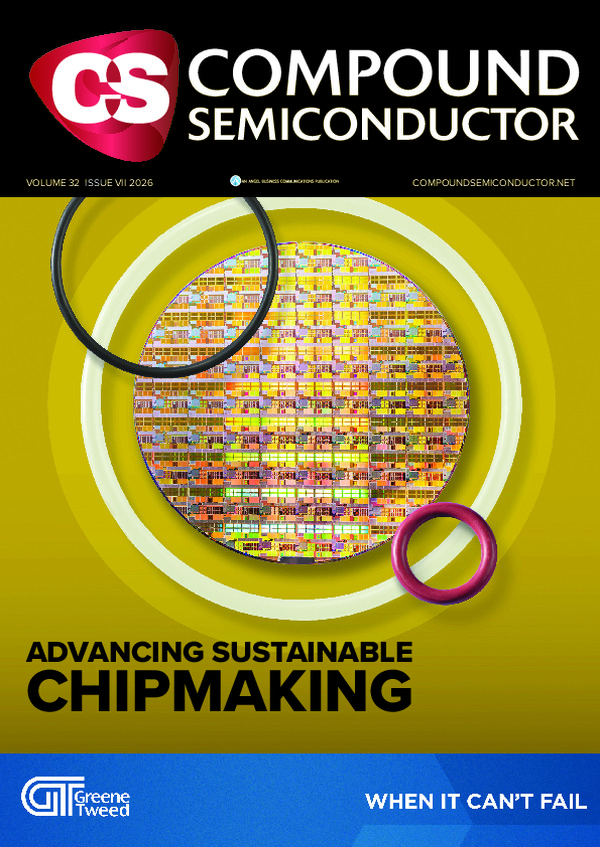
Advancing sustainable chipmaking

Drawing on decades of sealing expertise, Greene Tweed is helping fabs to reduce their environmental impact without having to compromise performance, reliability, or yield.
BY THYAG SADASIWAN, HENRY MA, AND ALAN MAHER FROM GREENE TWEED
The compound semiconductor industry is helping to transform our world. Thanks to the uptake of GaN and SiC high-efficiency power electronics, we have more efficient electric vehicles and renewable energy systems, while the deployment of InP and GaAs lasers and RF transistors is underpinning high-speed communications infrastructure, connecting our increasingly digital world.
Yet the fabs that make these chips, and the suppliers that support them, remain resource-intensive, and are having a significant impact on the environment. Chipmakers are using a number of process gases that threaten to harm the climate. They consume a great deal of water and energy, and they generate emissions throughout their operations and supply chains.
With governments, customers, and investors placing greater scrutiny on environmental performance, manufacturers of all forms of semiconductor device are under increasing pressure to trim their emissions, minimise waste and improve resource efficiency – and in conjunction, demonstrate progress toward sustainability targets.
Unfortunately, it’s not possible to fulfil these goals with a single breakthrough. What’s needed is a series of improvements, spanning equipment design, materials selection, process optimisation, and supply chain collaboration.
Playing a critical role in addressing this overarching objective are suppliers of equipment, including their consumables. Inside a fab, every component contributes to this facility’s total environmental footprint, whether through energy consumption, maintenance requirements, material usage, equipment uptime, or process reliability. That includes sealing solutions, which have a significant influence on emissions containment, contamination control, equipment longevity, and waste reduction.

Component-level sustainability
For decades, our company, Greene Tweed, has worked with semiconductor and semiconductor equipment manufacturers to solve some of the industry’s most demanding sealing challenges. Today, that expertise helps our customers to build more sustainable fabs that are not compromising performance, reliability, or yield. As a prominent supplier of industry-leading Chemraz sealing solutions that outperform and outlast in the world’s harshest semiconductor manufacturing applications, we help fabs comply with a Scope 3 emissions profile (this metric offers a complete breakdown of all indirect greenhouse gas emissions that occur across a company’s entire value chain).
High-performance sealing solutions, such as our Chemraz FFKM and Fusion FKM, are engineered to withstand aggressive chemistries, extreme temperatures, and demanding process environments. Our solutions can contribute to both operational efficiency and environmental performance by helping contain process gases, extend maintenance intervals, reduce unplanned downtime, and support longer equipment life. As our engineering decisions have a direct and measurable impact on our customers’ sustainability performance, we take that responsibility seriously.
Our approach extends beyond product durability. We are also advancing material solutions that are Non-Flourosurfactant (NFS)-compliant; exploring circularity initiatives, such as FFKM recycling; and developing technologies that empower our customers to monitor their equipment performance and optimise maintenance practices. Collectively, these initiatives are enabling a reduction in the environmental impact of semiconductor manufacturers, while maintaining the process control and reliability that advanced device production demands.
Real sustainability gains come from thousands of small engineering decisions made throughout the fab. While material selection, sealing performance, equipment reliability, and lifecycle management are rarely the most visible aspects of a sustainability strategy, all have a substantial impact. Through continued innovation in materials science, sealing technology, and responsible manufacturing, we are supporting semiconductor manufacturers to transition to a more sustainable future.

Enabling greener fabs
For semiconductor manufacturers, there are few sustainability topics generating more discussion than those surrounding per- and polyfluoroalkyl substances (PFAS). Concerns surrounding these classes of material are related to evaluations throughout the world by regulatory agencies, which are considering restrictions on various PFAS substances. This scrutiny creates uncertainty for an industry that’s, for many years, been relying on fluoropolymer materials for some of its most demanding applications. Addressing these challenges requires both urgency and precision. PFAS is a broad class of chemicals with diverse properties and applications. Note, though, that fluoropolymers, such as those used to make our Chemraz and Fusion portfolios, are considered polymers of low concern.
The uncertainty surrounding the future of PFAS is weighing heavily on fabs. They are striving to strike a perfect balance between preparing for changing rules, while avoiding a hit to process stability, contamination control, uptime, or yield. To help them navigate through these choppy waters, we are pursuing a multi-pronged proactive strategy that’s focused on material innovation, supply chain collaboration, and customer qualification support. Keys to our approach are an absence of polymerising fluoropolymers and the removal of fluorosurfactants from our manufacturing processes. We are working closely with suppliers to transition toward NFS across our material portfolio.
In conjunction with this strategy, our materials scientists are developing next-generation alternative materials and solutions capable of meeting the demanding requirements of semiconductor applications. Recent efforts have been directed at PFAS-free elastomers, designed to operate at temperatures up to 180 °C; and high-performance thermoplastic composites, engineered for maintaining strong chemical and wear resistance while operating at temperatures exceeding 300 °C.
As well as material development, we are contributing to qualification, a critical part of the transition process. Working directly with our customers, OEMs, and fluoropolymer manufacturers, we are evaluating new materials under real-world operating conditions. We are already supplying NFS-based materials for testing and qualification programmes – this is helping fabs to assess performance and accelerate adoption where feasible.
One of our goals is to transition most of our FKM and FFKM compounds to NFS formulations by 2030, or sooner where technically feasible. We are also aligned with broader industry initiatives, including the Semiconductor PFAS Consortium, which is advancing science-based approaches to PFAS management throughout the semiconductor value chain.
For manufacturers of compound semiconductor devices, the ultimate goal is not simply compliance. We know that chipmakers want to reduce risk while preserving the key metrics to fab performance: reliability, process control, and yield.
Predictive smart seals
Those running fabs increasingly see sustainability as going hand-in-hand with operational efficiency. When equipment performs reliably for longer periods, fabs consume fewer replacement components, generate less waste, reduce maintenance interventions, and maximise the value of resources already invested in production.
A significant weakness of traditional seal maintenance practices is that they often rely on fixed replacement schedules or reactive maintenance following failure. While this approach reduces some operational risk, the downside is that perfectly functional components are removed long before the end of their useful life. This leads to unnecessary material consumption, avoidable waste, and costly downtime.
Semiconductor manufacturers are looking to avoid these pitfalls as they pursue smarter, lower cost, more sustainable operations. To support their endeavours, we have developed an intrinsically sensing seal material that’s capable of providing real-time insight into seal health. As these novel seals experience compression, wear, aging, and process exposure, an electrical signal is generated, which changes predictably. By monitoring this response, equipment operators gain a better understanding of the actual condition of a seal, without having to open a process chamber or rely solely on an elapsed service time.
For makers of compound semiconductor materials and devices running high-value process tools, these insights extend well beyond sustainability. Superior visibility into seal performance helps reduce unexpected failures, increase uptime, protect yield, and cut the total cost of ownership. In an industry where disruptions, however brief, have significant operational consequences, greater predictability creates substantial value.
Our informative seal technology has valuable long-term potential. As fabs continue to invest in automation, as well as Industry 4.0 initiatives and digital transformation, the seal health data provided by our technology can form a key part of a broader ecosystem of connected equipment intelligence. When integrated with AI-driven analytics, smart seals promise to support predictive maintenance strategies, process optimisation, and even digital twin environments that are capable of simulating equipment behaviour before failures occur.
For semiconductor manufacturers, initiatives such as our seal technology deliver a powerful combination of environmental and operational benefits. They allow components to be used more efficiently, maintenance to become more targeted, and equipment performance to become more predictable. In an industry where reliability, yield, and sustainability are increasingly interconnected, smart sealing offers a glimpse into the future of intelligent fab operations.
Recycling and circularity
Due to the exceptional chemical and thermal resistance of FFKM seals, they are extremely difficult to recycle. That’s a concern, as fabs are pursuing circularity initiatives, and are placing a premium on recovering value from these high-performance materials.
One of the reasons why it is so challenging to recycle FFKM is that the material properties that make these polymers valuable inside semiconductor equipment also hamper efforts to reclaim and reprocess. Successfully recovering and reusing these materials demands deep expertise in both fluoropolymer chemistry and semiconductor process requirements.
Working with a leading semiconductor manufacturer, we have demonstrated the technical feasibility of recycling FFKM O-rings into renewed high-quality sealing materials that are suitable for both demanding semiconductor and general industrial applications. These efforts address one of industry’s most challenging materials recovery problems. At the same time, they are offering a potential pathway toward greater circularity within semiconductor manufacturing.
Our roles in this initiative have included evaluating recycling technologies, developing manufacturable compounds that contain recycled FFKM content, and validating performance characteristics against demanding requirements expected of critical sealing applications.
For fabs, this programme is creating a tangible opportunity to enhance sustainability through verified material circularity, while maintaining seal performance without compromise, and potentially reducing total cost of ownership.
Beyond materials and sourcing, we are working closely with customers to identify sustainability improvements across the broader semiconductor supply chain. In partnership with a leading OEM, we are helping develop and implement a returnable packaging programme that’s aiming to replace single-use shipping materials with reusable packaging solutions. Following multiple rounds of testing and deployment across a number of locations, this initiative is helping to reduce packaging waste, support customer sustainability objectives, and advance more circular logistics practices without compromising product quality or operational efficiency.
Sustainability beyond our products
Efforts to improve sustainability should not begin and end with the products used inside the fab. Semiconductor manufacturers are increasingly concurring with this view, and as part of their own sustainability commitments, they are evaluating the environmental performance of their suppliers and broader value chains.
We hold these values high, and are integrating sustainability across our operations, facilities, supply chain, and logistics network. These efforts are helping us reduce our environmental impact, while supporting our customers that are seeking to improve the sustainability performance of their supply chains, and address Scope 3 reporting requirements.
One example of this mindset is our global manufacturing network. By strategically locating our production closer to customer demand centres, we are reducing transportation requirements, while shortening lead times and trimming our emissions associated with the shipping of products around the world.
We are also rolling out programmes that reduce waste in packaging and logistics operations. In partnership with a leading OEM, we are helping develop and implement a returnable packaging solution designed to replace single-use shipping materials with reusable transport containers. The initiative has successfully completed multiple testing and implementation phases across customer sites, demonstrating how supply chain innovation can cut waste while maintaining product protection and operational efficiency.
Within our own facilities, we are continuing to pursue projects that increase resource efficiency and reduce our environmental impact. For example, at our Korean facility, we have introduced greywater recycling. This initiative is helping drive down freshwater consumption and support more responsible water management. This effort reflects a broader focus on identifying practical opportunities to reduce resource use while maintaining operational excellence.
Recently, we have been awarded an EcoVadis Committed. This reflects our progress related to sustainability. In this regard, we are already building on a strong foundation, while making continuous improvements across environment, labour and human rights, ethics, and sustainable supply chain practices.
Taken together, these efforts demonstrate that sustainability extends well beyond the fab floor. Through responsible operations, supply chain collaboration, resource efficiency initiatives, and long-term product design, we are working to reduce our own environmental footprint while helping customers advance theirs.
Bring us your challenges
We view sustainability as a shared responsibility. We have to play our part, alongside our customers, partners, and the broader semiconductor ecosystem.
As the compound semiconductor industry scales to support electrification, renewable energy, communications, and clean-energy technologies, the fabs making the devices to support these applications must employ practical solutions that improve environmental performance without compromising reliability, yield, or process control. The goal of sustainability is an evolving, complex target.
We have several projects and customer co-innovation programmes to help fabs achieve their sustainability goals. Together, we are leveraging resources, from R&D through to operations, in our joint commitment to sustainability.
Bring us your challenges.