Smart textiles use MoS₂ QDs for sleep monitoring
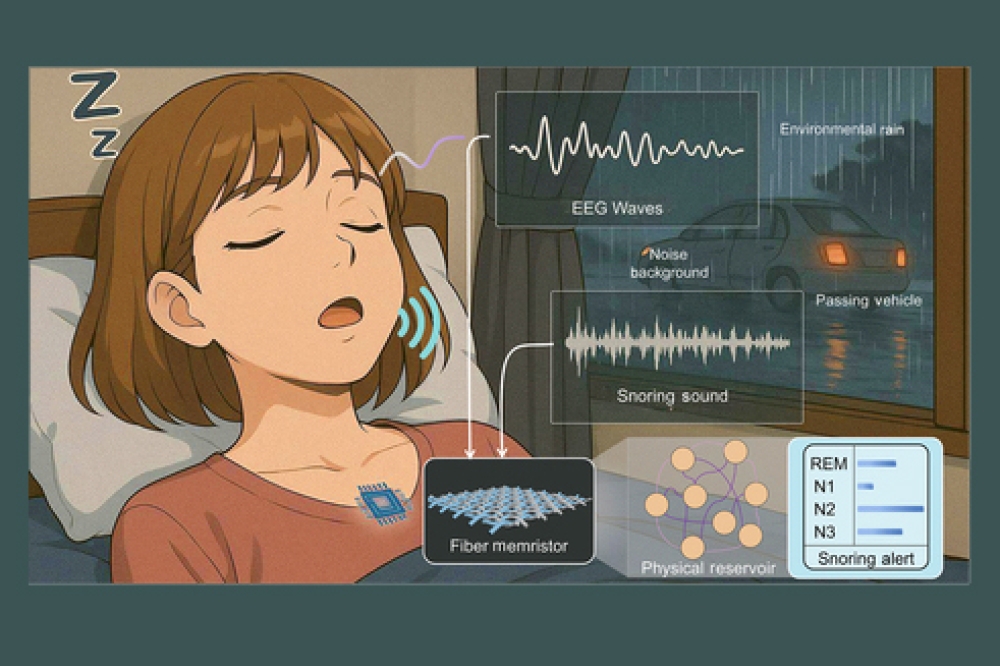
A research team at Shandong University has developed a fibre-shaped memristor based on MoS₂ quantum dots for physical reservoir computing to enable continuous and unobtrusive wearable sleep monitoring.
The device features an Ag/MoS₂ quantum dot/Ag coaxial structure, providing mechanical flexibility and stable pulse-programmable conductance suitable for textile integration. It is descrrbed in a recent article in Research, the first journal in the AAAS Science Partner Journal (SPJ) program.
The core innovation of the team led by Tianyu Wang and Jialin Meng at Shandong School of Integrated Circuits and State Key Laboratory of Crystal Materials, lies in using the memristor’s native nonlinear dynamics as a physical reservoir, enabling direct, in-situ mapping of raw EEG waveforms and the sound of snoring without digital preprocessing.
They say this use of neuromorphic electronics, particularly physical reservoir computing, offers a promising route by using the intrinsic dynamics of hardware devices to perform analogue signal processing without extensive training.
Operating at ±1 V and sub-nanoampere currents, the system achieves pico-watt-level power consumption, suitable for all-night wear. In real-world validation, it achieved 94.8 percent accuracy in snore event detection, 95.4 percent in sleep stage classification, and 93.5 percent in multi-modal fusion tasks.
Beyond sleep monitoring, the platform demonstrated versatility in handwritten character recognition and image compression, confirming its potential as a general-purpose analogue signal processor woven directly into fabrics.
Looking ahead, the team say this fibre memristor technology could be seamlessly integrated into everyday textiles to enable passive, continuous, and low-cost health monitoring in domestic settings.