
Light bends perovskite crystal lattice
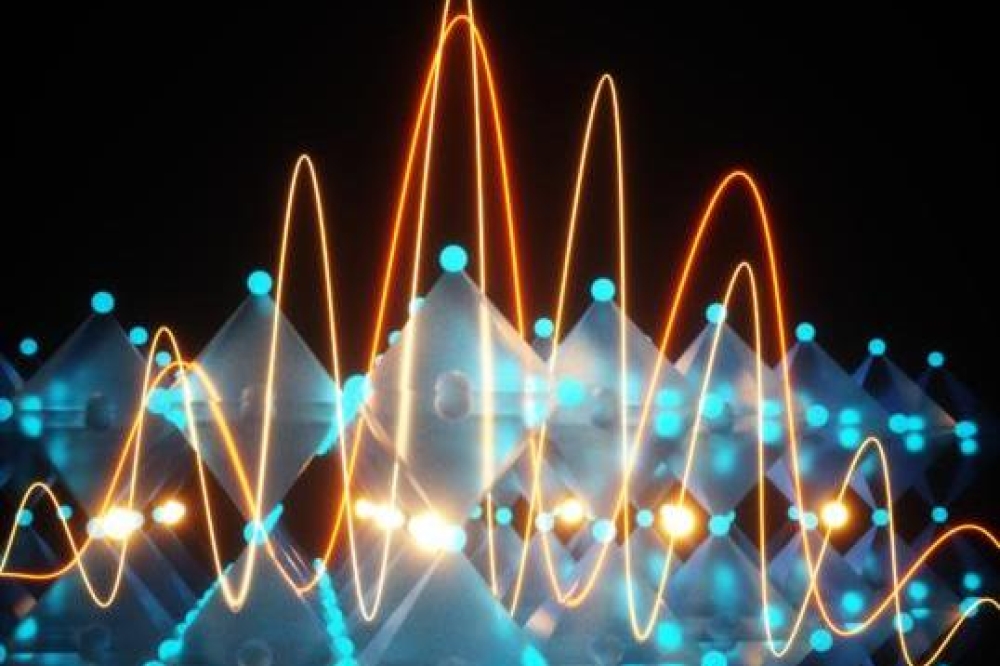
A new study 'Reversible, Photo-Induced Lattice Distortions in Halide Perovskites' published in Advanced Materials by researchers at the University of California Davis, shows that halide perovskite crystals reversibly change shape when exposed to light.
“They are ‘smart materials’ that can be tuned to respond to a stimulus in a way we can control,” said Marina Leite, professor of materials science engineering at UC Davis and senior author on the paper. “Their chemistry is very different in a way that can be beneficial for creating devices we couldn’t build before.”
Mansha Dubey, a graduate student working with Leite, shined lasers onto perovskite crystals and measured the response of the crystal lattice with an X-ray probe. The crystals were grown by collaborators Bekir Turedi, Andrii Kanak and Maksym Kovalenko at ETH Zürich, Switzerland.
They found that the exposure to light changes the lattice structure in a way that is rapid and reversible.
“There is a dramatic change in the lattice when you shine light on it, a unique phenomenon that you don’t see with silicon or GaAs,” Leite said. This photostriction effect is reversible and can be repeated again and again, she said.
By changing the composition of the perovskite, researchers can engineer the wavelengths of light absorbed and emitted by the crystal, a property called the bandgap. Perovskites of distinct composition have differing degrees of physical response to light at frequencies above the bandgap. The effect is tunable both by light frequency and power, Leite said.
“It’s not a binary on/off effect; it can be a scaled response, like a dimmer, depending on the light you shine on it,” she said.
Leite foresees that this photostriction effect in perovskites could open up new ways to design devices tuned or switched by light, such as sensors or actuators.
The work was supported a US federal Defense Advanced Research Projects Agency program to develop new materials for switchable photonic devices, and by a grant from the National Science Foundation. The project made use of the UC Davis Advanced Materials Characterization and Testing (AMCaT) laboratory, established with a grant from NSF.