
Brighter, more stable red LEDs for next-gen microLED displays
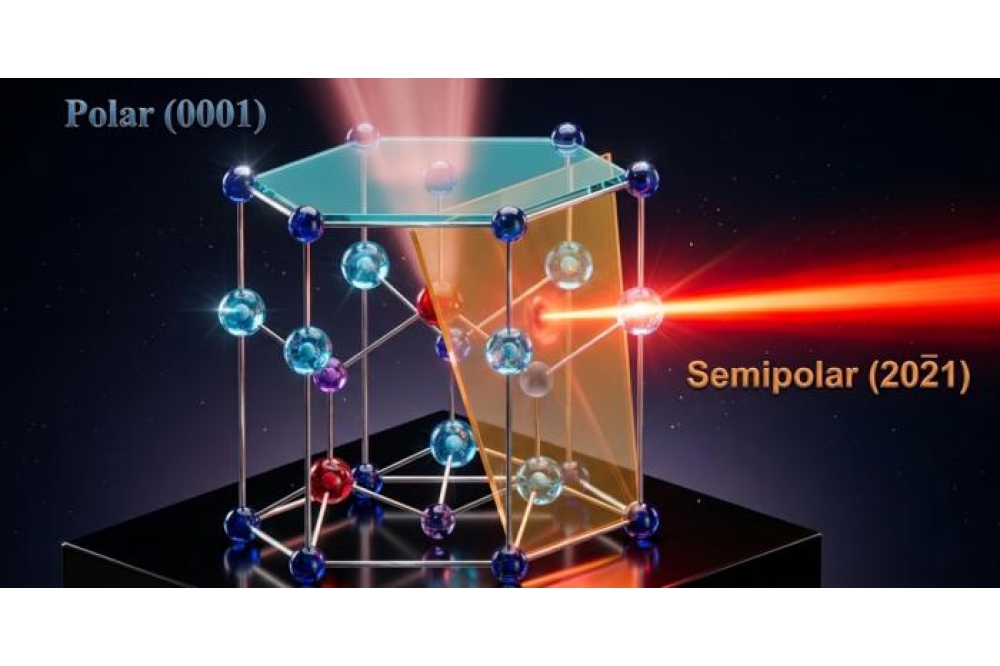
Researchers at the University of Osaka, in collaboration with Ritsumeikan University, have demonstrated that growing europium-doped GaN on a semipolar crystal plane dramatically improves red light emission.
They published their results 'Preferential formation of highly efficient Eu luminescent centres in Eu-doped GaN grown on semipolar (20 21) GaN' in Applied Physics Letters in March 2026.
The team found that this approach selectively promotes the formation of highly efficient Eu luminescent centres, resulting in red emission intensity more than 3.6 times higher than that of conventionally grown polar-plane material.
Red emitters based on Eu-doped GaN are attracting attention as promising light sources for next-generation microLED displays because they can provide narrow-linewidth, wavelength-stable red emission based on intra-4f-shell transitions of Eu ions. This is particularly important for full-colour monolithic integration with blue and green InGaN LEDs, where wavelength stability under device operation is essential.
However, conventional growth on polar (0001) GaN has a major drawback: many low-efficiency Eu luminescent centres form unintentionally, limiting light output. In the new study, the researchers investigated how the crystal growth plane affects the distribution of Eu luminescent centres and found that semipolar (20 21) GaN drastically changes that distribution.
Using combined excitation-emission spectroscopy, the team showed that low-efficiency centres associated with Eu clustering, OMVPE1 and OMVPE2, were absent in semipolar GaN:Eu. At the same time, the highly efficient centre OMVPE7 and another centre, OMVPE8, increased dramatically, by factors of 139 and 53, respectively. The resulting semipolar sample exhibited a narrower emission linewidth than the conventional sample, indicating that the brighter emission arose from changes in luminescent-centre populations rather than from improved light extraction.
The researchers further suggest that enhanced oxygen incorporation during semipolar growth plays a central role in this effect. Oxygen incorporation was higher in the semipolar sample than in the conventional sample, and this is thought to suppress Eu clustering while favouring local structures related to the highly efficient OMVPE7 centre.
Importantly, the advantages were not limited to weak excitation conditions. The semipolar GaN:Eu sample also showed suppressed efficiency droop under strong excitation, meaning that the emission remained comparatively robust as excitation power increased. Overall, the semipolar material delivered a 3.6-fold enhancement in emission at the maximum excitation power density used in the study.
These findings provide a clear pathway toward brighter GaN:Eu-based red LEDs. Because semipolar substrates are also preferred for suppressing wavelength shift in InGaN LEDs, the result represents an important step toward ultrahigh-resolution, wide-colour-gamut, and wavelength-stable full-colour microLED displays based on monolithic integration of red, green, and blue emitters on the same platform.
Shuhei Ichikawa, senior author, commented: “our results show that simply changing the crystal growth plane enables the selective self-formation of highly efficient Eu luminescent centres. Semipolar growth is therefore a very powerful route toward brighter Eu-doped GaN red emitters, and we hope to advance device-process optimisation and full-colour microLED integration toward practical applications.”