
Photon Design enables industry-first, 3D QD laser simulation
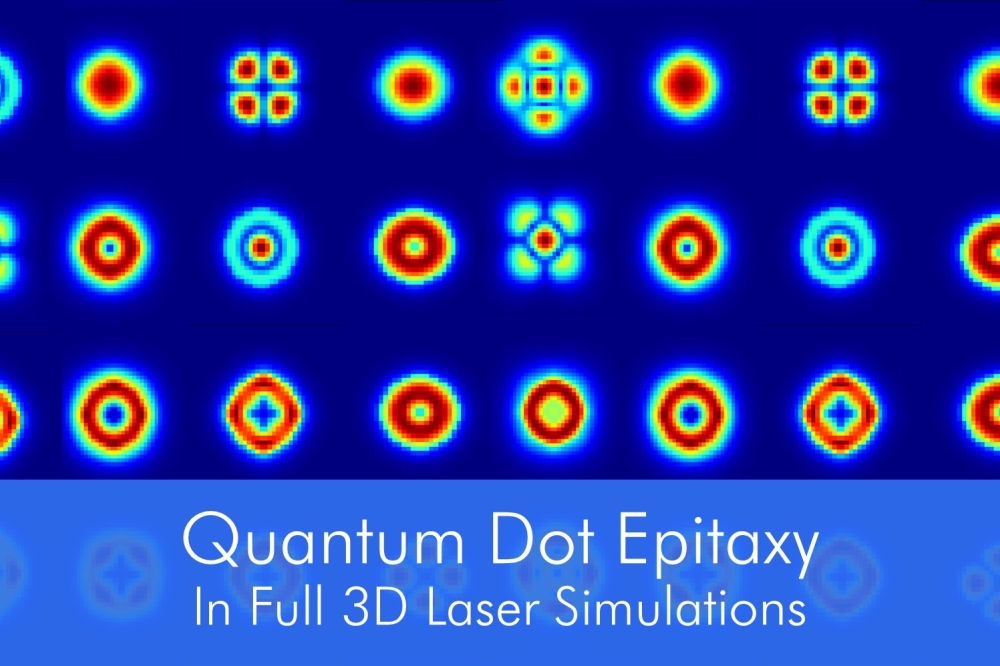
Photon Design, a developer of photonic simulation CAD software, has enabled the industry-first, 3D, quantum dot laser simulation, by integrating its HAROLD QD, quantum dot laser simulation tool with its PICWave, laser diode, SOA, and Photonic Integrated Circuit (PIC) simulator.
This was completed ahead of CLEO, the Conference on Lasers and Electro-Optics, where it will be officially launched. CLEO is a leading forum for laser science, providing peer-reviewed technical sessions on topics from quantum computing to advanced imaging technologies. It will take place at the Charlotte Convention Center in Charlotte, NC from May 17 to 20, 2026.
Dominic Gallagher, CEO of Photon Design, said: “HAROLD QD lets engineers model quantum dot laser structures, including dot size and distribution, with an eight-band K.P-based energy level modeller. Building on decades of advanced, engineering development, the QD simulations it produces include 3-D stress and strain models for quantum dot shapes, accurately producing laser gain and absorption spectra which match real-world tests. Quantum dot lasers are vital for next-generation, data centres, AI, and HPC applications, due to their high-temperature performance, efficient data transmission, and power savings. They also bring practical, silicon-based manufacturing benefits, enabling quantum dots to be grown directly on silicon waveguides."
He added: “HAROLD QD’s integration with PICWave for powerful PIC design, adds 3D, time evolving, quantum dot laser modelling into a unified design environment, optimising an engineer’s design flow. Once in PICWave, engineers benefit from access to Photon Design’s other design tools, importing rigorous simulation models of gratings for DFBs and ring resonators for tuneable laser designs; as well as building larger PICs by importing advanced lossless bends, tapers, and directional coupler components. Simulation effects include thermal rollover, carrier diffusion, current spreading, and hole burning. Its Wide-Band Gain Fitting algorithm ensures accurate results across a broad range of wavelengths.”