
Singapore team makes ultrathin perovskite solar cells
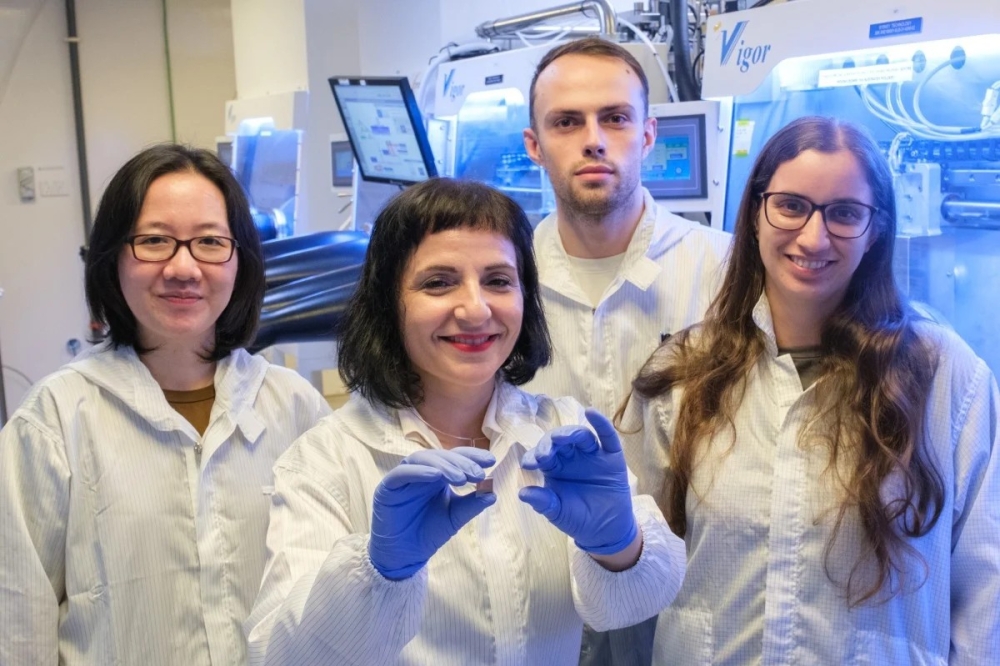
Scientists from Nanyang Technological University (NTU) Singapore, led by Annalisa Bruno, have created perovskite solar cells that are around 50 times thinner than conventional perovskite solar cells. Their results were published in ACS Energy Letters.
Despite their thinness, the devices achieved some of the highest power conversion efficiencies reported for ultrathin perovskite solar cells to date.
In opaque devices, the cells achieved power conversion efficiencies of about 7 percent, 11 percent and 12 percent for perovskite layers measuring 10, 30 and 60nm respectively. A semi-transparent cell with a 60nm thin perovskite layer allowed about 41 percent of visible light to pass through, while converting sunlight into electricity at 7.6 percent efficiency.
To make the cells, the NTU team used thermal evaporation in which the source materials are heated in a vacuum chamber until they evaporate. The vapour then settles on a surface, where it forms a thin film.
The method allows very thin and uniform perovskite layers to be deposited over large areas. It also avoids the use of toxic solvents and helps reduce defects in the solar cells, improving their ability to convert light into electricity.
By adjusting the process, the researchers were able to control the thickness of the perovskite layer and create both opaque and semi-transparent devices.
The team believes this is the first time ultrathin perovskite solar cells have been made entirely using vacuum-based processes.
Using the technique, the researchers produced ultrathin perovskite absorber layers down to 10 nm while retaining useful solar-cell performance.
First author of the paper, Luke White, a former PhD student at NTU, said: “By precisely controlling thermal evaporation, we are able to adjust the transparency of the solar cells. This opens up new possibilities for sustainable architecture, such as tinted windows that generate electricity.”
Giving an independent comment, Sam Stranks, professor of Energy Materials and Optoelectronics, Department of Chemical Engineering and Biotechnology, University of Cambridge, said: “This approach offers a high level of control over film thickness and uniformity, which will be needed if semi-transparent solar cells are to move towards larger-area applications.”
“Semi-transparent perovskite solar cells are an exciting route to harvesting energy from surfaces that are difficult to use with conventional silicon panels, such as windows, façades and lightweight electronics. The results reported here show a promising balance between transparency and power generation in very thin devices, while the next critical tests will be long-term stability, durability and performance over larger areas,” he added.
Because the new solar cells are semi-transparent and colour-neutral, they could potentially be incorporated into windows and façades without significantly changing how a building looks, according to the team.
“The built environment accounts for roughly 40 percent of global energy consumption, so technologies that seamlessly convert buildings’ surfaces into power-generating assets are gaining urgency,” said Bruno, who is a pioneer in the field of perovskite solar cells.
“Our perovskite solar cells offer distinct advantages as they can be manufactured using simple processes at relatively low temperatures. They can also be tuned to absorb specific wavelengths while remaining transparent, and could potentially be scaled over large areas, reducing their carbon footprint,” she added.
As an example, if the technology were scaled up while maintaining similar performance, large glass façades could be transformed into active surfaces for solar power generation.
Preliminary estimates suggest that a deployment across a major glass-fronted building, such as an office tower at Raffles Place or Marina Bay, could theoretically generate several hundred megawatt-hours of electricity annually.
Depending on the usable glass area and building orientation, this level of energy generation would be equivalent to the annual electricity consumption of about 100 four-room HDB flats.
A patent for the development of the ultrathin perovskite films in a novel structure has been filed through NTUitive, the University’s innovation and enterprise company.
The researchers are now in talks with companies to validate and standardise the thermal evaporation process used in this study. They will also work to improve the long-term stability, durability and large-area performance of the perovskite solar cells before they can be commercially deployed.