
Three-way boost to high-power deep-UV emitter efficiency
Researchers in Jiangnan Dai’s group at Huazhong University of Science and Technology have achieved a record 21.2 percent wall-plug efficiency for a III-nitride deep-ultraviolet light emitter, breaking the long-standing 20 percent barrier under high-current operation.
The work, 'High-Power III-Nitride Deep-Ultraviolet Light Emitters with Record 21 percent Wall-Plug Efficiency' published in Advanced Functional Materials, introduces a cooperative photon-redirection strategy that ntegrates three light-management elements enhance light extraction, especially for the notoriously difficult transverse-magnetic (TM) polarised light.
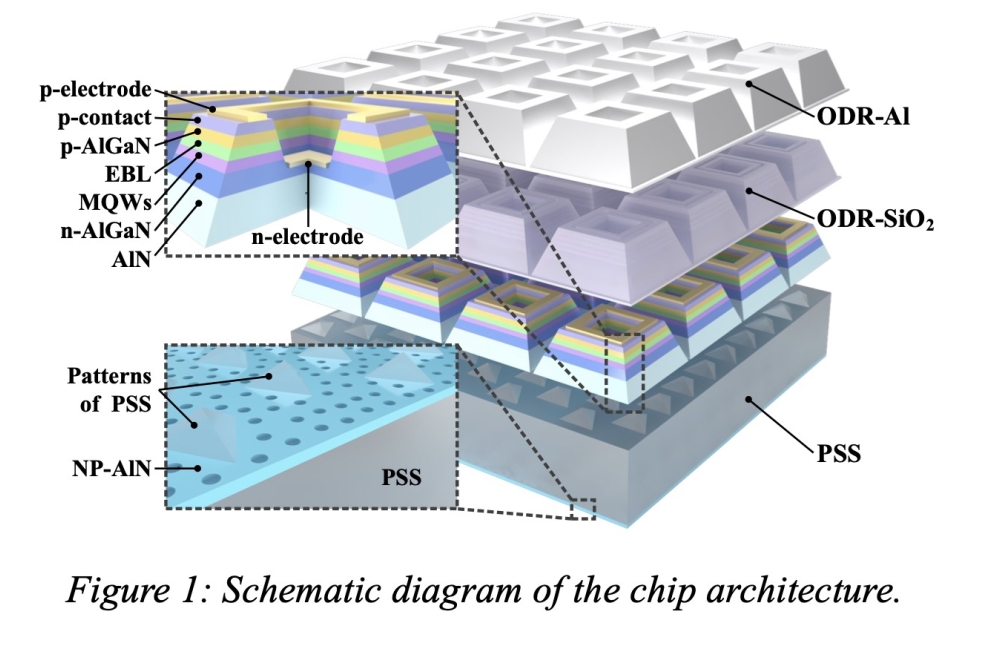
The chip architecture (illustrated above).combines an in-situ nano-porous AlN (NP-AlN) scattering layer, an optimised mesa with a SiO2/Al omnidirectional reflector (ODR), and a double-sided patterned sapphire substrate (PSS).
Unlike conventional designs where n‑electrode formation interrupts reflective sidewalls, the team placed n‑electrodes at the centre of each mesa, preserving a continuous reflective perimeter. The omnidirectional reflector redirects laterally propagating photons toward the front emission surface. The double-sided patterned sapphire substrate introduces inclined facets that expand the escape cone, while the nano-porous AlN layer fills the planar regions between patterns, providing additional scattering pathways for photons that would otherwise undergo total internal reflection.
Finite-difference time-domain simulations showed that this cooperative design enhances transverse electric mode light extraction by 11.3 percent and transverse magnetic mode extraction by an extraordinary 252.1 percent. Given that TM‑polarised light dominates DUV emission near 280 nm, this substantial gain is decisive for overall performance, according to the team.
The performance of the chip packaged with a hemisphere lens is shown in Figure 2. The fabricated chip delivered a peak wall-plug efficiency of 21.2 percent at 70 mA, with a corresponding output power of 77.7 mW. The devices maintained >16 percent efficiency over a wide current range from 10 to 350 mA, and achieved a saturation output of 375.6 mW at 540 mA. This combination of high peak efficiency and high power under practical injection currents surpasses previously reported DUV LEDs, which often reach peak efficiency only at impractically low currents (<10 mA).
The work represents the first report of a gh-power DUV LED exceeding 20 percent wall-plug efficiency, marking a critical advance toward mercury-free solid-state ultraviolet sources for applications such as industrial lithography, high-power optical communication, and water treatment. The team notes that the integrated architecture can be readily scaled, and future work will explore combining these efficient emitters with UV sensors and flexible optoelectronic devices.