
AI accelerates power design
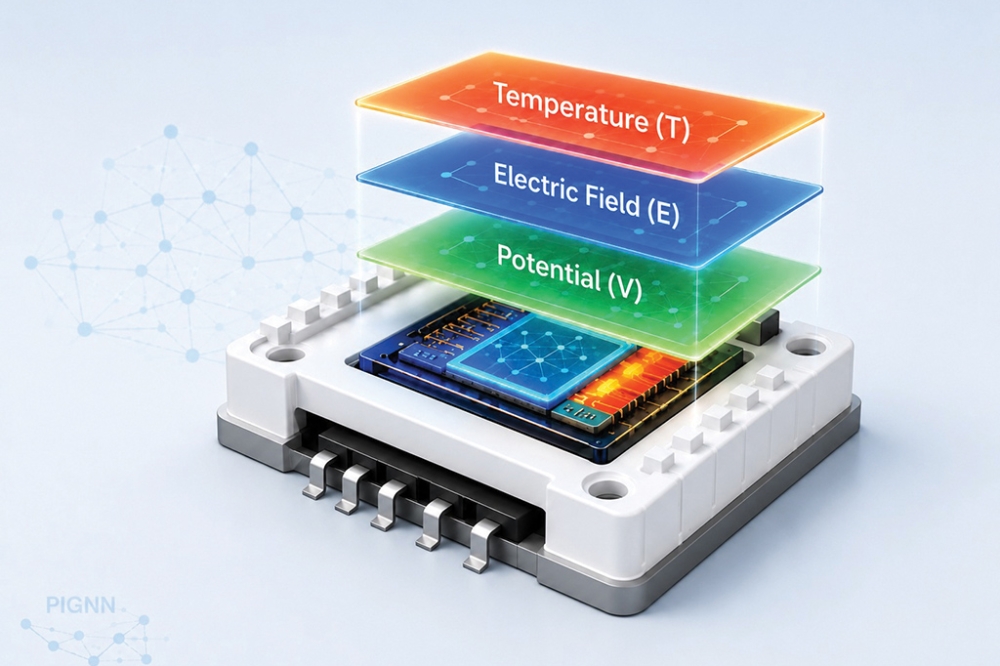
By slashing the time it takes for electro-thermal simulations of wide-bandgap devices by a factor of more than 5,000, a new physics-informed graph neural network is unlocking rapid structural optimisation and SPICE parameter extraction.
BY LI ZHENG, XINHONG CHENG AND COLLEAGUES FROM SHANGHAI INSTITUTE OF MICROSYSTEM AND INFORMATION TECHNOLOGY, CHINESE ACADEMY OF SCIENCES
There’s much in favour of a relentless push towards higher power densities in modern electronics. Gains on the front save space, thanks to smaller footprints, and may trim weight. What’s more, there’s the opportunity for product miniaturisation, faster charging rates, and lower operational costs.
Holding the key to realising higher power densities are wide-bandgap semiconductors, in particular GaN and SiC. Introducing these devices in place of silicon incumbents delivers a hike in efficiency. However, this goes hand-in-hand with formidable challenges associated with thermal management.
When devices fail under stressful conditions, such as short-circuits, the fundamental weakness is often related to a thermal phenomenon. Due to this, accurate electro-thermal analysis is non-negotiable for reliability.
Unfortunately, traditional simulation methods are painfully slow, creating a bottleneck in the design cycle. Every iteration can cost days of computational time. This delay is a severe impediment to progress: it stifles innovation, it forces designers to rely on approximations, and it limits exploration of optimal device structures and accurate system-level models.
Given these issues, there’s an urgent need for a paradigm shift that will equip design engineers with the opportunity to maintain high-fidelity physics without suffering from crippling computational overheads.

Figure 1. (a) A universal PIGNN modelling framework as a AI Accelerated
model for E-T analysis, structural parameter auto-design of power
devices and global optimal extraction of spice parameters. (b) The PIGNN
model adopts a supervised encoder-processor- decoder framework, encoder
converts grid data into a graph, processor updates node/edge embeddings
through L message-passing layers and decoder extracts node features.
The modelling challenge
One of the weaknesses of conventional electro-thermal analysis, which is typically performed with finite element methods (FEM), is that it struggles with multi-scale complexity. Due to this, simulating an entire power die that contains thousands of parallel cells is prohibitively expensive. So, engineers are often forced to settle for simplified, less accurate models.
It’s not overstating the issue to claim that this gap between detailed device physics and system-level circuit simulation is a major hurdle. It should also be noted that when designing critical structures, such as field-limiting rings for high-voltage devices, an iterative trial-and-error process must be adopted, consuming vast amounts of engineering time and resources. What’s clear is that the need for a unified, fast, scalable modelling framework has never been more acute.
Overcoming this challenge is critical in applications that pursue higher efficiencies and power densities. For instance, in electric vehicle traction inverters and data centre power supplies, power modules have a compact layout, making thermal interactions extremely complex. When traditional simulation tools are employed to deal with problems associated with ‘system-level’ electro-thermal coupling, they fall far short of what’s required. They are either insufficiently accurate, or they require computation times spanning weeks, a timescale utterly incompatible with agile development cycles. Due to these severe limitations, many in academia and industry have a shared goal: the development of a method that delves into the microscopic structure of a device while rapidly deducing the macroscopic thermal behaviour of an entire chip, or even a module.

Figure 2. PIGNN’s multi-scale modelling for a SiC short circuit. (a) Cell-level temperature under different bias at various times. (b) Cell-level electric field components. (c)(d) Temperature, electric-field distribution across the die. (e) Temperature characteristics of the packaged device.
AI solution
Our team is offering a powerful solution, which marries deep learning with fundamental physics: the Physics-Informed Graph Neural Network (PIGNN). This framework represents a device’s mesh – that’s the digital grid used for simulation – as a graph. Points are nodes, and their connections are edges.
The innovation in our approach lies in how we train this network. It learns not just from the data generated by traditional simulators, such as Sentaurus, but by directly incorporating the governing physical equations into its learning process. So, our network draws on Poisson’s equation, and those for carrier continuity, drift-diffusion and heat conduction. By incorporating a physics-informed approach, our model respects the underlying laws of nature, and makes robust predictions, even for conditions not explicitly seen during training.
The core advantage of PIGNN is the flexibility of its ‘graph structure’, combined with the constraints of ‘physical information’. The graph structure is naturally suited to representing irregular meshes and non-uniform material distributions, a strength that enables seamless handling of multi-scale geometries, from nanometre-scale channels to millimetre-scale substrates. Thanks to an embedding of physical equations, predictions are not based on mere data fitting, but result from physically consistent reasoning. With this design, after the model has been trained on one device structure and a range of operating conditions, it may be generalised to accommodate new geometries and bias voltages through its ‘transductive learning’ capability. Accomplished without retraining, this vastly expands the application scope.

Figure 3. Schematic of PIGNN-based device design: Structural parameters
are incorporated as learnable variables, with Electric-Field uniformity
of rings added to loss function for global optimisation.
Speed and accuracy
Our performance gains are transformative. According to benchmarking, the PIGNN framework can predict both static and transient electro-thermal responses over 5,000 times faster than conventional Sentaurus FEM simulations. Crucially, this speed is not at the expense of an inferior accuracy. When predicting short-circuit thermal transients, our model maintains an error below
1.5 percent.
This combination of speed and accuracy completely redefines the boundaries of design exploration. Previously, engineers, constrained by time, may have evaluated just a few dozen design variants. Now, by leveraging PIGNN’s rapid inference capability, they can screen and optimise thousands of structural parameter combinations within hours, uncovering optimal ‘sweet spots’ overlooked by traditional methods. As well as pushing the performance limits of the final product, this transformation significantly enhances the foresight and reliability of the design process.
Designing with AI
The true power of this accelerated model comes from its application to real-world design problems. We have demonstrated this strength by automating the design of field-limiting rings (FLRs) for a GaN vertical power device. Within the PIGNN framework, ring spacing and width have become learnable parameters. We tailored the model’s loss function to maximise the breakdown voltage by optimising electric-field uniformity.
After training, our AI-based approach has proposed an optimised FLR structure with a breakdown voltage of 2000 V. Subsequent validation in Sentaurus provided excellent agreement, proving the framework’s capability as a powerful design accelerator that can converge to reliable, high-performance solutions.
This process mimics and dramatically accelerates the decision-making of a seasoned engineer. Rather than blindly attempting changes with every iteration, our AI model intelligently adjusts structural parameters based on feedback from physical laws (via partial differential equation loss) and guidance from performance objectives (via custom loss). This model ‘understands’ how changing the width of one ring affects the electric field profile across the entire depletion region. Based on these changes, the model seeks a global optimum.
More diverse design tasks can be pursued with this approach, such as termination structure optimisation, the best cell layout for reduced thermal coupling, and even the exploration of novel voltage-withstanding structures.
Universal parameter extraction
As well as supporting structural design, our framework bridges the gap to circuit simulation. We are able to perform global optimisation for SPICE model parameter extraction for both SiC MOSFETs and GaN HEMTs. By treating device terminals as a graph, and incorporating temperature as a global node, the PIGNN can learn a unified set of SPICE parameters, valid across a wide temperature range that spans -40 °C to 125 °C.
Results with this approach show excellent, non-piecewise fitting of key capacitance curves, and highly precise replication of DC output characteristics. This demonstrates that we can thus provide circuit designers with accurate models derived directly from physics.
To fully appreciate the extent of this success, be aware that the traditional parameter extraction methods tend to rely on piecewise fitting for specific operating points, where parameters lack physical correlation. This weakness leads to model inaccuracies during extrapolation, or under extreme conditions.
Our framework is fundamentally different. It unifies a device’s internal physics with its external terminal characteristics through the graph model. The parameter set extracted via a single global optimisation inherently reflects the device’s intrinsic physical mechanisms. Consequently, the resulting SPICE model is not only accurate within the training data range, but exhibits higher credibility when predicting complex switching transients or thermal coupling effects never directly tested.
Stable and scalable
With any optimisation system, a critical concern is stability. Does the system reliably converge to a good solution? We have rigorously tested the robustness of our PIGNN framework, by evaluating it from 25 different sets of initial parameters, for both the FLR design and SPICE extraction tasks.
Encouragingly, our framework demonstrates robust convergence every time, proving its suitability for automated design workflows. What’s more, while traditional FEM simulation time scales linearly with problem size, our trained PIGNN model maintains inference times on the order of seconds, regardless of scale, enabling full-die thermal analysis, a task previously considered impractical. This stability and scalability pave the way for building ‘digital twins’ and enabling ‘real-time health management’. One can imagine a future where a critical power module has a virtual model based on PIGNN that updates synchronously with its physical counterpart. The system controller could use this ultra-fast model to predict internal hot spots and stress distributions in real-time, based on actual operating conditions. It’s an insight that opens the door to proactive adjustment-control strategies, which extend lifespan or prevent failure. This marks a leap in reliability design from post-facto verification towards real-time predictive maintenance.
Future enabled
Our work is not simply showcasing an incredibly speedy simulator; it offers a new methodology for power device engineering. By integrating multi-scale physics with the adaptive learning capability of graph neural networks, we have created a tool that dramatically accelerates the two most time-consuming phases of development: device structural optimisation and compact model generation. Our AI-accelerated framework promises to shorten design cycles, enable more innovative device architectures, and improve the reliability of next-generation power electronics by making high-fidelity electro-thermal analysis a practical part of the iterative design process.
Looking ahead, the potential of this framework goes far beyond silicon-based and wide-bandgap power devices. Its core idea – the integration of physical equations with graph neural networks – is transferable to the design and modelling of multi-physics coupled systems, such as photonic devices, MEMS sensors, and even bio-chips. As chip integration continues to increase and heterogeneous integration technologies advance, design complexity is growing exponentially. The co-design paradigm, using physics as a guide and AI as an acceleration engine, is emerging as the key to confronting this challenge and unleashing the full potential of next-generation semiconductor technologies. Our work is a solid step towards that future.