
Terbium-doped AlGaN eyes microLED displays
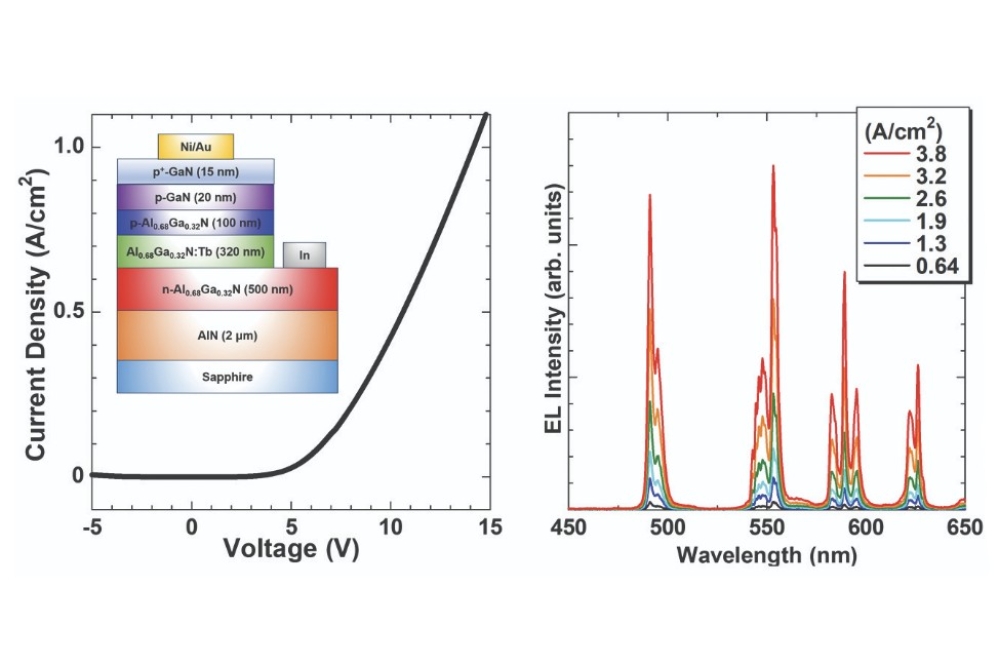
Researchers from the University of Osaka and Ritsumeikan University are claiming to have provided the first demonstration of electroluminescence from terbium-doped AlGaN-based LEDs.
This breakthrough could aid the development of monolithic microLEDs for displays, according to Shuhei Ichikawa from The University of Osaka.
Ichikawa points out that as conventional microLEDs rely on inter-band transitions, the emission colour is fixed after epitaxy – and the production of a full-colour display requires either a stacking of multiple emission layers or a lateral arrangement of sub-pixels.
“A major advantage of this terbium-doped AlGaN light-emitting diode is its ability to generate four colours solely through terbium-ion emission, eliminating the need for the complex integration structures typical of conventional microLEDs.”
Production of the team’s devices began by forming AlGaN-on-sapphire heterostructure in a Taiyo Nippon Sanso SR-200 MOCVD reactor. Devices were fabricated with terbium-doped layers with AlGaN compositions of Al0.36Ga0.64N, Al0.53Ga0.47N, Al0.59Ga0.41N and Al0.62Ga0.38N.
It is claimed that high-volume production of these devices would be no more challenging than that of conventional LEDs. “The terbium metal organic precursor has a melting point in the range of 40-80 °C; by controlling the bottle temperature, it can be maintained in a liquid state and used for bubbling in the same manner as conventional precursors,” argues Ichikawa.
According to secondary ion mass spectrometry, the terbium concentration in the active region slightly decreases from 2.0 x 1019 cm-3 to 1.5 x 1019 cm-3 as the aluminium content increases.
External quantum efficiency (EQE) of these novel emitters increases with aluminium concentration – it is just over 10 times higher for Al0.62Ga0.38N than Al0.36Ga0.64N. While an increase in aluminium concentration degrades the electrical properties, Tb3+ emission is much stronger, due to enhanced energy transfer from the alloy to the dopant.
These LEDs produce incredibly stable electroluminescent emission peaks at around 620 nm, 580 nm, 550 nm and 490 nm, due to 5D4 – 7FJ (J = 3,4,5,6) transitions.
With the addition of the terbium dopant, AlGaN LEDs produce sharp electroluminescent peaks at around 620 nm, 580 nm, 550 nm and 490 nm.
One option for realising single-colour emission from terbium-doped LEDs – a critical requirement for making full-colour displays – is to place bandpass filters over the devices. However, this is viewed as impractical, as it limits EQE. According to Ichikawa, a far better solution is to control the branching ratio: “Fortunately, the emission of all four visible colours is governed by the relaxation process from the same excited state of the terbium ion – the 5D4 state.”
There is a strong possibility that a single emission colour can be made to dominate, argues Ichikawa, by shortening the radiative lifetime. This could be accomplished by coupling a specific emission wavelength, with architectures involving plasmon resonance or resonant cavities. “It is known that in materials like terbium-doped glass, green emission becomes the dominant component.”
Efforts must also be directed at increasing EQE. Values for the latest devices are below 0.01 percent.
“Our group has already achieved a peak EQE approaching 10 percent with europium-doped GaN red LEDs; similarly, we anticipate significant EQE improvements in terbium-doped AlGaN through the optimisation of crystal growth conditions,” says Ichikawa.
He points out that with europium-doped GaN, the breakthrough came with co-doping with oxygen atoms. “I believe that developing a co-doping technique using different impurities will be the crucial factor for terbium-doped AlGaN as well.”
Reference
S. Yamazaki et al. Appl. Phys. Lett. 128 261112 (2026)