
Printed oxygen 'highways' shatter 2D transistor speed limit
Connecting 2D semiconductors like WS2 to traditional metal electrodes is a multidisciplinary nightmare. When metal touches these 2D sheets, it often creates a Schottky barrier 'resistance wall' that throttles electrical flow and generates wasted heat.
One approach is to use ultra-thin insulators to act as buffers, but those materials need to be less than 1nm thick to work. At that microscopic scale, even a tiny flaw in the manufacturing process can cause the entire device to fail.
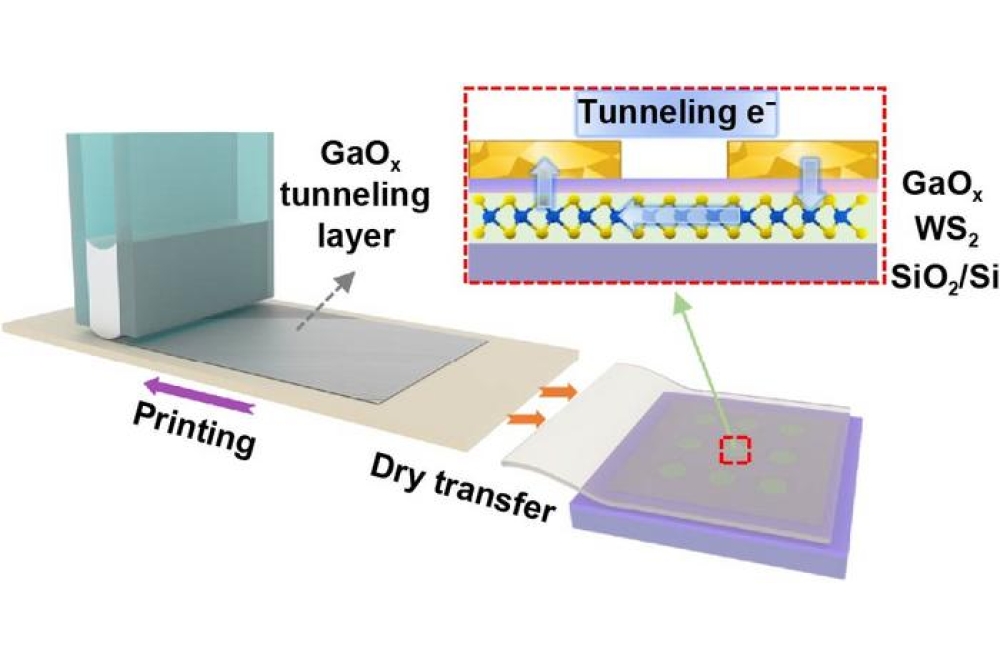
Now a Chinese team has used a room-temperature printing process to create a record-breaking electronic connection for 2D materials. By applying a 3.6nm-thick "skin" of gallium oxide GaOx between metal wires and a 2D WS2 semiconductor sheet, the researchers achieved an electron mobility of 296 cm2·V−1·s−1 – claimed to be the highest ever recorded for this type of material.
Published in the International Journal of Extreme Manufacturing, the new approach outlined in the paper 'Ultrathin GaOx tunneling contact for 2D transition-metal dichalcogenides transistor' significantly reduces the energy required to move electricity through a device, reaching a electrical barrier of just 3.7 meV.
Also, because this method uses liquid metal printing rather than high-heat industrial furnaces, it offers a factory-ready pathway to mass-producing electronics that are faster, cooler, and more energy-efficient than anything currently on the market, according to the researchers.
Shenghuang Lin and their co-workers at the Songshan Lake Materials Laboratory and Wuhan University of Technology have in effect embraced the 'defects' within their printed films. Their 3.6nm GaOx layer is thick enough to be durable but remains electrically 'transparent' because of its high concentration of oxygen vacancies - tiny microscopic gaps in the atomic lattice.
In a typical electrical connection, electrons are like travellers facing an impossible leap across a wide canyon. In this new GaOx layer, the oxygen vacancies act as molecular stepping stones. Electrons use a hybrid tunnelling mechanism, hopping from one vacancy to the next to cross the interface with almost no resistance.
The practical results of this mechanism are visible in the device benchmarks. The contact resistance, the measure of how much energy is lost at the connection point, was measured at 2.38 kΩ·μm, which is two orders of magnitude lower than traditional buffered contacts.
In a factory context, this means transistors can operate at much lower voltages without sacrificing speed. Furthermore, the team demonstrated the process is scalable by printing an array of over 30 devices on a single chip, with the resulting transistors maintaining stable performance for over three months in normal air without specialized protective packaging.
Next, the researchers plan to apply this room-temperature printing to large-scale, factory-grown semiconductor wafers to ensure consistent performance across entire production batches.