
Breaking the limits of OLED with chiral liquid crystals
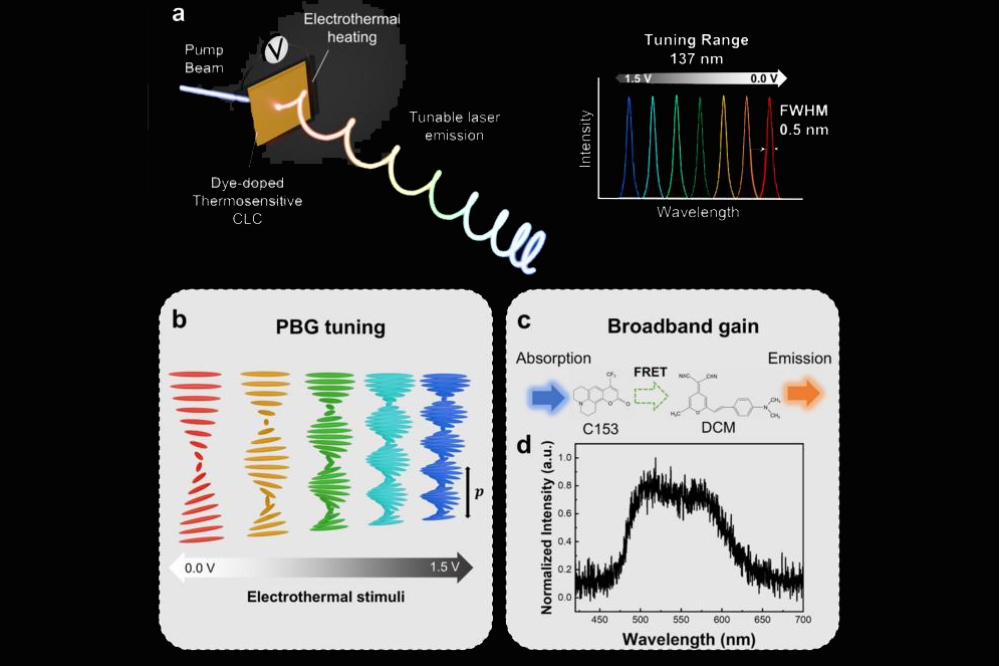
Researchers led by Su Seok Choi of the department of electrical engineering at Pohang University of Science and Technology (POSTECH) in Korea have demonstrated a next-generation laser emission platform capable of precise colour control under battery-level low voltage.
The study 'Low-Voltage Operating Multi-color Tunable Chiral Liquid Crystal Laser with Continuous and Broadband Emission From a Single Pixel' was published in Laser & Photonics Reviews in March 2026.
The clarity and purity of colour are fundamentally determined by how narrowly light is confined within a specific wavelength range, typically quantified by the full width at half maximum (FWHM) of the emission spectrum. Conventional OLED-based displays exhibit relatively broad emission spectra (FWHM ~40 nm), while even advanced quantum dot (QD) emitters remain around ~30 nm. These intrinsic spectral limitations restrict colour purity and pose critical challenges for emerging applications such as holographic and advanced AR/VR displays, which require laser-like ultra-narrowband (~1 nm) emission for precise optical wavefront and phase control.
In addition, existing display technologies rely on the colour mixing of discrete red–green–blue (RGB) emitters, leading to structural complexity and limited capability for continuous spectral tuning. Achieving both ultra-high colour purity and continuous wavelength tunability within a single device has remained a long-standing challenge.
To address these limitations, the research team introduced a novel photonic architecture that integrates OLED emissive materials with chiral liquid crystals (CLCs). The helically ordered structure of CLCs forms a periodic resonant cavity capable of selectively amplifying specific wavelengths. By coupling broadband OLED emission into this chiral resonant structure, the team successfully transformed it into laser-like emission with an ultra-narrow linewidth of approximately 1 nm (FWHM), achieving colour purity tens of times higher than that of conventional OLEDs.
Beyond spectral narrowing, the team also achieved continuous wavelength tunability within a single device. By employing an electrothermal actuation mechanism, small electrical inputs induce controlled thermal modulation of the CLC helical pitch, thereby shifting the resonance wavelength. Notably, this enables continuous colour tuning over a wide visible spectral range of approximately 135 nm under a low driving voltage below 1.5 V, overcoming the high-voltage limitations of conventional tunable laser systems.
Importantly, the proposed platform achieves this functionality within a single-pixel architecture. Unlike conventional displays that require multiple RGB subpixels, the device can generate a continuous spectrum of colours from a single emissive unit, significantly simplifying the device structure and enabling high integration density for future display and photonic systems.
The team says the work is notable in that it realises ultra-high-brightness emission together with low-voltage, colour-tunable vertical-cavity lasing — key attributes for next-generation display applications.
Potential applications include holographic displays, AR/VR and micro-displays, ultra-high colour gamut imaging systems, wavelength-tunable optical communications, biosensing, optical encryption, and next-generation photonic semiconductor devices for AI.
Choi commented: “By combining OLED materials with chiral liquid crystals, we have demonstrated laser-grade ultra-high colour purity emission and precise wavelength control at practical low voltages. This work establishes a new platform that could fundamentally transform the architecture of displays and optoelectronic devices.”
This research was supported by the Samsung Future Technology Foundation under its designated display research program.