
GaN: Boosting optical power converter efficiency
When electrical power is required, but it’s impractical to supply this via the mains or batteries, optical power converters provide an attractive alternative. It’s a technology that’s focused on GaAs and InGaP, but GaN has the upper hand on a number of fronts – and now boasts a power conversion efficiency of more than 60 percent, thanks to efforts at the Japanese optoelectronics trailblazer Nichia.
According to this team, one significant advantage of switching from traditional III-Vs to GaN and its related alloys is a superior temperature stability, both for the optical power-convertor and the source, which could be a GaN-based LED or laser diode. What’s more, GaN is well-suited to operation in harsh environments, such as aerospace, due to its high thermal conductivity and high radiation resistance.
Efforts to develop optical power converters can draw on the development of solar cells fabricated with the same material system. For GaN-based solar cells, InGaN/GaN multi-quantum wells are often used as the absorber, which must harvest a broad emission spectrum. With optical power converters, a key difference is the need to optimise absorption for a single wavelength.
For both optical power converters and solar cells, high light absorption must go hand-in-hand with a high fill factor – and for GaN-based devices, that’s challenging, because thick multi-quantum wells tend to degrade material quality and carrier transport. Another potential limitation is a contact resistance that is not low enough to maintain performance under high-intensity illumination. Due to these issues, prior to Nichia’s breakthrough, the highest reported power conversion efficiency for GaN optical power converters was about 43 percent, realised under a power intensity of just 5 mW cm-2.
To deliver a significant improvement in both these figures – and those for the fill factor and absorption efficiency – Nichia’s engineers have leveraged technology developed for high-power LED products. This included drawing on the company’s high-quality GaN epitaxial growth on sapphire substrates.
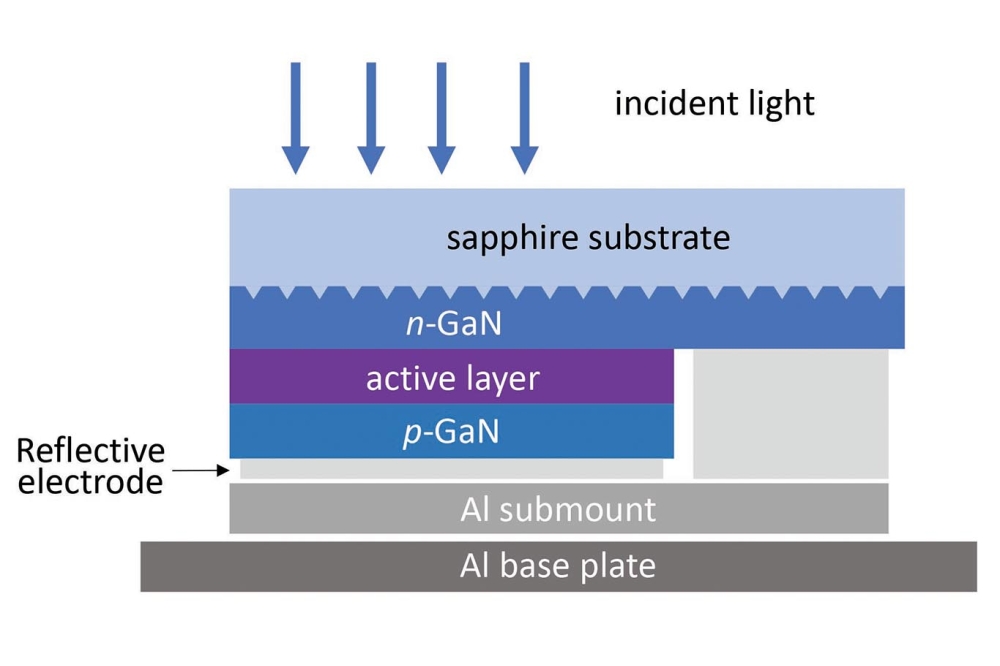
The optical power converter produced by Nichia is said to have a device structure similar to that of a high-power LED. At the heart of this converter, formed using MOCVD, is an active layer consisting of 60 pairs of 2 nm-thick In0.12Ga0.88N and 2.3 nm-thick GaN. This design, with an absorption edge around 420 nm, is chosen to balance absorption efficiency with high-quality epitaxial growth.
The optical power-converter chip, 1.4 mm by 1.4 mm in size, is flip-chip bonded to an AlN sub-mount with the reflective electrode on the rear facet, so that light is incident from the sapphire substrate side. No coating is applied to the light-incident facet. With this design, incident light may be internally reflected several times, aiding overall absorption.
Under a -2 V bias, the reverse-leakage current is as low as 20 nA cm-2, indicating good crystal quality. Based on the temperature dependence of the reverse-leakage current, Nichia’s engineers have concluded that trap-assisted, thermally activated carrier transmission is dominant.
Electro-optical measurements have determined that the external quantum efficiency peaks at around 80 percent at 400 nm. At shorter wavelengths, efficiency falls, due to increased absorption loss in n-type GaN; and at longer wavelengths reduced absorption in the active layer drags down efficiency.
Using an in-house 401 nm laser and an illumination intensity of 96 W cm-2, the fill factor is 86.2 percent and the power conversion efficiency 60.1 percent. Over the range of illumination intensity from 20 W cm-2 to 96 W cm-2, power conversion efficiency remains above 60 percent, peaking at 60.2 percent at 45 W cm-2.
Nichia’s engineers have also evaluated the temperature dependence of the power-conversion efficiency at an illumination intensity of 96 W cm-2. While this efficiency declines with temperature, it’s as high as 55.6 percent at 125 °C.
Based on reports of violet laser diode efficiencies of more than 45 percent, researchers claim that end-to-end transmission efficiencies of nearly 30 percent are feasible, using technologies well-suited to high-volume production.
Pictured above: The design of Nichia’s optical power converter is similar to that of a high-power LED.
Reference
H. Ogawa et al. Appl. Phys. Express 19 021009 (2026)