
Quinas links memory device physics to AI performance
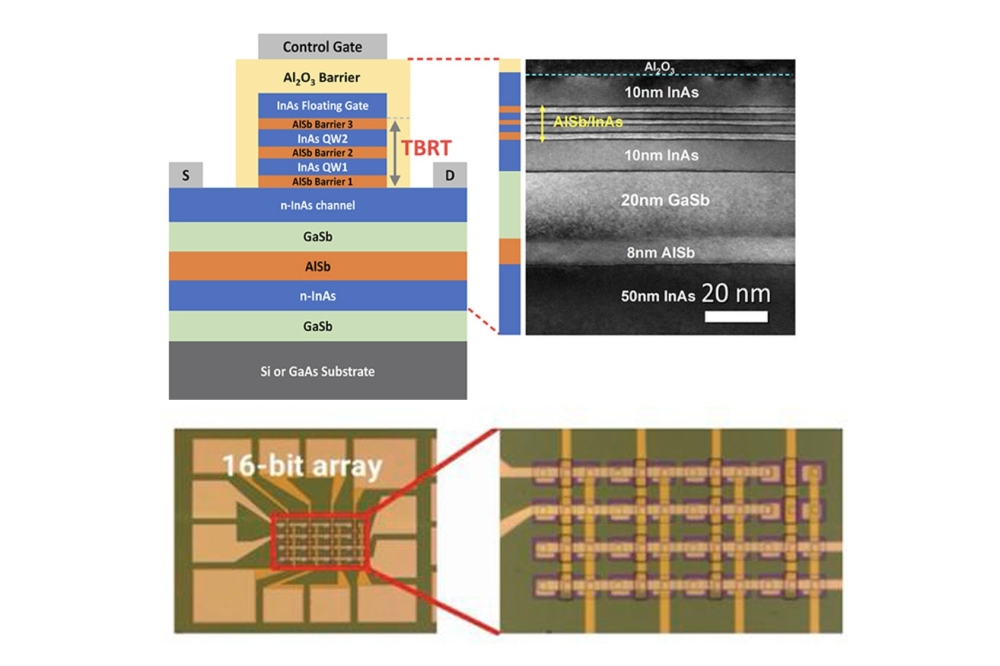
QuInas Technology, the UK developer of the compound-semiconductor memory technology ULTRARAM, has published new research in the Journal of Applied Physics that links device-level physics directly to AI system performance.
The paper 'Artificial synapse based on ULTRARAM memory device for neuromorphic applications' uses compact modelling and hardware-aware benchmarking to address a key limitation in how emerging memory technologies are typically evaluated. It demonstrates how ULTRARAM can be modelled and evaluated as a synaptic memory element for next-generation AI hardware.
The company will also present this work at the International Symposium on Quality Electronic Design (ISQED) 2026, in San Francisco from 8–10 April, focussing on system integration and design considerations, bringing ULTRARAM into the electronic design automation (EDA) and system design community.
Developed in collaboration with IIT Roorkee and Lancaster University, this new research introduces a physics-based compact modelling framework that links device-level behaviour — including resonant tunnelling and floating-gate charge dynamics — to circuit- and system-level performance.
This enables, for the first time, hardware-aware evaluation of ULTRARAM in neuromorphic and in-memory computing architectures, using crossbar array simulations and DNN+NeuroSim benchmarking on tasks such as CIFAR-10 classification.
“Much of today’s AI hardware research evaluates memory technologies under idealised assumptions,” said James Ashforth-Pook, CEO of QuInAs Technology. “This work takes a different approach — connecting real device physics directly to system-level performance. That’s essential if we are to build practical, energy-efficient AI systems.”
The research shows that ULTRARAM can achieve competitive accuracy while offering advantages in energy efficiency and area compared to conventional SRAM-based approaches, highlighting its potential as a platform for future AI hardware.
Lead author Abhishek Kumar added: “By integrating physics-based modelling with system-level benchmarking, we can better understand how emerging memory technologies behave in real AI workloads, rather than relying on idealised models.”
ULTRARAM is based on III–V compound semiconductor heterostructures and leverages resonant tunnelling to enable ultra-low energy switching and long data retention, positioning it as a candidate for neuromorphic and in-memory computing applications.