
Unlocking 29.76% efficiency for perovskite tandems
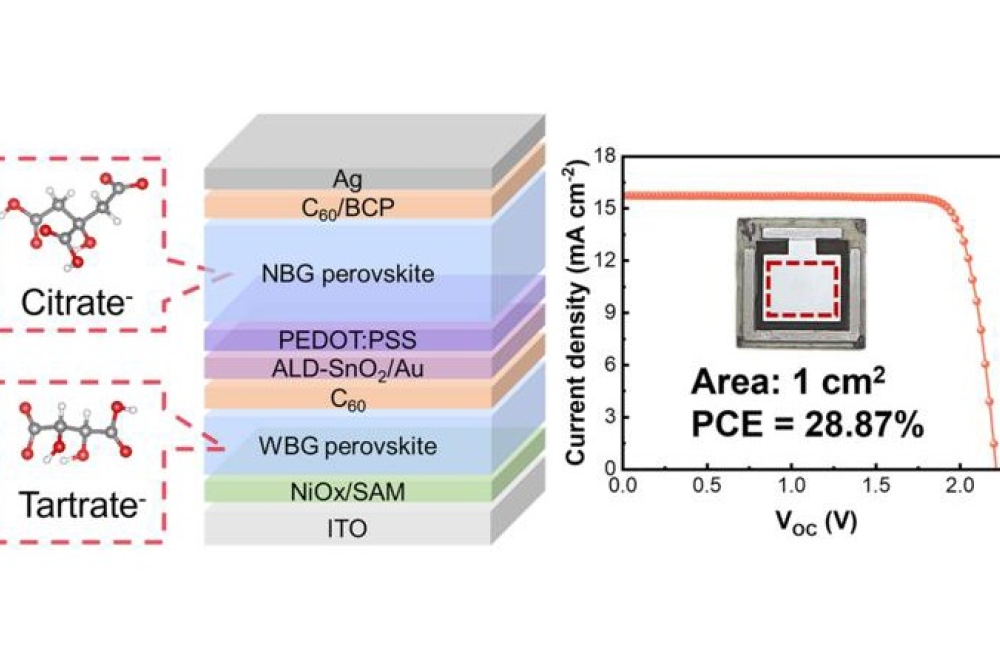
All-perovskite tandem solar cells (TSCs) hold great promise for next-generation photovoltaics, with a theoretical efficiency exceeding 40 percent. However, their practical performance is hampered by mismatched crystallisation kinetics between their wide-bandgap (WBG) and narrow-bandgap (NBG) subcells, leading to phase segregation and defect accumulation.
To address this challenge, a research group led by GE Ziyi and LIU Chang from the Ningbo Institute of Materials Technology and Engineering of the Chinese Academy of Sciences developed an innovative colloidal chemistry strategy to enhance the performance of these TSCs, achieving a power conversion efficiency (PCE) of 29.76 percent. The study was published in Joule on March 27 2026.
The researchers designed a unified carboxylate-based modulator system using two graded carboxylate anions—tartrate (Ta-) and citrate (Cit-)—to precisely regulate the nucleation dynamics of the two subcells.
In the WBG subcell, Ta- stabilises Pb2+ coordination, suppressing phase segregation and promoting uniform crystal growth. Cit-, meanwhile, optimises Sn-I bonding in NBG colloids, passivating (turning off) Sn2+ defects and enhancing charge transport. Choline cations further synergise with these modulators, passivating undercoordinated metal ions at crystal-colloid interfaces to form a robust stabilisation matrix.
With this integrated strategy, the optimised tandem device achieved an impressive PCE of 29.76 percent, with a certified value of 29.22 percent. The device also demonstrated strong operational stability, retaining more than 90.2 percent of its initial efficiency after 700 hours of continuous operation under maximum power point tracking.
Notably, the 1 cm2 large-area tandem cell delivered a high PCE of 28.87 percent, highlighting the scalability of the colloidal chemistry strategy.
The researchers note that this work provides a universal approach to harmonise multijunction crystallisation, paving the way for the commercialisation of high-efficiency all-perovskite tandem solar technologies.
The study was supported by the National Key Research and Development Program of China, the Young Scientists Fund of the National Natural Science Foundation of China, and the National Natural Science Foundation of China, among others.