Solar module generates 326 W per square metre
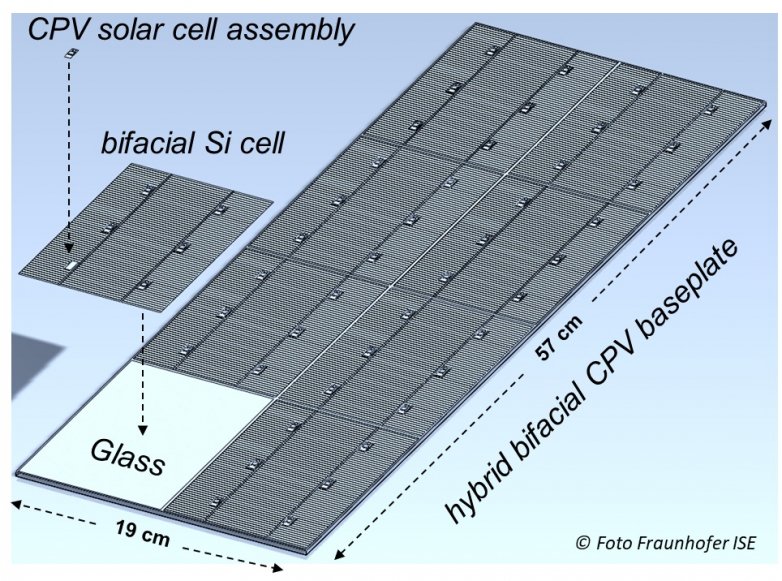
Fraunhofer ISE team's hybrid bifacial high-concentration photovoltaic module (HCPV) combines silicon, lenses and III-V triple junction cells
Researchers at Germany’s Fraunhofer ISE have established a hybrid bifacial high-concentration photovoltaic module (CPV) which they declare can reach a power output of as much as 326 W/m2.
The module, called EyeCon, is manufactured by applying silicone-on-glass Fresnel lenses with an aperture of 47.6 mm × 47.6 mm in a 4 × 12 lens array and III‐V triple‐junction solar cells onto the front surface of p‐PERC bifacial crystalline silicon cells. “Such hybrid modules use lenses and multijunction cells to concentrate and convert direct normal irradiance (DNI) while absorbing diffuse and scattered sunlight with an integrated Si solar cell,” the scientists explained.
They also said that the module concentration ratio was raised to 321x and that the absorption of diffuse irradiation was also increased by enabling the rear side of the Si cell to absorb light hitting the glass baseplate of the module.
The silicon solar batteries were interconnected and laminated through standard industrial procedures, while the installing and affiliation of the CPV solar batteries were done with pick-and-place and ultrasonic heavy-wire bonding methods.
The outside characterisation of the module was conducted on the dual-axis solar tracker of the research institute in Freiburg, southern Germany. “We show with outdoor measurements that the power output of the bifacial EyeCon module reaches up to 326 W/m2 when the direct to worldwide irradiance ratio is 92 percent,” said the researchers.
According to the scientists, the results of the experiments show that the silicon cell generates between 23 and 42 W/m2 of extra power when the scattered irradiance part increases from 8 percent to 30 percent. This represents a power increase in between 7.6 percent and 19 percent over traditional CPV modules.
The EyeCon module is described in the paper 'Development and outside characterisation of a hybrid bifacial HCPV module', published in Development in Photovoltaics.
Compared to standard CPV modules, which just take into consideration the direct light, hybrid CPV modules have lower effectiveness. Their power output by area, nevertheless, is higher because they harvest not only direct but also diffuse and rear side irradiation. Therefore, the concept attains the highest power per square meter of any PV innovation today.