Hammer-on technique for atomic vibrations in a crystal
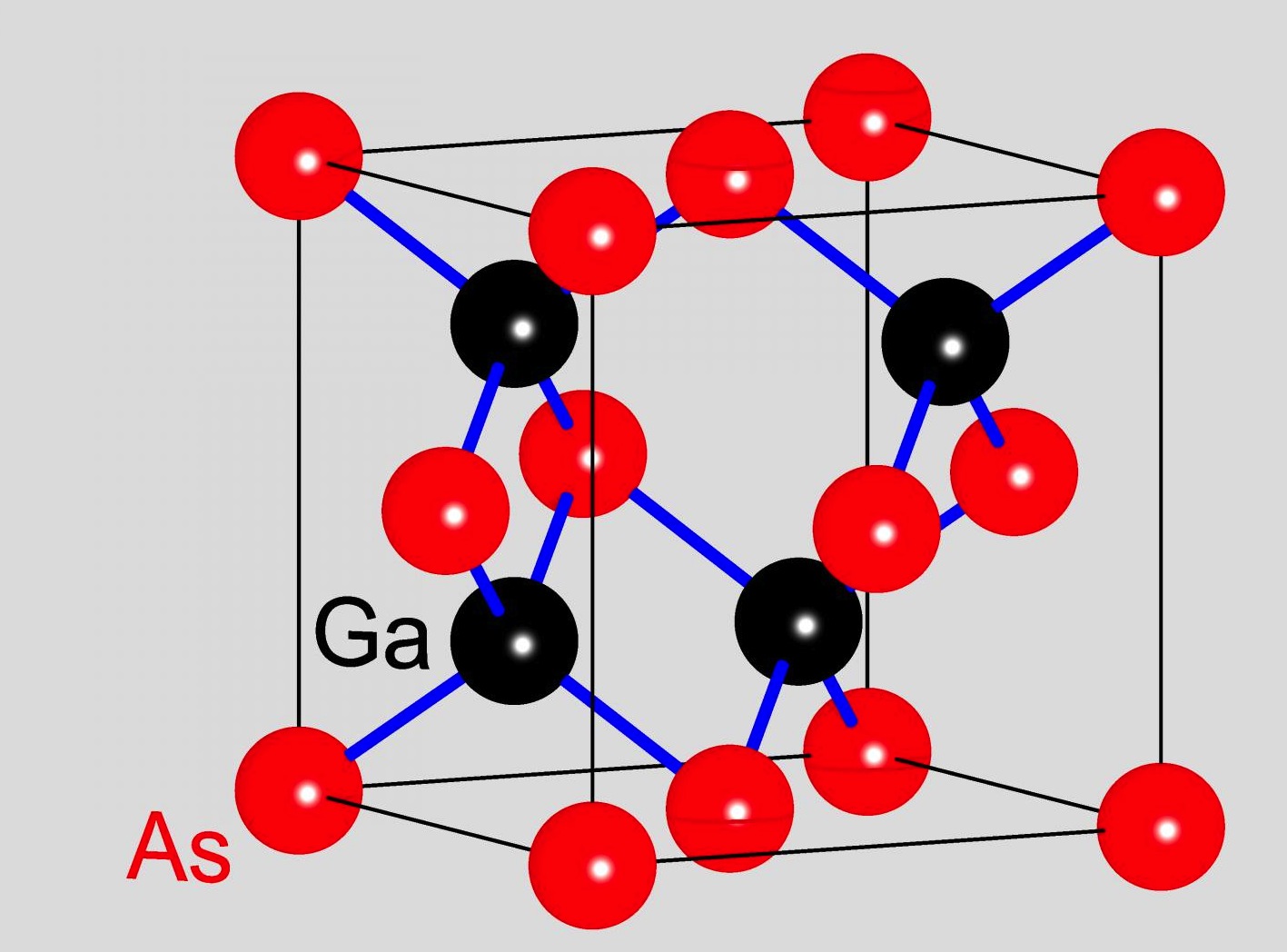
Researchers show how vibrations of atoms in a crystal of GaAs are impulsively shifted to a higher frequency by an optically excited electric current
To hammer-on a guitar, a technique deployed by many rock guitarists, means to shorten a vibrating string quickly with a second finger and, thus, switch to a higher tone. This technique allows for faster playing and legato, a smoother linking of subsequent tones.
Researchers from Berlin and Paris have now demonstrated a hammer-on analogue in crystals by switching the frequency of atomic motions with an impulsively generated electric current. As they report in the most recent issue of the journal Physical Review Letters, an electric current generated by femtosecond optical excitation shifts particular lattice vibrations, the transverse optical (TO) phonons, to a higher frequency.
The crystal lattice of GaAs consists of a regular arrangement of gallium and arsenic atoms (Fig. 1 above) held together by covalent chemical bonds. The atoms in the lattice can undergo a variety of vibrations, among them the TO phonon with a frequency of 8 THz = 8 000 000 000 000 vibrations per second. The electron density on the arsenic atoms is somewhat higher than on the gallium atoms, leading to a local electric dipole moment and making the crystal lattice electrically polar. This property makes the vibrational motion susceptible to electric forces.
In the experiments, a first femtosecond optical pulse launches a TO phonon oscillation, which is disturbed by a second pulse exciting electrons from the valence to the conduction band of the semiconductor. This excitation is connected with a shift of local charge, i.e., a so-called electric shift current. The shift current enhances the electron density on the gallium atoms. This change in the crystal's electron distribution leads to a transient electric polarization, which generates an electric force and, thus, acts back on the TO phonon motion. As a result, the TO phonon frequency in the excited crystal changes by a small amount.
The measurement of the tiny phonon frequency shift represents a big experimental challenge. In the present study, the TO phonon oscillation was mapped in real-time via the THz wave radiated from the oscillating phonon dipole moment. The THz wave was measured in amplitude and phase with extremely high precision (Fig. 2 below).

The radiated THz wave displays a frequency up-shift after the second pulse has interacted with the sample. The frequency shift is obvious from the slightly shorter oscillation period of the THz wave (red trace in Fig. 2) compared to the case without the second pulse (black trace). The up-shift of the TO phonon frequency has a value of 100 GHz or approximately 1 percent of the initial frequency. An analysis of the experimental results shows that one photo-excited electron in a crystal volume of 20 000 GaAs unit cells induces the one-percent frequency up shift.
The change of TO phonon frequency observed here for the first time should also occur in a wider range of semiconductors with a polar lattice and in ferroelectric materials.
'Frequency upshift of the transverse optical phonon resonance in GaAs by femtosecond electron-hole excitation' by A. Ghalgaoui, et al; Phys. Rev. Lett. 125, 027401 (2020).