Researchers make Valley-Hall nanoscale lasers
Scientists demonstrate room-temperature low-threshold lasing from a cavity mode hosted within the topological bandgap of the structure
In a new paper published in Light Science & Application, a team of scientists, led by Yuri Kivshar from the Australian National University and Hong-Gyu Park from the Korea University, and co-workers have implemented nanophotonic cavities in a nanopatterned InGaAsP membrane incorporating III-V semiconductor quantum wells.
The nanocavities exhibit a photonic analogue of valley-Hall effect. Researchers demonstrated room-temperature low-threshold lasing from a cavity mode hosted within the topological bandgap of the structure.
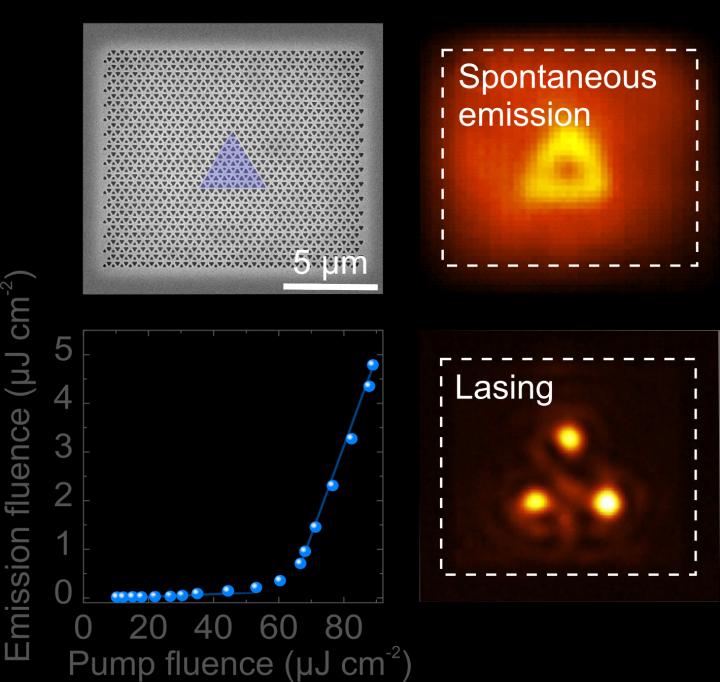
The SEM image of the fabricated structure and experimental results are shown above. The cavity is based on the closed valley-Hall domain wall created by inversion of staggering nanoholes sizes in a bipartite honeycomb lattice. In the topological bandgap frequency range, the cavity supports a quantised spectrum of modes confined to the domain wall. The images show real-space emission profiles below and above the threshold.
The scientists explain: "In experiment, we first observe spontaneous emission from the cavity. The emission profile shows the enhancement along the entire perimeter of the triangular cavity associated with edge states. When increasing a pump power, we observe a threshold transition to lasing with a narrow-linewidth where the emission gets confined at the three corners."
When two spots are isolated, coherence of the emission is confirmed by interference fringes observed in the measured far-field radiation patterns. An isolated corner emits a donut-shaped beam carrying a singularity. These findings make a step topologically controlled ultrathin light sources with nontrivial radiation characteristics. The researchers forecast:
"The proposed all-dielectric platform holds promise for the versatile design of active topological metasurfaces with integrated light sources. Such topological nanocavities has vast potential for advances in nonlinear nanophotonics, low-power nanolasing and cavity quantum electrodynamics".
'Room-temperature lasing from nanophotonic topological cavities' by Daria Smirnova et al; Light: Science & Applications volume 9, Article number: 127 (2020)