
Mind the (band) gap ...
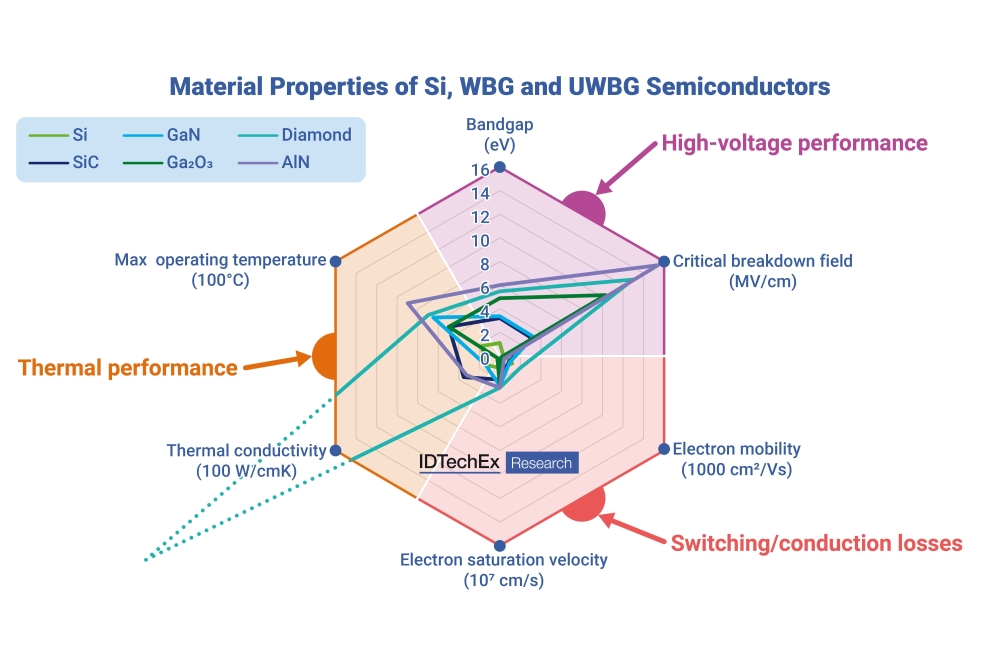
As part of IDTechEx's report 'Power Electronics Market 2026-2036: Data Centers, Electric Vehicles, and Renewables', the market research company has looked at how ultra-wide bandgap devices (UWBGs) will disrupt the landscape.
UWBGs have so far received much less attention than their wide bandgap counterparts, and are much earlier in development, with only early device prototypes available for a limited number of materials.
IDTechEx has done SWOT analyses on UWBG semiconductor materials and is in contact with key players across the three main UWBG materials: Ga2O3, AlN, and diamond.
While all three have the potential to offer advantages over incumbent materials, especially in terms of high-voltage or extreme-environment performance, all three have drawbacks.
Doping AlN effectively has proved challenging (though polarisation-doping could be an effective solution here). Ga2O3 has very low thermal conductivity. Growing single-crystal diamond to the wafer sizes suitable for commercial power electronics applications is difficult and expensive.
They each also have key commercial drivers: Ga2O3's relatively straightforward manufacture from melt; AlN's route to commercialisation through optoelectronics; and diamond's superior material properties.
As such, it remains unclear which material, if any, will "win" the UWBG race, says IDTechEx. However, what is clear is that all three are still a long way from large-scale commercialisation. Ga2O3', with device prototypes, might be the closest, but even players in this space do not expect commercialisation for at least the next five years.
It is also clear, says IDTechEx, that the cost premiums associated with these materials will prevent them from taking over the wide bandgap space. They are more likely to further complement WBGs in extreme and niche applications, such as in aerospace, where the performance improvements justify higher costs.