Researchers create SiC colour 'recipe book'
Researchers from Friedrich Alexander University and the Max Planck Institute in Erlangen, Germany have created a list of "˜recipes' physicists can use to create specific types of defects with desired optical properties in SiC.
In one of the first attempts to systematically explore colour centres, the group used proton irradiation techniques to create the colour centres in SiC. They adjusted proton dose and temperature to find the right conditions that reliably produce the desired type of colour centre. The team reports its findings in Applied Physics Letters, from AIP Publishing.
Atomic defects in the lattice of SiC crystals create colour centres that can emit photons with unique spectral signatures. While some materials considered for quantum computing require cryogenically low temperatures, colour centres in SiC can emit at room temperature. As the push to create increasingly smaller devices continues into atom-scale sensors and single-photon emitters, the ability to take advantage of existing SiC integrated circuit technology makes the material a standout candidate.
To create the defects, Michael Krieger and his colleagues bombarded SiC samples with protons. The team then let the SiC go through a heating phase called annealing. "We're doing a lot of damage to these crystals," Krieger said. "However, during annealing, the crystal structure recovers, but defects are also formed - some of them are the desired colour centres."
To ensure that their recipes are compatible with usual semiconductor technology, the group opted to use proton irradiation. Moreover, this approach doesn't require electron accelerators or nuclear reactors like other techniques used to create colour centres.
The data from using different doses and annealing temperatures showed that producing defects in SiC follows a pattern. Initially protons generate predominantly silicon vacancies in the crystal, then those vacancies sequentially transform into other defect complexes.
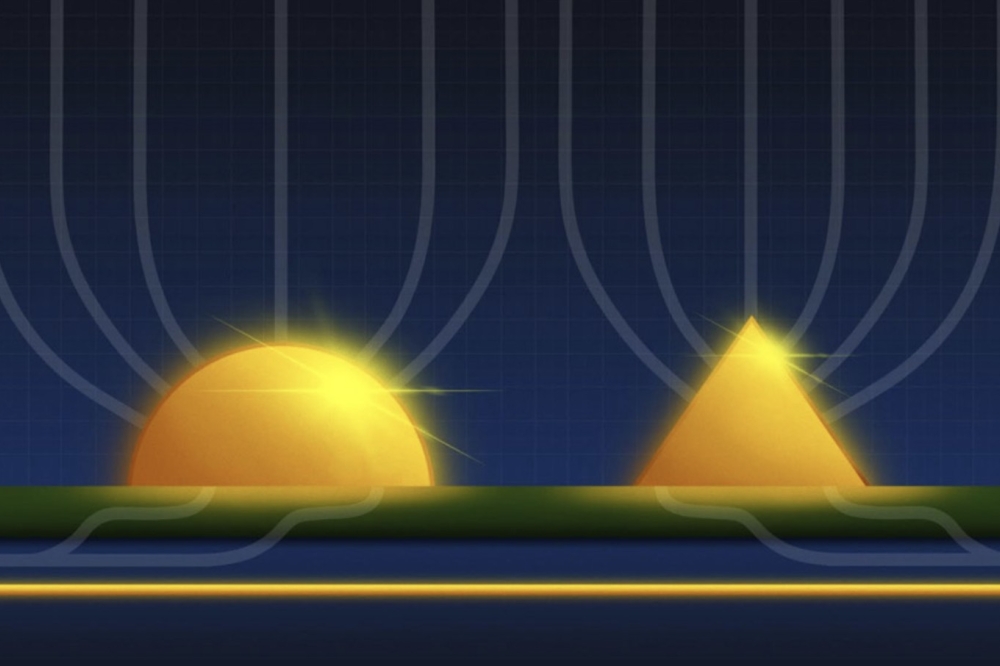
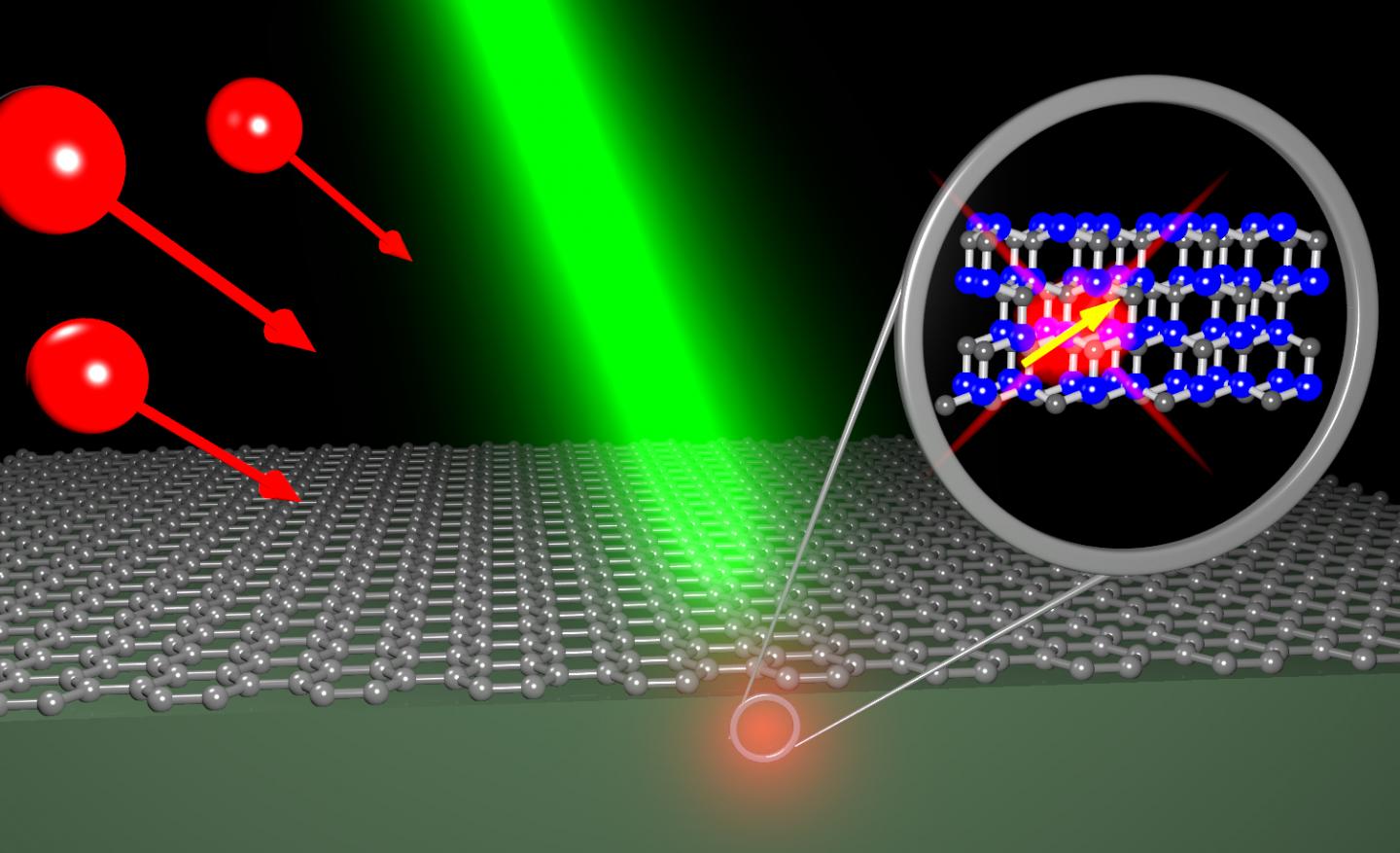
The picture above shows a green SiC substrate at the bottom with the graphene layer on top irradiated by protons, generating a luminescent defect in the SiC crystal.
Studying the defects' low-temperature photoluminescence spectra led the team to discover three previously unreported signatures. The three temperature-stable (TS) lines were shown to correlate with proton dose and annealing temperature.
Krieger said these TS lines have exciting properties and further research is already going on as the group hopes to use and control those defects for use in SiC-based quantum technology devices.
"˜Controlled generation of intrinsic near-infrared colour centres in 4H-SiC via proton irradiation and annealing' by Maximilian Ruehl et al; Applied Physics Letters Sept. 18, 2018