
Protecting perovskite against the environment
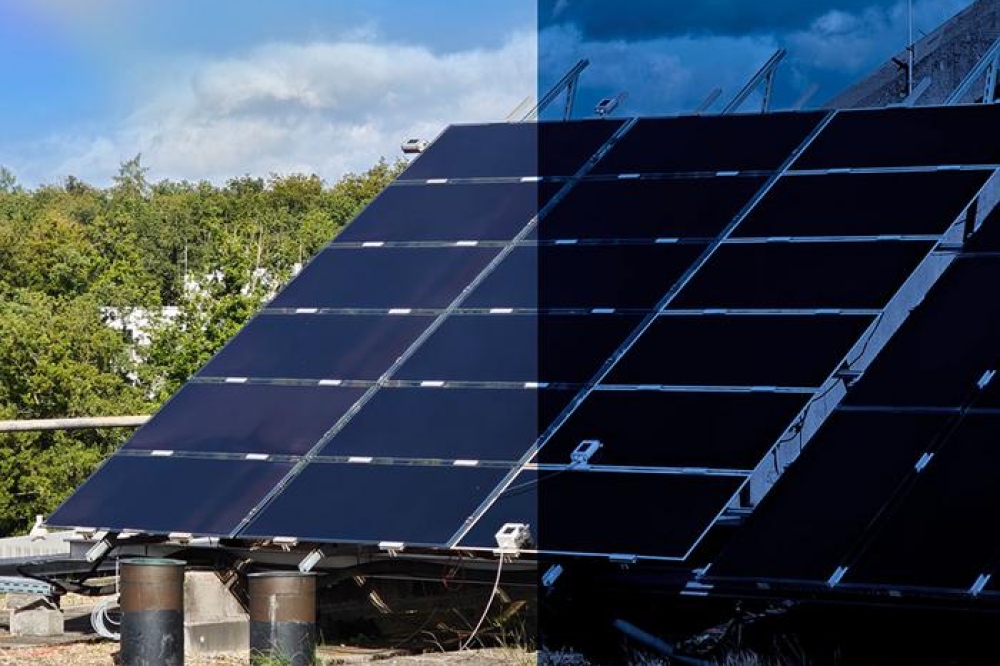
A team from the University of Stuttgart, together with researchers from China, Germany, the UK, Spain, Italy, and Switzerland, has succeeded in enhancing both the efficiency and environmental resilience of perovskite solar cells. They say this is another important step towards the application of a technology that holds great promise for photovoltaics.
The results 'Photoswitchable isomers to improve grain boundary resilience and perovskite solar cells stability under light cycling' were published in Nature Energy.
"We have recently achieved significant advances in protecting perovskite solar cells against light, heat, moisture, and mechanical stress. But operating them reliably under changing environmental conditions is still a challenge," says Michael Saliba, head of the Institute for Photovoltaics (IPV) at the University of Stuttgart.
By making the material more robust, the international team believe they have moved substantially closer to achieving this goal.
Their research focuses on perovskites based on triple cations, a combination of methylammonium, formamidium, and cesium. “Triple-cation perovskites are considered by many experts a gold standard because they combine high efficiency with long-term stability while being reproducible,” explains Saliba, who was the first to discover and systematically research these material compositions in 2016.
Perovskites are also of particular interest because their unique geometry makes them highly 'tuneable' meaning that their properties can be precisely adjusted through targeted modifications.
Light-switchable molecules for protecting grain boundaries
"Further advances are required to commercialise these perovskites and establish them as a reliable alternative to silicon semiconductors,” says Saliba. "To achieve this, we apply minor adjustments that produce major effects." Grain boundaries act as one of these fine-tuning points. They can be likened to the joints between paving stones: Essential for holding the structure together, yet most vulnerable to environmental stress. This instability under combined heat, light, and moisture represents the critical weakness of perovskite materials.
“Stabilising the grain boundaries stabilises the entire solar cell,” explains Weiwei Zuo, one of the co-authors from ipv. To achieve this stabilisation, the researchers introduced specialised light-switchable molecules into the grain boundaries, which alter their shape in response to light. This allows them to be dynamically regulated and used as a buffer that absorbs tension in the material.
To test the improved material, the research team simulated real-world stress scenarios in the lab that typically occur under fluctuating daylight conditions and environmental influences. The experiments demonstrate that perovskite solar cells stabilised with light-switchable molecules retain over 95 percent of their initial performance and achieve an efficiency of approximately 27 percent, even after two hours of continuous UV exposure at 65 °C and 600 temperature cycles ranging from –40 °C to +85 °C. “Our new material design increases the operational stability and lifespan of perovskite solar cells while maintaining competitive performance, making them even more suitable for practical applications,” explain Saliba and Zuo.
Reference
Zhang, Z., Zhu, R., Li, G. et al. Nature Energy (2026)