
Vitrealab and Brilliance to work together on AR
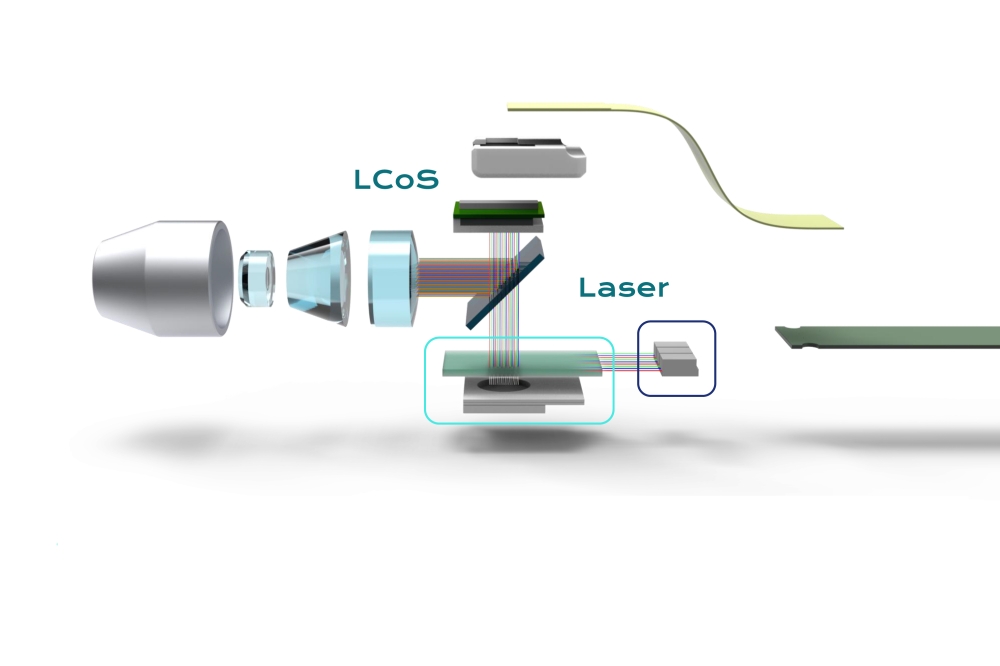
Vitrealab, an Austrian developer of photonic integrated circuits (PICs) for laser–LCoS- based AR light engines, and Brilliance, a Netherlands manufacturer of RGB laser chips for AR smart glasses, have announced a collaboration to explore new approaches in laser illumination for augmented reality (AR).
They aim to create more compact, efficient, and high- performance display systems for the next generation of AR smart glasses and related applications.
The cooperation will include joint R&D, prototype demonstrations, and coordinated commercialisation efforts. While the primary focus is AR smart glasses, the companies say that the technology has broader relevance for automotive head-up displays, portable projection, and other compact optical applications.
The technical core is the integration of Brilliance’s proprietary RGB laserchip Neptune into Vitrealab’s Quantum Light Chip. Brilliance’s laser diode coupling technology is said to ensure efficient injection of coherent light into miniature optical systems while maintaining stability and polarisation. At the same time, it reduces the number of optical elements.
Vitrealab’s PIC technology then guides this laser light with minimal losses, distributing it into arrays of beams with uniform intensity, precise divergence angles, and high beam quality. This combination makes it possible to preserve polarisation throughout the system, according to the companies, which is critical for efficient LCoS modulation, while also achieving high brightness and optical uniformity across the display field.
The result is a laser illumination source that addresses one of the key bottlenecks in AR optics: how to achieve wide fields of view, high brightness, and low power consumption in a form factor small enough to fit into lightweight smart glasses. The approach is inherently scalable, as both laser diodes and photonic integrated circuits can be manufactured in volume, making this technology a strong candidate for future consumer-grade AR products.
“In response to customer requests for smaller light engines, we decided to pursue a compact design and join forces with Brilliance,” said Jonas Zeuner, CTO of Vitrealab. “This joint technical solution is highly customisable and will allow our partners to significantly enhance their light sources and optimise the design specifications of existing LCoS light engines.”
“Vitrealab’s innovations in light-engine technology complement our mission to deliver high-quality and compact RGB laser solutions for AR glasses,” said Tim Tiek, CEO of Brilliance. “This cooperation gives us the opportunity to accelerate development and bring practical, efficient display systems to market.”