
AlScN: A nitride for computation?
The novel ternary AlScN enables a silicon-compatible, wake-up-free ferroelectric memory for next-generation AI hardware.
BY MINGRUI LIU, XIAOJUAN SUN AND DABING LI FROM STATE KEY LABORATORY OF LUMINESCENCE SCIENCE AND TECHNOLOGY, CHANGCHUN INSTITUTE OF OPTICS FINE MECHANICS AND PHYSICS, CHINESE ACADEMY OF SCIENCES
Due to rapid advances in AI, the traditional computing architectures, which separate storage and computation, are facing critical speed and power bottlenecks. The latter is not helped by frequent data migration between processors and memory, accounting for more than 60 percent of total power consumption, while energy efficiency for actual computation remains below 10 percent.
Note that we literally do far better. By utilising synaptic networks for information transmission and processing, our brains provide highly parallel storage and computation. This leads to advanced intelligence, far surpassing that of computers, with a power consumption of just 20 W. Imagine if computer memory could emulate neural synapses – such a breakthrough would revolutionise the global electronics industry.
Offering much promise on this front are ferroelectric materials. Featuring electric-field-tuneable polarisation, ferroelectrics enable information writing via electrical pulses, and non-volatile storage/computation through remanent polarisation. And they have another key asset, multi-domain state regulation, that enables high-precision linear conductance modulation, and ultimately multi-level storage, closely mimicking synaptic weight updates in biological learning. These strengths ensure that ferroelectrics are an ideal platform for energy-efficient neuromorphic devices.

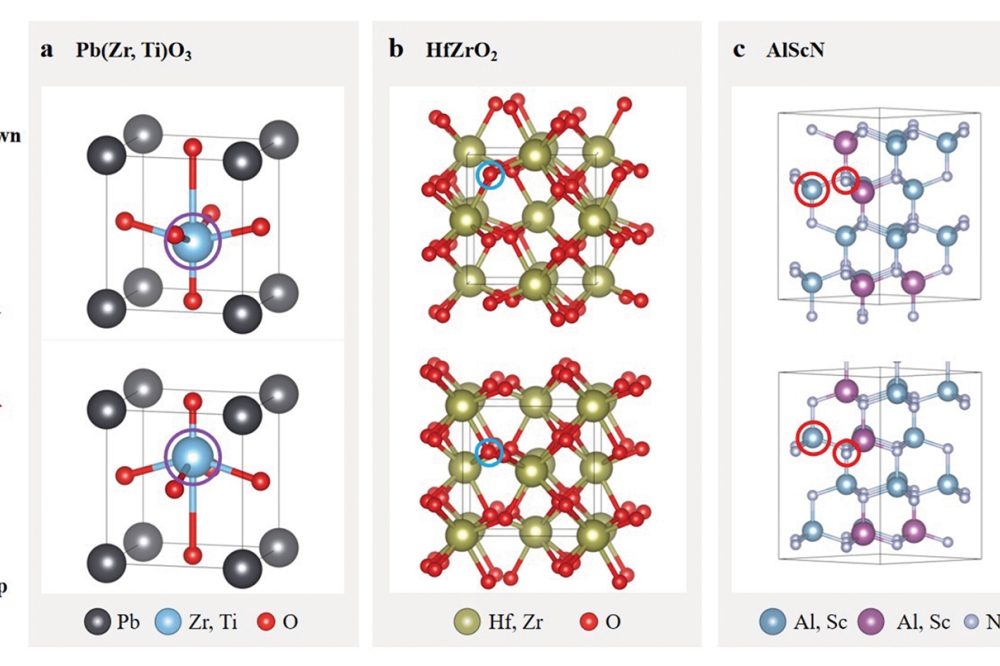
Figure 1. (a) In ABO3-type perovskite ferroelectrics represented by Pb(Zr,Ti)O3,
polarisation reversal involves the movement of B-site atoms. (b) In
hafnium-based ferroelectrics, polarisation reversal involves the
movement of oxygen atoms. (c) In wurtzite nitride ferroelectrics
represented by AlScN, polarisation reversal involves the simultaneous
movement of nitrogen and metal atoms.
Why wurtzite ferroelectrics?
Unfortunately, most ferroelectrics are oxides. This makes them challenging to integrate into mainstream semiconductor platforms. But there’s hope, with recent advances in wurtzite-structured ferroelectric nitrides providing new opportunities to overcome this dilemma. This class of materials breaks new ground by combining a compatibility with silicon platforms with: enhanced remanent polarisation, a key metric that is 2-6 times higher than that for HfO2 or perovskite ferroelectrics; sustainable thickness scaling; a high Curie temperature of more than 1100 °C; and a stable ferroelectric phase.
Although the discovery of wurtzite nitride ferroelectrics has promise, there are concerns, related to high coercive fields that result in an increased switching voltage and degraded endurance and ‘wake-up effects’ – they cause devices to require repeated electrical cycling to reach peak performance.
The root cause of these issues lies in microscopic domain evolution, as the polarisation direction of these ferroelectrics is governed by the stacking order of the metal and nitrogen atoms. Unlike oxide ferroelectrics, where polarisation reversal involves a more straightforward single-atom movement, simultaneous motion of metal and nitrogen atoms is required. This leads to larger energetic switching barriers, manifesting as wasted power and operational instability. Due to this, it is critical to clarify real-time domain dynamics under external electric fields and manipulate, at low fields, the motion of the domain walls – they are the boundaries between oppositely polarised regions.
Our team at the Chinese Academy of Sciences has addressed these challenges in wurtzite ferroelectrics by focusing on real-time domain wall motion in representative Al0.75Sc0.25N films. Our primary tools are dark-field transmission electron microscopy and first-principles simulations.
We have found that under the same bias, the transverse motion of the domain wall (perpendicular to the c-axis [0001] direction) invariably precedes the longitudinal motion (along the c-axis), due to a 98 percent reduction in energy barriers. This is a game-changing finding, fundamentally breaking the traditional ferroelectric switching model and providing a new framework for polarisation reversal in complex lattice systems.
Based on our observations, it is possible for high-domain-wall-density AlScN, ideally with a mixed polarity penetrating the entire film, to realise polarisation reversal through transverse motion of the domain wall. However, single-polarity films need additional reversed-domain nucleation and longitudinal motion with higher energy barriers, thereby exhibiting high coercive fields and wake-up behaviour.
This is an exciting discovery. It implies that a promising pathway for reducing the overall polarisation reversal energy of wurtzite ferroelectrics is to maximise lateral domain wall movement while suppressing longitudinal migration.

Figure 2. Top: The energy barriers of the transverse and longitudinal
motions of the domain wall calculated by first principles simulations.
Bottom left: Contour plots of the domain wall motion versus time,
integrated differential phase contrast scanning tunnelling electron
microscopy images of the dark (N polarity) and light (metal polarity)
regions. Bottom right: Regulation of wake-up effect and the coercive
electric field.
Engineering the breakthrough
Guided by the underlying mechanism, we have cut the overall energy cost by promoting the transverse motion of domain walls, realised by regulating the mixed polarity penetrating the entire film. This strategy delivers a 25 percent reduction in the coercive field strength while maintaining a high remanent polarisation and completely eliminating wake-up effects across 150 mm-diameter films. To the best of our knowledge, these results are setting a new benchmark for ferroelectric properties and crystal quality.
Our work establishes a universal framework for optimising polarisation switching in wurtzite ferroelectrics. It is a particularly timely advance, offering a solution for addressing the growing demand for energy-efficient computing architectures in the AI era, and providing a clear pathway from fundamental research to industrial applications in memory, logic, and sensing devices.
It’s worth noting that ferroelectric domain walls have been regarded as nanoscale functional interfaces, exhibiting reduced dimensionality and a different symmetry from the host material. Due to this, they give rise to physical properties that do not exist in the surrounding uniformly polarised domains.
We will now pivot our research, switching our focus to harnessing conductive domain walls as programmable functional elements that could enable precise control over multi-level resistance states and emulate memristive behaviours that are critical for neuromorphic computing. Success will not only pave the way for sub-nanometre device scaling, but also revolutionise integration, by merging memory and computation at the atomic interface. By leveraging domain wall conductivity for synaptic weight modulation, we foresee a new generation of ultra-dense neuromorphic architectures – they could finally bridge the gap between traditional systems and biological brain efficiency. The ability to engineer intelligent nanointerfaces may well define the next frontier in post-Moore’s-law electronics.