
Scientists reveal fully solvent‑free perovskite PV tech
An international team of researchers has developed a multi-source co-evaporation recipe that markedly enhances the crystal quality of vacuum-deposited perovskite films. They reported the breakthrough in Nature Materials in the paper 'Crystal-facet-directed all-vacuum-deposited perovskite solar cells.
They say that the advance brings all vacuum-deposited single-junction perovskite cells as well as perovskite-on-silicon tandem solar cells closer to scalable production.
The researchers include scientists from Hong Kong University of Science and Technology (HKUST) led by Lin Yen-Hung in the Department of Electronic and Computer Engineering (ECE), a group at the University of Oxford led by Henry Snaith in the Department of Physics, Eurac Research, and Université Grenoble Alpes in partnership with the French Alternative Energies and Atomic Energy Commission (CEA).
Today’s highest-performing perovskites are often made from solution 'inks', while many industrial thin-film products (from OLED displays to optical coatings) are produced by vacuum deposition — a clean, solvent-free process that can coat large areas very uniformly. However, when perovskites are fabricated entirely by vacuum deposition, the crystals can form in less-than-ideal ways, leaving the films more defect-prone and significantly unstable.
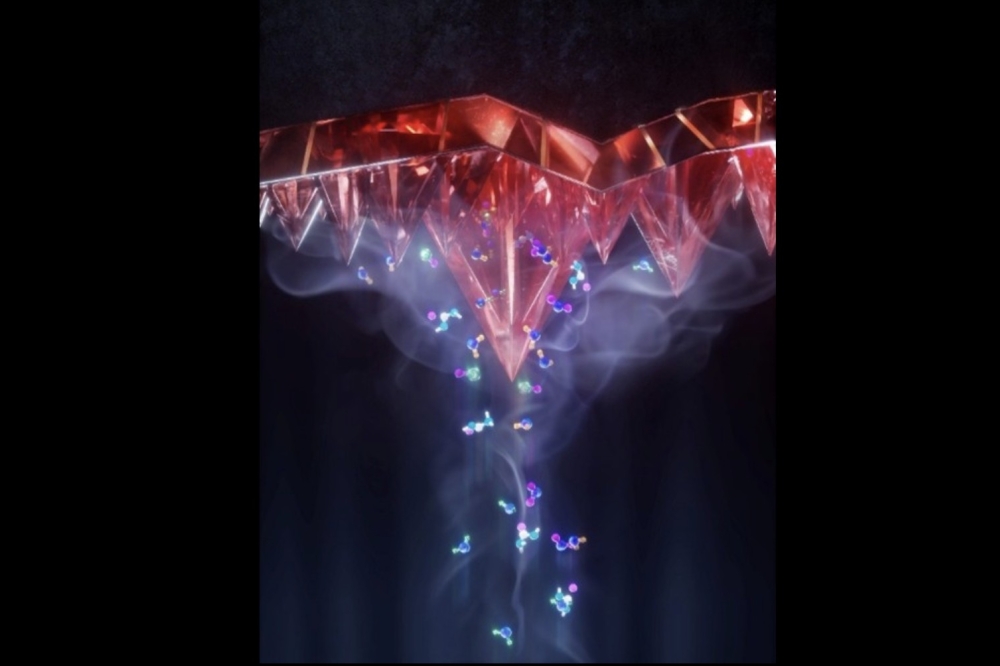
The team found that introducing a PbCl2 'co-source' during thermal co-evaporation can effectively direct how the perovskite crystals grow. The approach yields a highly ordered wide-bandgap perovskite (1.67 eV) with many grains aligned in a (100) 'face-up orientation, which is a hallmark of a more crystalline film that better resists light- and heat-driven degradation, resulting in improved optoelectronic properties and stronger stability under light and heat stressors.
Using this new deposition recipe, the team achieved the first certified performance for an all-vacuum-deposited wide-bandgap perovskite solar cell, reaching a maximum-power-point-tracked power conversion efficiency of 18.35 percent on a 0.25 cm2 device. In the lab, the cells achieved 19.3 percent efficiency and delivered 18.5 percent on the more challenging 1 cm2 cell size.
To test durability, the team followed the International Summit on Organic Photovoltaic Stability (ISOS) protocol. Under the stringent ISOS-L-2 accelerated ageing test: full-spectrum, 1-sun-equivalent illumination with no ultraviolet filter, at 75 ± 5 °C in air, operated at open circuit, the encapsulated cells retained 80 percent of their peak performance after 1,080 hours.
“Our work addresses the core materials-science problem that has held back vacuum-deposited perovskites,” said first author Shen Xinyi, a postdoctoral researcher of HKUST’s ECE Department. “By engineering the evaporation process to control crystal orientation, we have achieved extended thermal and photostability on par with state-of-the-art solution-processed counterparts, but with all the inherent advantages of a dry, industry-compatible vacuum technique.”
To see what was happening inside the devices as they operated, the team used operando hyperspectral imaging to map optical signals across a working solar cell, pixel by pixel. This capability was developed at HKUST.
Leader of the HKUST team Lin Yen-Hung, assistant professor in the Department of Electronic and Computer Engineering, commented: “Leveraging operando hyperspectral imaging, we obtained unprecedented spatiotemporal insights into device physics and revealed the factors governing extended device lifetime. We visualised and distinguished the processes of halide segregation and trap-mediated recombination at the microscopic scale, directly linking these features to macroscopic device performance.”
This analysis also differentiated beneficial radiative recombination from detrimental non-ideal pathways, providing a powerful diagnostic tool for future optimisation.
High-quality vacuum-deposited perovskite layers are especially valuable for tandem solar cells. Using their improved films, the team achieved conformal coating on industrial-standard silicon heterojunction cells with micron-scale texture, delivering 27.2 percent-efficient 1-cm2 perovskite-on-silicon tandem solar cells. In an outdoor trial in Italy, their all-vacuum-deposited tandem cells maintained approximately 80 percent of their initial performance after 8 months of real-world operation, highlighting progress toward stable perovskite-on-silicon tandems.
“This co-evaporation method is directly compatible with existing industrial infrastructure for thin-film deposition,” Lin said. “It transforms vacuum deposition from a compromised alternative into a frontrunner for producing high-performance, stable perovskite solar cells and tandem cells, offering a clear pathway from the lab to the factory floor.”
Thie study was carried out through a collaboration between the HKUST team, the University of Oxford, the National Thin-Film Facility for Advanced Functional Materials at Oxford, Eurac Research, and Université Grenoble Alpes in partnership with the French Alternative Energies and Atomic Energy Commission (CEA).
Pictured above: Schematic illustration of conformal, oriented perovskite crystal structure deposited via co-evaporation on a micron-textured industrial standard Si wafer.