
Vexlum: Expanding VECSEL production capacity
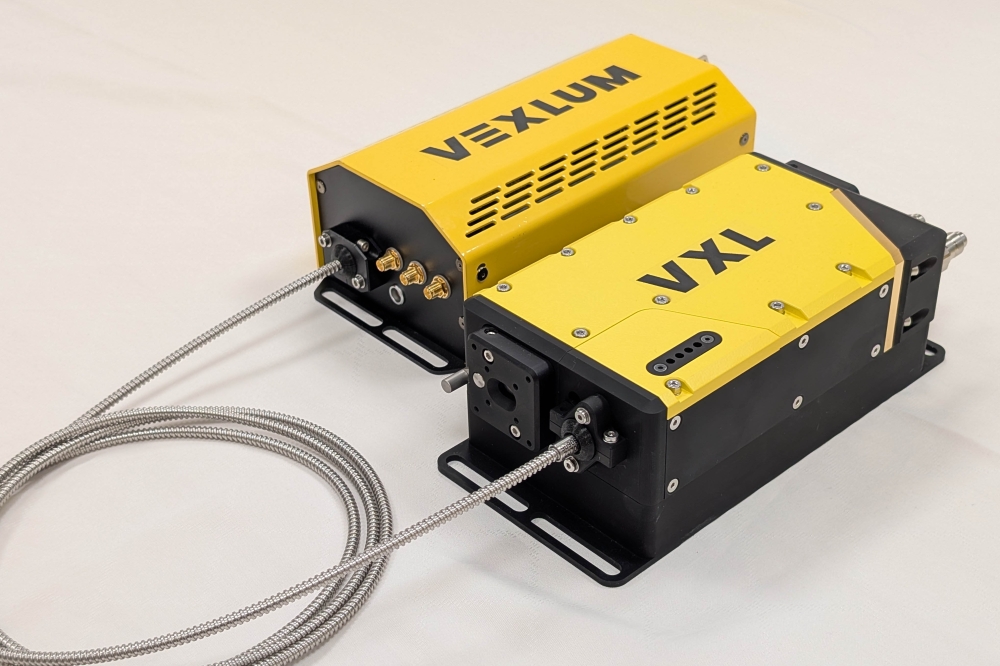
To ramp production of its VECSELs for the quantum tech industry, Finish start-up Vexlum is investing in its clean room, including the addition of an MBE tool.
BY RICHARD STEVENSON, EDITOR, CS MAGAZINE
When designing any product, there’s a lengthy wish list one needs to try and address. Often versatility and accuracy of its output will be favoured, along with robustness, compactness and competitive pricing. But it’s impossible to excel on all these fronts, so compromise is inevitable. This poses the crucial question: What factors really matter?
It’s a dilemma at play for those that are looking to serve the quantum tech industry with lasers for pumping atomic transitions. They will aim to combine criteria associated with SWAP – that’s short for size, weight and power – with a capability to deliver emission that targets exactly the right wavelength over a potentially expansive spectral range with a low-noise source.
That’s a tough set of criteria to fulfil. So, in situations where size and weight are not a deal breaker, one can consider cumbersome, complex contraptions, involving multiple boxes that may house a combination of seed sources, amplifiers, frequency-doubling cavities and locking electronics. But if a compact source tops the agenda, makers of VCSEL will sense an opportunity – although it’s not easy to produce this laser with an emission that matches a particular atomic transition.
Offering an attractive alternative to both those sources is the vertical external-cavity surface-emitting laser (VECSEL). It’s a source that employs a laser diode, used to pump a semiconductor gain chip that’s positioned in a cavity formed by two mirrors, made from stacks of alternating III-Vs with different refractive indices.
One of the pioneers of the VECSEL is Vexlum. Founded in 2017, this spin out of the University of Tampere has just raised €10 million to increase VECSEL production, in response to increasing global demand for optical sources for atomic clocks and quantum computing.
According to company CEO Jussi-Pekka Penttinen, the unique strength of Vexlum, which is the only company focused on just producing VESCELs, is its capability to make single-frequency VESCELs with a narrow line width, very low noise, excellent beam quality, and high power across the visible range. That includes wavelengths that are difficult to access with other classes of laser.
“Our company colour is yellow, because I'm sure you know there's this famous yellow gap,” says Penttinen. “One of the first wavelengths we made at the university was yellow – lasers for sodium guide stars and then dermatology.”
Crushing the competition
Penttinen says that for the quantum markets Vexlum is now targeting, the primary rival is not the VCSEL, due to its insufficient power that’s is limited to the milliwatt range. According to the CEO, for applications such as quantum computing, output powers of several watts are needed, with more power enabling the pumping of more atoms. Due to this, competition comes from large, complex laser systems, such as amplified diode lasers, frequency-doubled diode lasers, and frequency-doubled fibre lasers.
“Seeing the roadmaps of these quantum companies, it's no longer viable to make very large laser systems, because you would start to fill factories with just lasers,” says Penttinen. There are also concerns regarding the energy consumption of these large laser systems. Due to this, Vexlum’s watt-level lasers are “very tempting”, says Penttinen, as they are just a few litres in size, so roughly one-tenth that of the competition.
With the VESCEL, dimensions are determined by cavity length and mode size. Consequently, advances in engineering and electronics can drive reductions in volume – a trajectory Vexlum is pursuing.
Another attribute of Vexlum’s VECSELs is the quality of their emission. Thanks to the combination of surface-emitting gain and an external cavity, optical output has a very low linewidth and minimal noise. And wavelength tuning is available: “Our lasers can be frequency locked to the target using the cavity piezo, with an inter-cavity electro-optical modulator.”
From the deep UV to the IR
A key competency of the Finnish start-up is its capability to span a vast spectral range, by drawing on a variety of semiconductor gain chips based on quantum-well emission. Using the GaAs material system, Vexlum covers 700 nm to 1.3 µm; and switching to InP and GaSb increases the upper end to 1.7 µm and 2.2 µm, respectively. Meanwhile, frequency doubling extends the emission down to 350 nm.
On the one hand, gain chips are difficult to grow, as they contain many tens of epilayers; but they are free from doping.
“I often joke that if you can grow a quantum well, you can always make a VECSEL, but you cannot always make a diode laser, because doping is often more complicated,” remarks Penttinen.
When considering this remark, it’s important to be aware that Vexlum is drawing on two decades of experience in developing gain material. “We can make new wavelengths within weeks that could take someone else twenty years,” says the company CEO.
Penttinen has been involved in the development of Vexlum’s technology for many years. Initially inspired by a news article detailing efforts at the Optoelectronic Research Centre at the University of Tampere, he took a summer internship in 2010, before switching to a full-time role. During his initial interview, he remarked that he would like to play a role in a start-up emerging from the Optoelectronic Research Centre, a dream now fulfilled as co-founder and CEO of Vexlum, where he leads a team of around 40.
The first whiff of commercial potential came in 2012, when quantum researchers at NIST in Boulder got in touch, explaining that they needed a laser emitting at around 1.1 µm for magnesium-ion trapping.
“We found out, together with the quantum researchers at NIST, that VECSEL technology is very good match, because of the wavelength versatility, noise, power and beam properties, and also the intra-cavity doubling.”
This helped spur the founding of Vexlum in 2017, when interest in quantum was far less than it is today – so much so that the university’s innovation service warned Penttinen that the target markets were “too niche”. Fortunately, he did not heed this advice. Vexlum sold its first laser in 2019, and hundreds more since then. Sales will continue to climb, and the aim is to double production capacity every year.
Today Vexlum rents space from Tampere University, which has five MBE tools and an extensive cleanroom. The €10 million of seed funding, coming primarily from Nordic investors, will be used to complete Vexlum’s own cleanroom, with equipment that includes an MBE tool. Part of the reason for using this epitaxial technique is that it reflects the company’s expertise. However, Penttinen argues that MBE is also more versatile than alternative forms of epitaxy for producing gain chips spanning a very wide spectral range.
With its own MBE tool, Vexlum will benefit from increased capacity, allowing the company to expand on many fronts.
“Quantum is certainly our starting market,” says Penttinen, but there are also opportunities in markets using older laser technologies, such as gas lasers. “We are already providing prototypes [there],” adds Penttinen, who is sure to play a key role in expanding the deployment of the VECSEL in many applications.

Vexlum’s CEO, Jussi-Pekka Penttinen (right) with Executive Chairman, Chief Scientific Officer and academic at the University of Tampere, Mircea Guina (left).