
Tiny laser-based sensor could bring lab testing into homes
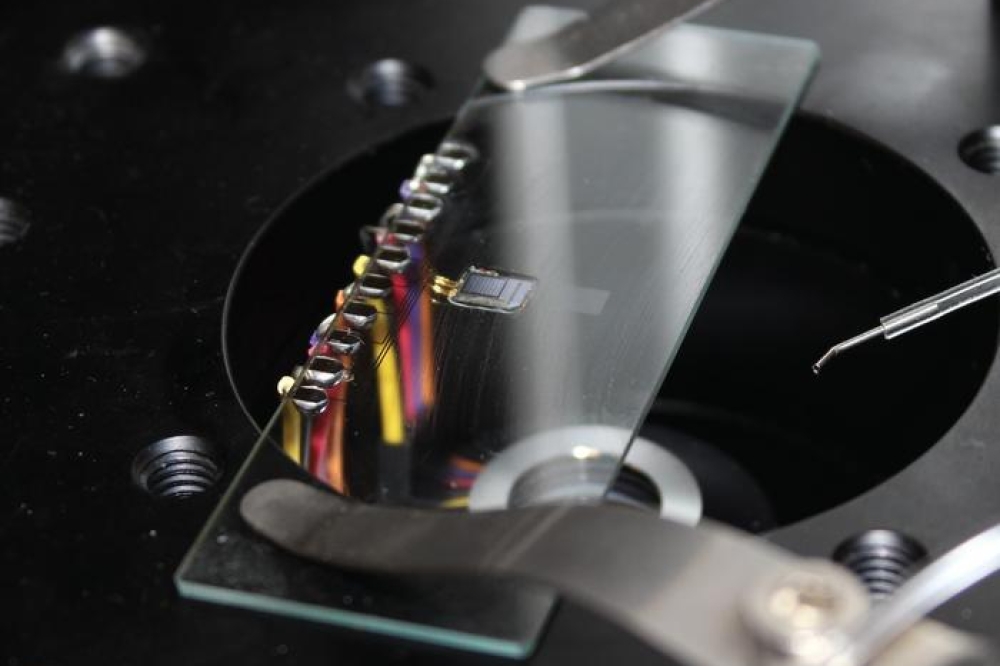
A research team at Chalmers University of Technology in Sweden has developed a VCSEL-based laser technology that makes it possible to create a miniature biosensor with the laser source and optics integrated onto a 1cm semiconductor chip.
Optical biosensors based on surface-plasmon resonance are an important tool used for studying how various biomolecules interact with each other - for example antibodies in the immune system. With his inforrmation, researchers can gain insights leading to new medicines and vaccines or assess whether a sample contains signs of infection.
Such sensors direct light onto a gold surface and measure minuscule changes in the light’s reflection when biomolecules are placed on the surface. The Chalmers' laser technology makes it possible to create such biosensors in a miniature format.
To be able to monitor the interaction of biomolecules using an optical sensor, a precise laser beam must strike the gold surface at a very steep angle. The solutions used today require bulky optical components, such as prisms, which also make them time-consuming to install and align.
The Chalmers team’s metasurface-enabled, on-chip surface plasmon resonance (SPR) biosensor enables label-free biomolecular analysis in a miniaturised, chip-scale format.
By integrating flat metaoptics together with hundreds of microscopic semiconductor lasers (bottom-emitting, oxide-confined GaAs VCSELs with a lasing wavelength of λ = 984 nm), a collimated fan of light for angle-resolved SPR measurements can be emitted directly into a glass substrate, eliminating the need for conventional optics.
“With this technology, we want to create an instrument that allows healthcare professionals to take certain samples in the patient’s home. For example, we’re currently evaluating how well our sensor can perform a C-reactive protein (CRP) test. Because this technology is very general and can detect a wide range of biomolecular interactions, we see many potential applications for a wide variety of tests. This could allow patients to be discharged from hospital sooner after an operation – thereby freeing up hospital beds – and reduce the number of healthcare visits for sampling,” says Erik Strandberg, doctoral candidate in photonics at Chalmers and lead author of a study published in ACS Sensors.
“By successfully integrating the optics with the laser sources right on the chip, our innovation opens a lot of doors and is a key step towards shrinking the current biotech instruments and creating portable, battery-powered systems", he says.
In the next step, the researchers aim to further develop the technology by boosting the sensitivity of the sensor, as well as increasing the number of samples that can be analysed simultaneously.
“So far, we haven’t been able to use all the lasers on our chips to analyse samples, but this field offers great opportunities for further development. If we succeed, we believe the sensor will eventually make it possible to analyse significantly more samples at once than current technologies allow. But first, we plan to create a prototype of a portable sensor that can be used without extensive training. The ultimate goal is for hospitals and clinics to be able to use the sensor outside the lab,” says Hana Jungová, senior researcher in the study.