
MicroLEDs move closer to replacing lasers
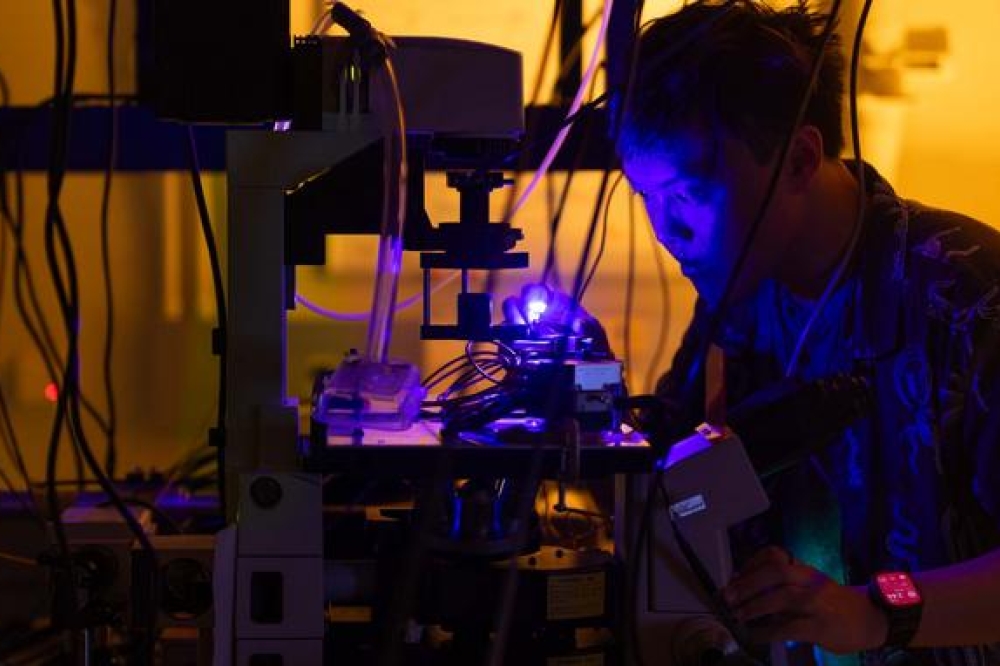
Research co-authored by UC Santa Barbara doctoral student Roark Chao points to a practical path forward for using microLEDs to take on work traditionally handled by lasers, from moving data inside server racks to powering next-generation displays.
“We’re talking about devices that are literally the size of a hair follicle,” said Chao, who studies electrical engineering. “If you can engineer how the light comes out, those microLEDs can start to replace lasers in short-distance data communication.”
The work builds on UCSB’s longstanding strengths in GaN research and optoelectronics. Chao is co-advised by Steven DenBaars and Jon Schuller, both co-authors on the study, which also includes blue LED Nobel laureate Shuji Nakamura.
The study 'Enhanced emission efficiency and directionality in InGaN/GaN microLEDs laterally enclosed by distributed Bragg reflectors', published in Optica Express, demonstrates a new microLED design that improves both efficiency and beam directionality.
By laterally enclosing the emitting region with distributed Bragg reflectors, the researchers achieved roughly 20 percent higher optical output through air-side emission, more than 130 percent higher output through the substrate side and about 30 percent reduced beam divergence compared with reference devices.
Beyond directing light more precisely, the redesigned microLEDs also deliver substantially higher efficiency. The team observed roughly 35 percent higher electrical efficiency and about 46 percent higher wall-plug efficiency — meaning the devices convert significantly more of the power drawn from the wall into usable light compared to conventional microLED designs.
“The big thing with lasers is that they start having thermal issues at relatively low temperatures,” Chao said. “MicroLEDs can be driven much hotter without needing complex cooling. That means less replacement, less cost and more flexibility in data centers.”
As cloud computing and AI continue to expand, data centres must transmit massive volumes of information quickly and efficiently. Even incremental improvements in light sources can have significant economic impact.
“What’s exciting about microLEDs is that they offer multiple solutions in one package,” Chao said. “They can improve data communication, enable brighter and thinner displays, and even work for things like AR or VR — all using the same underlying technology.”