
Polymatech unveils high-power UV LED platform
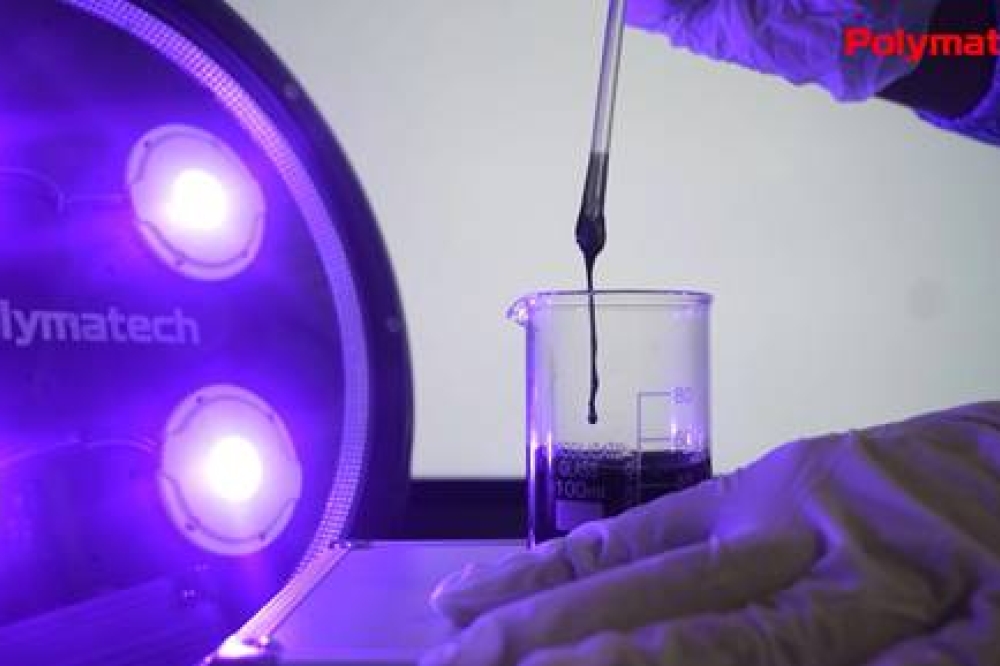
Polymatech Electronics, India’s first opto-semiconductor chip manufacturer, has demonstrated its next-generation high-power UV LED chips engineered for ultra-fast, energy-efficient industrial curing.
In a newly released video, Polymatech showed its proprietary UV LED technology delivering instantaneous curing of UV-sensitive inks, adhesives, coatings, resins, and solder masks.
The company says it has achieved industry-leading photon flux density enabling sub-one-second curing; precision wavelength control (UVA 395–405 nm) optimised for material-specific chemistry; and breakthrough thermal management supporting continuous operation above 150 W/cm²
The technology uses a chip-on-board (COB) architecture delivering more than 50,000 hours of operating life, and has up to 80 percent lower power consumption than mercury-based systems
Polymatech will show the UV LED platform at CES 2026 in Las Vegas, USA, providing global technology leaders, OEMs, and industry buyers with the first opportunity to experience the product’s performance in a live demonstration environment.
Eswara Rao Nandam, CEO and MD of Polymatech Electronics, said: “This is a defining moment for India’s semiconductor sector. We have indigenously developed a world-class UV LED platform that not only meets but surpasses global benchmarks for speed, reliability, and sustainability. This innovation strengthens India’s leadership in high-value optoelectronics and directly supports the nation’s Atmanirbhar Bharat objectives.”
Allen Wagner, CTO, added: “Through advanced optical extraction techniques, high-density emitter arrays, and next-generation epitaxial engineering, we have achieved curing performance that sets a new global standard. Importantly, this capability is delivered with exceptional thermal stability and long-term reliability even under extreme operating conditions.”
Polymatech has initiated pilot production at its Chennai facility and plans to rapidly scale manufacturing capacity at its new Singapore facility. Commercial shipments are scheduled to commence in Q1 2026.