Diamond power switch shatters performance records
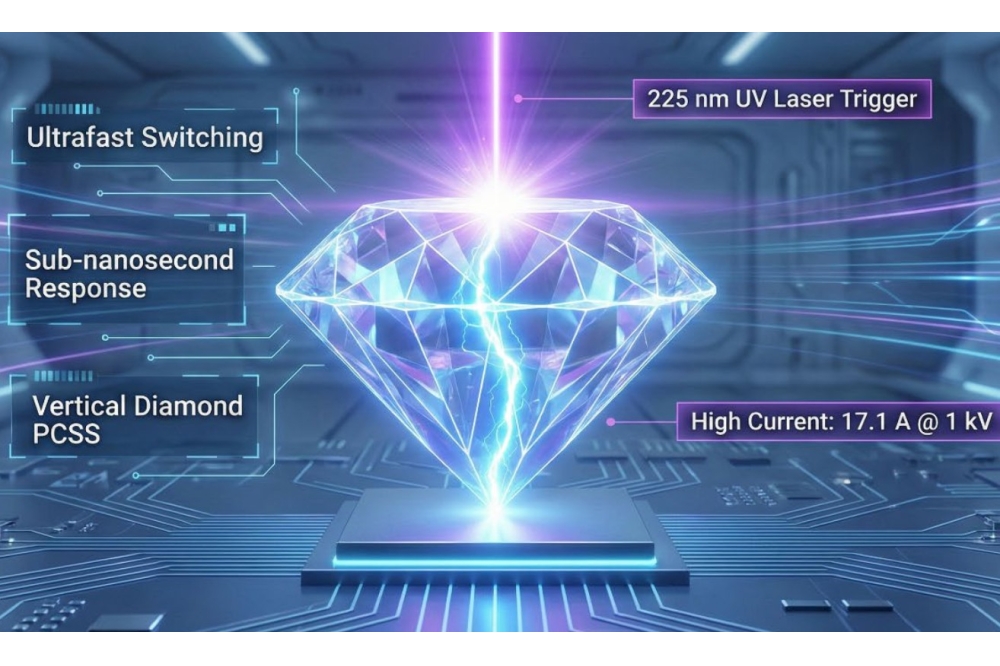
Researchers at the University of Illinois Urbana-Champaign in the US have demonstrated a diamond-based power switch that shatters previous performance records, capable of handling 17.1A of current at 1kV.
The breakthrough, 'Ultrafast Vertical Photoconductive Intrinsic Diamond Switch with High Current (17.1 A at 1 kV)', published in Applied Physics Letters, marks a critical milestone in developing the ultrafast, high-efficiency components needed for a resilient global power grid and the next generation of electric vehicles.
Diamond has long been considered the ultimate semiconductor because it can withstand extreme electrical stress, move electricity at unmatched speeds, and dissipate heat far better than any other material. However, actually building a practical diamond switch has been a decades-long challenge.
“Diamond is an incredible material, but it is notoriously difficult to control using traditional methods,” says Can Bayram, who led the research at the Nick Holonyak Jr. Micro and Nanotechnology Laboratory. “Most electronics rely on doping—adding impurities to a crystal to make it conduct. In diamond, that process is so difficult it often compromises the material’s best qualities.”
The Illinois team took a different, more elegant path: they used light.
Instead of relying on chemical impurities, the team developed a photoconductive switch that remains an insulator until it is struck by a specific wavelength of deep-ultraviolet light. When illuminated, the diamond instantly becomes a high-performance conductor.
Crucially, while previous diamond switches struggled with designs that carried electricity mainly along the surface—where the material is most likely to fail—the Illinois researchers created a 'vertical' architecture. This design drives current through the protected interior, or bulk of the diamond crystal.
"By using a specific ultraviolet wavelength — the 'matched-absorption' window — we can trigger the entire volume of the diamond simultaneously," Bayram explains. "This allowed us to achieve the lowest on-resistance ever recorded for a high-voltage diamond switch, making it significantly more efficient than previous designs."
The switch's speed is equally impressive, capable of turning off in just 25 nanoseconds (billionths of a second). This speed is vital for protecting modern power grids from sudden surges and short circuits, particularly in high-voltage direct-current (HVDC) networks used to transport wind and solar power over long distances.
"This isn't just a lab record; it's a proof of concept for the infrastructure of the future," says Bayram. "We are building the fundamental building blocks for a resilient, low-carbon energy economy."
This research was supported by the Advanced Research Projects Agency-Energy (ARPA-E)