
AI is redefining the optical transceiver market
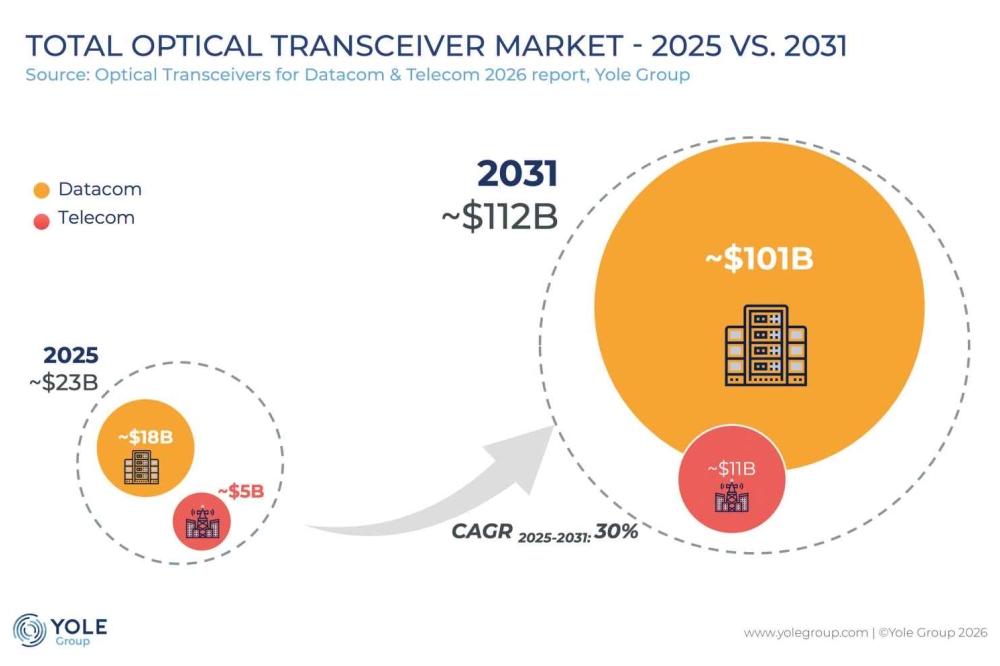
According to Yole's latest photonics report, 'Optical Transceivers for Datacom & Telecom 2026', the global optical transceiver market is entering a new growth cycle.
From $23.4b in 2025 to $112.3b in 2031, the market is showing an impressive 30 percent CAGR for datacom applications. This growth is fuelled by AI training and inference infrastructure, which are expected to account for more than 90 percent of total market revenue by the end of the forecast period.
"AI is no longer simply increasing demand for optical transceivers; it is redefining the entire photonics industry roadmap," commented Martin Vallo, senior technology and market analyst for photonics and lighting at Yole Group.
The rise of AI is fundamentally changing the role of optical connectivity. As AI models grow in scale and complexity, the amount of data exchanged between processors, servers, racks, and data centres is increasing dramatically, creating unprecedented demand for high-performance optical interconnects.
In the new report, Yole's analysts examine how AI-driven infrastructure requirements are accelerating technology transitions across the industry. Market participants are simultaneously facing migration to higher-speed architectures such as 800G, 1.6T, and eventually 3.2T, while also adopting new photonic platforms, packaging approaches, and optical engine designs.
Among the report’s key findings, silicon photonics emerges as the dominant technology platform for next-generation optical interconnects, supported by its ability to deliver improved bandwidth density, lower power consumption, and a natural migration path toward co-packaged optics. At the same time, new material platforms including thin-film lithium niobate (TFLN), InP, barium titanate (BTO), and organic modulators are gaining momentum as the industry prepares for 400G-per-lane architectures.
The report also highlights significant shifts in the competitive landscape and global supply chain. Chinese vendors Terahop, Eoptolink, and Accelink continue to strengthen their position in datacom optics, while Western companies Coherent, NVIDIA, and Lumentum maintain strategic leadership in enabling technologies such as DSPs, coherent systems, lasers, silicon photonic platforms, and advanced optical engines. Meanwhile, supply constraints around EML lasers, DSPs, and photonic integration technologies are becoming increasingly important considerations for future market growth.
Lakshman Srinivasanm, technology and market analyst for photonics and lighting at Yole Group said: "The optical transceiver market is entering a new growth cycle. As AI clusters become larger and more distributed, optical connectivity is evolving from a networking component into a strategic infrastructure technology, creating significant opportunities across the value chain."een significantly reduced compared with the previous generation, contributing to improved integration and design flexibility.