
Vishay proximity sensor targets battery-powered devicces
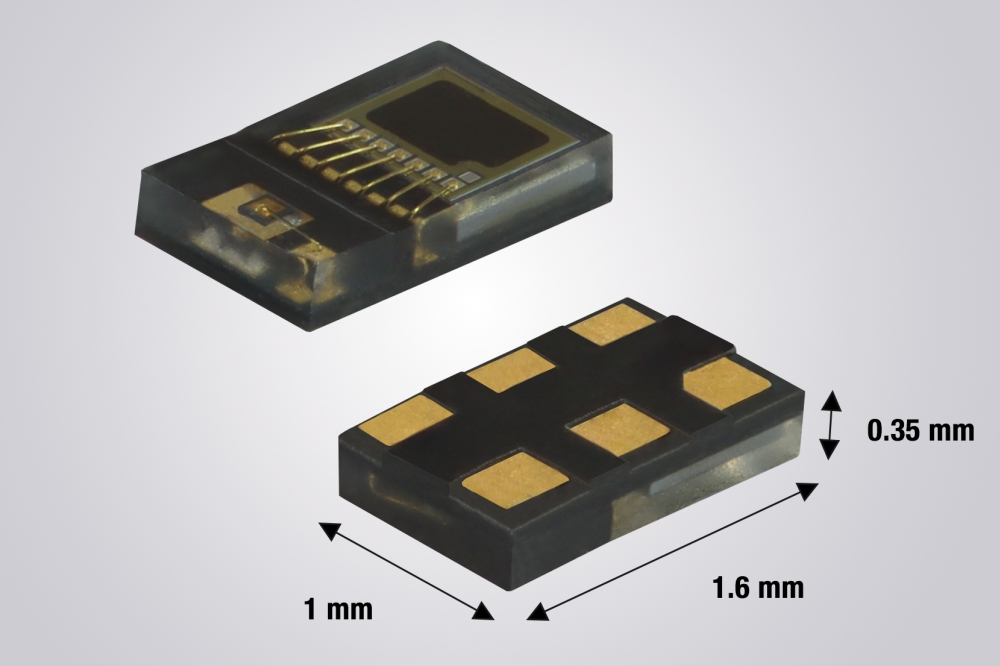
Vishay Intertechnology's optoelectronics group has introduced a new fully integrated short distance proximity sensor designed to increase efficiency, design flexibility, and performance in consumer applications.
Featuring a VCSEL, the VCNL36829UM combines a photodiode, application-specific integrated circuit (ASIC), 16-bit ADC, and smart dual I²C slave address in a compact 1.6 mm x 1.0 mm x 0.35 mm transparent mold package with an isolation wall design.
Compared to previous-generation solutions, the proximity sensor offers a 44 percent smaller volume, higher proximity resolution of 14 bits, and stronger sunlight immunity up to 200 klx. Combined with a range of 50 mm, low idle current of 5 μA, and a typical rated supply voltage of 1.8 V, the VCNL36829UM delivers superior proximity detection while reducing power consumption to increase efficiency in space-constrained, battery-powered applications.
The sensor is designed to detect if users are wearing or not wearing smart wearable devices, including true wireless stereo (TWS) earphones, virtual reality / augmented reality (VR / AR) headsets, and smart glasses. It is also suitable for touchless dispensing and lid-off detection in consumer appliances. To lower costs in these applications, the device’s smart dual I²C slave address allows for the connection of two proximity sensors without the need for a multiplexer.
The VCNL36829UM offers a programmable interrupt function that allows designers to specify high and low thresholds, reducing continuous communication with the microcontroller and lowering system power consumption. The sensor’s isolation wall design delivers excellent crosstalk immunity. The device uses intelligent cancellation to further reduce crosstalk, while a smart persistence scheme ensures accurate sensing and faster response time. The VCSEL wavelength peaks at 940 nm and has no visible “red-tail.” The sensor is RoHS-compliant, halogen-free, and Vishay Green.