Loading...
News Article

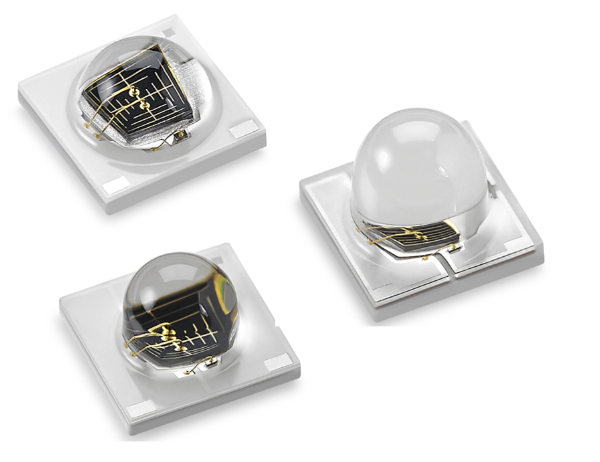
Luminus adds eleven high-intensity IR LEDs
News

Dual-junction technology allows double the power density in the same footprint

Luminus Devices, a Californian firm using technology from MIT, has expanded its portfolio of high-power IR LEDs with eleven emitters designed to address the rapid expansion of automotive, consumer, machine vision, medical, and security applications.

The Luminus IR SST LEDs are now offered in three wavelengths – 810nm, 850nm, and 940nm – and six beam angle options ranging from 40° to 130°. The high radiometric power output and low thermal resistance allow system designers to reduce the number of emitters and overall footprint for a broad range of infrared applications.

Nine of the newly-introduced IR products are based on dual-junction technology which nearly doubles the power density and keeps efficiency virtually unchanged. This makes it easier to develop solutions with much higher radiant intensity and more compact designs. The IR SST product line delivers very high radiometric power, up to 1600 mW typical at 850 nm and 1 A drive current, and radiant intensity in excess of 1300 mW/sr.

“Our dual-junction technology allows us to double the power density in the same footprint,” said Yves Bertic, senior director of global product marketing. “Now product designers can address applications that need longer reach and more intense and focused beams.”

Optical options have also been expanded to support the increasing variety of infrared applications.

A small, 40°, beam angle is the perfect replacement for legacy 2mm to 5mm through-hole IR LEDs, and the broadest beam angle, 130°, is ideal for flood illumination that is more common in security applications. Whether for biometric applications or monitoring for security, this latest generation of IR LEDs supports ongoing industry development and reduces time to market.

SiC MOSFETs: Understanding the benefits of plasma nitridation
Wolfspeed reports Q2 results
VueReal secures $40.5m to scale MicroSolid printing
Mitsubishi joins Horizon Europe's FLAGCHIP project
Vishay launches new high voltage SiC diodes
UK team leads diamond-FET breakthrough
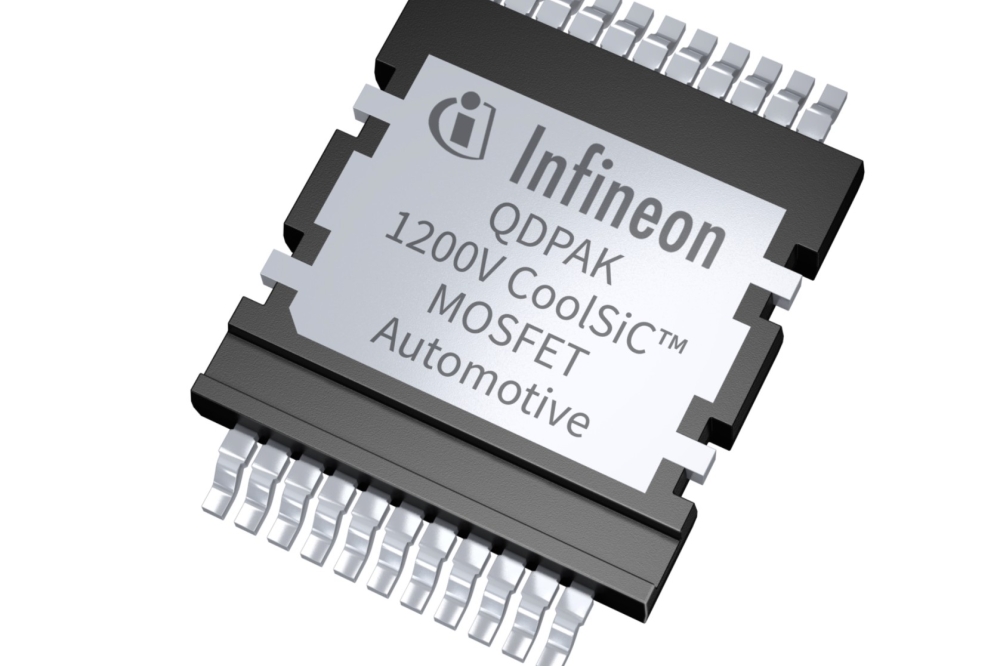
GaN adoption at tipping point, says Infineon
BluGlass files tuneable GaN laser patents
QD company Quantum Science expands into new facility
Innoscience files lawsuit against Infineon
Riber revenues up 5% to €41.2m
Forvia Hella to use CoolSiC for next generation charging
Photon Design to exhibit QD simulation tool
Ortel transfers CW laser fabrication to Canada
Luminus adds red and blue multi-mode Lasers
PseudolithIC raises $6M for heterogeneous chiplet tech
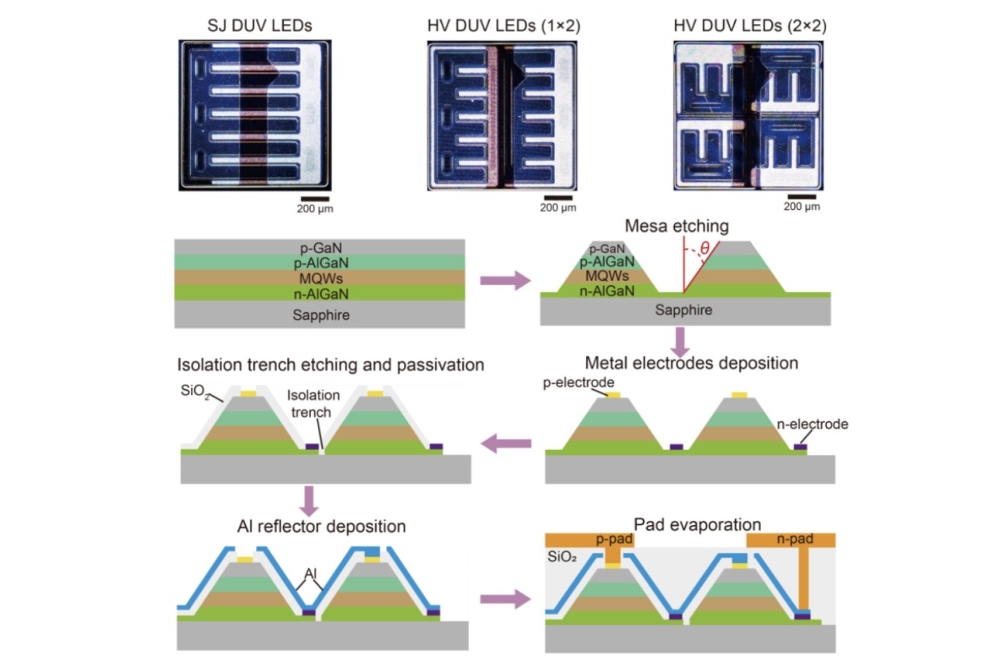
Mesa sidewall design improves HV DUV LEDs
IQE revenue to exceed expectations
'Game-changing' VCSEL system targets clinical imaging
German start-up secures finance for SiC processing tech
Macom signs preliminaries for CHIPS Act funding
IQE and Quintessent partner on QD lasers for AI
EU funds perovskite tandems for fuel-free space propulsion
EU to invest €3m in GeSi quantum project
Transforming the current density of AlN Schottky barrier diodes
Turbocharging the GaN MOSFET with a HfO₂ gate
Wolfspeed launches Gen 4 SiC MOSFET technology
Report predicts high growth for UK's North East
Element Six unveils Cu-diamond composite
SemiQ launches hi-rel 1700V SiC MOSFETs
Lynred to exhibit Eyesential SWIR sensor for machine vision
Thorlabs buys VCSEL firm Praevium Research
×
Search the news archive

To close this popup you can press escape or click the close icon.
Logo
x
Logo
×
Register - Step 1

You may choose to subscribe to the Compound Semiconductor Magazine, the Compound Semiconductor Newsletter, or both. You may also request additional information if required, before submitting your application.


Please subscribe me to:


You chose the industry type of "Other"

Please enter the industry that you work in: