Experimental LEDs emit warm and cool white light
KAUST team uses InGaN to build phosphor-free monolithic white-light LEDs
A KAUST team has recently developed a way of producing a white-light LED that overcomes some critical challenges.
There are two main ways to make white-light LEDs. One is to combine devices of different materials, where each material emits a different colour. But this increases the complexity and cost of manufacture of LEDs. The other approach is to use a single semiconductor and mix in a phosphor that absorbs some of the light emitted and then re-emits it as a different colour. However, phosphor degrades over time, limiting the useful lifetime of these devices.
Daisuke Iida and Kazuhiro Ohkawa's team at KAUST have devised a way to build phosphor-free monolithic white-light LEDs using the semiconductor InGaN.
The emission colour of InGaN depends on the relative content of the indium and gallium atoms. For example, GaN emits ultraviolet light, but adding indium shifts the emission across the visible spectrum and into the infrared. The emission can be controlled further by sandwiching very thin layers of InGaN with one composition between two layers of different composition, creating so-called quantum wells.
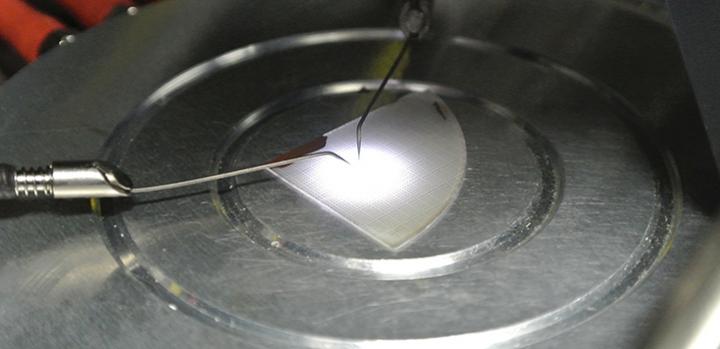
"What is unique about our devices is that we use material defects, or V-pit structures, to enhance the injection of a current into the semiconductor," says Iida. The LEDs designed by the KAUST team included both blue-light emitting quantum wells with a 20 percent indium content and 34 percent indium red quantum wells. Combined, this monolithic LED emits light across the entire visible spectrum. By controlling the current passing through the device, the team could change the emission from a warm white to a natural white and through to a cool white.
"The next step is to improve the emission efficacy of the red emission component," says Iida. "The red emission is a key factor of the high colour-rendering LEDs with the natural white emission."